
präsentiert von

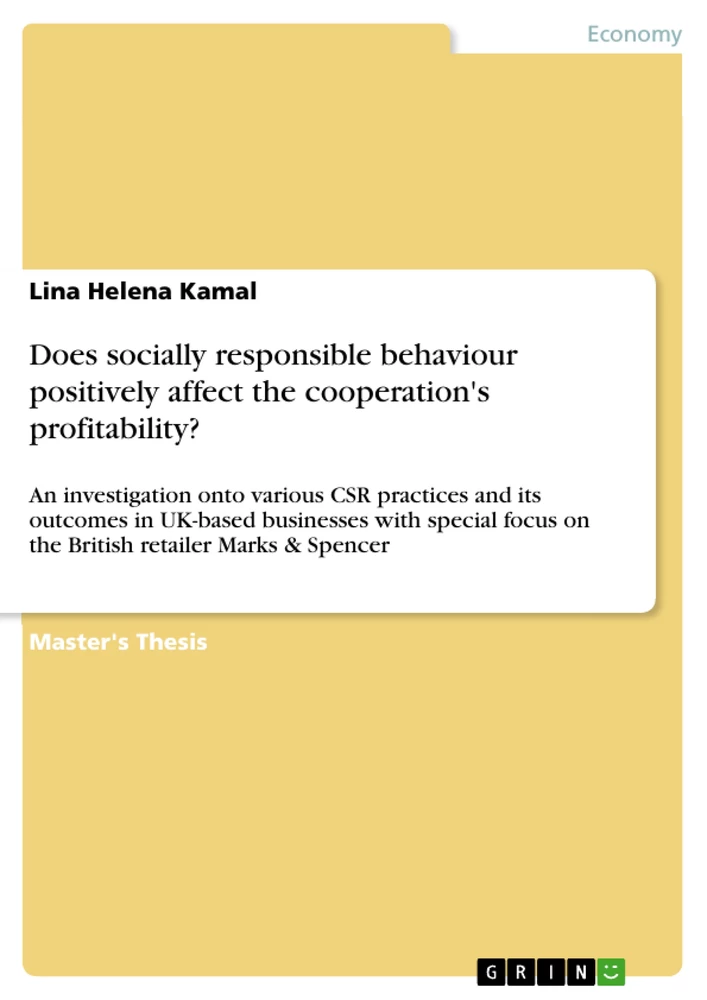
Table of Contents
1.0 Introduction
1.1 Background & Academic Context:
1.2 Purpose and Research Question
1.3 Choice of Case Study- Marks & Spencer
2.0 Theoretical Framework - Literature Review
2.1 Brief history on CSR
2.2 CSR Definitions
2.3 Creating Sustainable Value
2.3.1 Sustainable Value Framework
2.4 Problem Discussion:
2.5 CSR & Profitability
2.5.1 CSR brings in the cash
2.5.2 Waste of shareholder money
2.6 Possible results for CSR
2.6.1 Employees & Work Environment
2.6.2 Cost Reduction
2.6.3 Sales & Marketing
2.6.3.1 Differentiation
2.6.3.2 Brand Reputation
3.0 Methodology
3.1 Research Model:
3.2 Research Strategy:
3.3 Analysis Technique:
3.4 Nature of the Data and Information
3.5 Critique of Approach:
4.0 Findings and Analysis
4.1 Introduction to Case Study
4.2 Findings on CSR initiatives by M&S
4.3 Framework application onto M&S case study:
4.3.1 Balance Score Card Suitability
4.3.2 Structure and origin of the findings
4.3.2.1-MARKS AND SPENCER- Learning and Growth Perspective-
4.3.2.2 MARKS AND SPENCER- Internal Business Process Perspective-
4.3.2.3 MARKS AND SPENCER- Customer Perspective
4.3.2.4 MARKS AND SPENCER- Financial Perspective
4.3 Analysis & Discussion:
4.3.1 Analysis of the BSC findings on M&S plan A
4.4.1.1 Learning & Growth Perspective discussion
4.4.1.2 Internal Business Perspective Discussion
4.4.1.3 Customer Perspective Discussion:
4.4.1.4 Financial Perspective Discussion
4.4.2 Findings’ Analysis in light of Hart & Milstein’s framework:
4.4.2.1 Internal Today - Growing profits and Reducing risk:
4.4.2.2 External Today - Enhancing Reputation & Legitimacy:
4.4.2.3 Internal Tomorrow - Accelerating Innovation & Repositioning:
4.4.2.4 External Tomorrow – Crystallising the firms’ growth path
5.0 Conclusion, Recommendations & Reflection
5.1 Creating Sustainable Value
5. 2 Does responsible business behaviour lead to profitability?
5.3 Hart and Milstein View
Objectives and Core Topics
The primary objective of this dissertation is to investigate whether socially responsible business behaviour positively influences a corporation's profitability. By conducting an in-depth case study of the British retailer Marks & Spencer and its 'Plan A' sustainability strategy, the research aims to evaluate the financial and non-financial impacts of CSR practices on business performance.
- The relationship between Corporate Social Responsibility (CSR) and financial profitability.
- The application of the Balanced Scorecard (BSC) framework to evaluate CSR initiatives.
- Analysis of M&S 'Plan A' sustainability strategies across customers, employees, internal processes, and financial perspectives.
- The role of ethical branding, consumer trust, and reputation as drivers for competitive advantage.
- Strategic recommendations for retailers on integrating sustainable practices into business models.
Excerpt from the Book
1.1 Background & Academic Context:
Can businesses be successful both economically as well as socially? The question has baffled companies for ages. 200 years ago, particularly since the time of Adam Smith there has been this ongoing debate around social responsibility and the effective role of organisations beyond making a profit (Barnett, 2010).
However, it is probably accurate to say that all societies at all points in time have had some degree of expectation that organisations would act responsibly by some definition (Carroll, 2003; Senge et al, 2008) since there is a labour law to abide by as the minimum required. Yet, the public’s expectations are increasingly raising the bar as to what is acceptable behaviour and how much responsibility a cooperation should shoulder; for example the Nike cooperation scandal on child workers in Pakistan in early 2000 (Zadek, 2004). Nike workers’ young age- 9 years- and working conditions led many in the western world to boycott Nike’s products to show discontent of their business operations (Porter and Kramer, 2006). It could be argued that somehow, shifts in ethics or values precede the establishment of new laws, for these can be regarded as the driving force behind the initial creation of a new rule/law, as was exemplified above.
Today, associations, NGOs and intra-governmental organizations have been putting pressure on industries to consider their impact on human life and environment. With social and environmental issues getting more attention, consumer awareness is holding up. This has led to new requirements from the demand side (Carroll, 1999; Senge et al, 2010; Mullerat, 2009) Thus, there is rising consciousness in society on social and environmental issues,
Summary of Chapters
1.0 Introduction: This chapter introduces the research background, the ongoing debate regarding the economic versus social success of businesses, and defines the research question and case study selection.
2.0 Theoretical Framework - Literature Review: This section reviews historical CSR concepts, various definitions, the 'Sustainable Value Framework', and the academic debate surrounding the profitability of CSR.
3.0 Methodology: This chapter outlines the research design, including the use of the 'Research Onion' model, the case study approach, and the application of the Balanced Scorecard for analysis.
4.0 Findings and Analysis: This core chapter presents the empirical data of the M&S case study, applying the Balanced Scorecard across four perspectives and discussing findings in the context of the Hart & Milstein framework.
5.0 Conclusion, Recommendations & Reflection: The final chapter summarizes findings regarding the impact of CSR on profitability, offers strategic recommendations, and provides a reflective personal critique of the research process.
Keywords
Corporate Social Responsibility, CSR, Sustainability, Plan A, Marks & Spencer, Profitability, Balanced Scorecard, Stakeholder Theory, Ethical Consumption, Brand Reputation, Sustainable Value Framework, Competitive Advantage, Operational Efficiency, Retail Management, Business Ethics.
Frequently Asked Questions
What is the core subject of this dissertation?
The research examines the relationship between Corporate Social Responsibility (CSR) and a company's profitability, specifically focusing on the retail sector.
What are the central themes of the work?
The work focuses on sustainable business models, ethical supply chain management, stakeholder relations, and the alignment of corporate strategy with environmental and social goals.
What is the primary research question?
The study seeks to answer whether socially responsible behaviour positively affects the corporation’s profitability.
Which scientific methodology does the author use?
The author uses a qualitative, inductive case study approach, utilizing the Balanced Scorecard (BSC) framework to evaluate sustainability initiatives across four key business dimensions.
What does the main body of the work cover?
The main body covers a comprehensive literature review of CSR theories and a detailed analysis of M&S's 'Plan A', assessing its operational, internal, customer, and financial impacts.
Which keywords characterize this work?
Key terms include Corporate Social Responsibility, Sustainability, Plan A, Profitability, Balanced Scorecard, Stakeholder Theory, and Ethical Consumption.
How did the recession influence M&S's CSR performance?
The research suggests that the recession hindered the ability to measure the direct financial profitability of Plan A, as market conditions were distorted by constrained consumer spending during that period.
What conclusion does the author draw regarding CSR as a profit generator?
The author concludes that while direct revenue increases were not conclusively linked to CSR in the short term, the investment significantly enhanced the brand's reputation, employee retention, and long-term risk resilience.
Ende der Leseprobe aus 92 Seiten
- nach oben
- Arbeit zitieren
- Lina Helena Kamal (Autor:in), 2011, Does socially responsible behaviour positively affect the cooperation's profitability?, München, Page::Imprint:: GRINVerlagOHG, https://www.diplomarbeiten24.de/document/178097

neugierig - aktuell - relevant
Entdecken Sie hilfreiche Tipps und Tricks rund ums Studium!

Entdecken Sie hilfreiche Tipps und Tricks rund ums Studium!
Ihre Hausarbeit / Abschlussarbeit:

- - Publikation als E-Book und Buch
- - Hohes Honorar auf die Verkäufe
- - Für Sie komplett kostenlos - mit ISBN
- - Es dauert nur 5 Minuten
- - Jede Arbeit findet Leser

- © GRIN Publishing GmbH.
- Alle Inhalte urheberrechtlich geschützt. Kopieren und verbreiten untersagt.
- info@grin.com
- AGB
- Open Publishing
Der GRIN Verlag hat sich seit 1998 auf die Veröffentlichung akademischer eBooks und Bücher spezialisiert. Der GRIN Verlag steht damit als erstes Unternehmen für User Generated Quality Content. Die Verlagsseiten GRIN.com, Hausarbeiten.de und Diplomarbeiten24 bieten für Hochschullehrer, Absolventen und Studenten die ideale Plattform, wissenschaftliche Texte wie Hausarbeiten, Referate, Bachelorarbeiten, Masterarbeiten, Diplomarbeiten, Dissertationen und wissenschaftliche Aufsätze einem breiten Publikum zu präsentieren.
Kostenfreie Veröffentlichung: Hausarbeit, Bachelorarbeit, Diplomarbeit, Dissertation, Masterarbeit, Interpretation oder Referat jetzt veröffentlichen!
Folgen Sie GRIN auf


- GRIN Verlag GmbH
-
- Nymphenburger Str. 86
- 80636
- Munich, Deutschland
- +49 89-550559-0
- +49 89-550559-10
- info@grin.com
-
