
präsentiert von

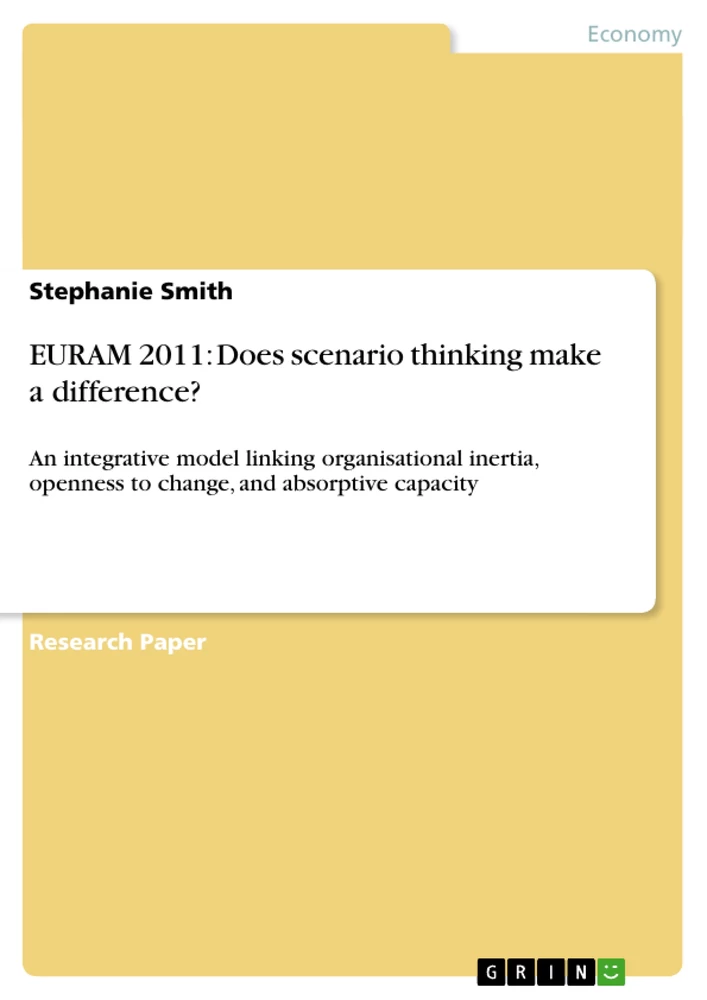
Table of Contents
1. Introduction
2. Theoretical background
2.1 Organisational inertia
2.1.1 Definition of organisational inertia and the value of change
2.1.2 Reality of change outcome
2.2 Absorptive capacity
2.2.1 Definition
2.2.2 The outcomes of absorptive capacity
2.3 The objective of scenario planning
3. The model: Does scenario thinking make a difference?
3.1 A micro-level perspective
3.2 The integration of theories and concepts
3.2.1 The influence of the individual's consciousness on its openness to change
3.2.2 The role of scenario thinking
3.2.3 The degree of openness to change
3.2.4 How the degree of openness to change determines the organisation's absorptive capacity
4. Discussion
4.1 Theoretical contributions
4.2 Limitations
4.3 Managerial implications
5. Conclusion
Objectives and Core Topics
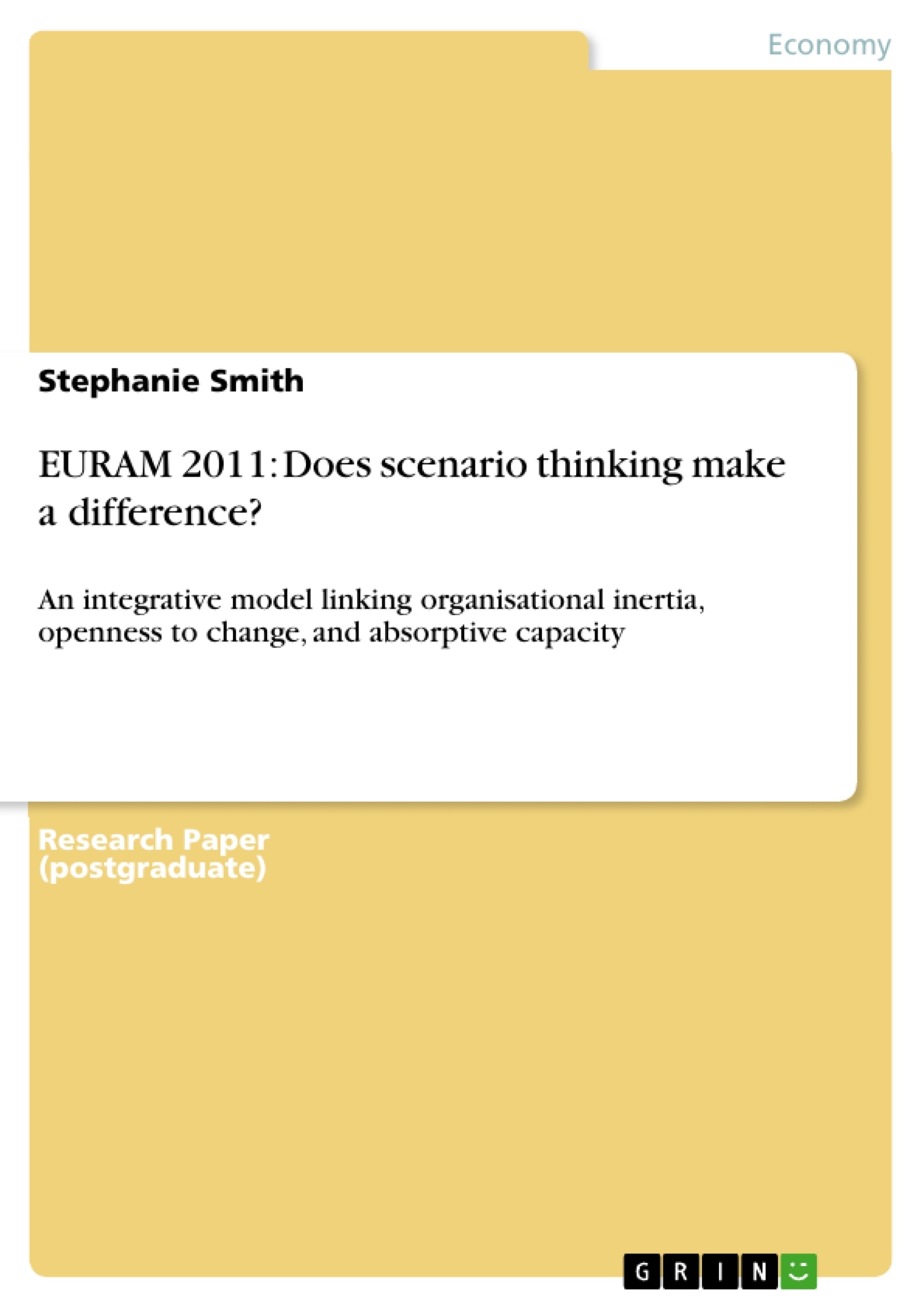
The research aims to establish an integrative model that links organizational inertia, scenario planning, and absorptive capacity, with a specific focus on the micro-level perspective of how individuals contribute to organizational success and innovation.
- The impact of scenario thinking on an individual's openness to change.
- The role of individual consciousness and mental models in processing new information.
- Bridging the gap between individual absorptive capacity and organizational performance.
- Analyzing the relationship between employee attitudes and organizational flexibility.
- Practical approaches for implementing scenario thinking as a management tool.
Excerpt from the Book
3.1 A micro-level perspective
Why are individuals worth consideration? Do they - each - significantly contribute to an organisation's performance sufficiently to deserve so much attention? Since organisations remain struggling with overcoming organisational inertia and mitigating resulting adverse consequences, it is warranted to assume latent obstacles, which need to be detected. Subsequently, the crucial role individual play within the scope of pro-active knowledge creation and change processes is underlined.
Individual absorptive capacity. Organisational absorptive capacity accrues from combining individuals' capability of utilising newly gained knowledge, potentially resolving in an enhanced level of collective absorptive capacity (Zhao & Anand, 2009). Accordingly, Zhao and Anand claim that "[a]n organization also has to motivate its members to learn and absorb new knowledge, since organizational members may be reluctant to do so due to their comfort with the status quo, fear of uncertainty, unwillingness to seek or share knowledge, and their concern about losing privileges [...]" (2009: 966).
The conclusion that individuals are essential regarding absorptive capacity is supported by Szulanski's findings which suggest that the most influential impediment of knowledge transfer within an organisation is a knowledge receiving group of employees lacking absorptive capacity (Szulanski, 1996). Likewise, Lane et al. "[...] reemphasize Cohen and Levinthal's original proposal that individual cognitions are the basis of a firm's absorptive capacity" (2006: 857). Becker-Ritterspach (2010) also distinguishes the micro- and the macro-level: His case findings suggest that "[...] to understand the microfoundations of absorptive capacity, it is particularly insightful to adopt a social learning prospective" (Becker-Ritterspach, 2010: 3), as processing new knowledge is part of the interaction between individuals. He points out that transformation, a part of the learning process, is a prerequisite for the integration of new knowledge into the new social context (Becker-Ritterspach, 2010) requiring the provision of empowerment and facilitation to take part in the new setting.
Summary of Chapters
1. Introduction: Outlines the challenges companies face regarding organizational inertia and change, introducing the necessity for innovative approaches like scenario thinking.
2. Theoretical background: Examines foundational concepts, specifically organizational inertia, the definition and importance of absorptive capacity, and the methodology of scenario planning.
3. The model: Does scenario thinking make a difference?: Develops the core integrative model focusing on the micro-level perspective of the individual and how their consciousness and openness to change influence organizational absorptive capacity.
4. Discussion: Evaluates the theoretical contributions, addresses limitations of the research model, and provides managerial implications for fostering organizational change.
5. Conclusion: Summarizes the key findings, emphasizing that integrating individuals through scenario thinking is a potent method for enhancing an organization's adaptive capacity.
Keywords
organisational inertia, absorptive capacity, scenario thinking, openness to change, innovation, organizational performance, micro-level perspective, knowledge transfer, mental models, strategic management, individual consciousness, organizational change.
Frequently Asked Questions
What is the core focus of this research paper?
The paper explores the role of individuals within an organization, specifically how "scenario thinking" can mitigate organizational inertia and enhance an individual's "absorptive capacity" regarding new information and change.
What are the primary themes discussed in the study?
The central themes include organizational inertia, the multi-level nature of absorptive capacity (individual vs. collective), the application of scenario planning as a management tool, and the psychological openness of employees toward organizational change.
What is the primary goal of this research?
The objective is to present an integrative conceptual model that demonstrates how scenario thinking can positively influence an individual's openness to change, thereby contributing to the overall success and innovation capabilities of the organization.
Which methodology is applied in this work?
This is a conceptual piece of work. It utilizes a multi-theoretical approach, synthesizing existing literature on organizational learning, psychology, and management to derive unique propositions about the link between individual attitudes and organizational adaptability.
What topics are covered in the main body?
The main body covers the theoretical definitions of inertia and absorptive capacity, the development of a micro-level model linking individual consciousness to organizational outcomes, and a discussion on how managers can practically apply these findings.
How would you characterize this research with keywords?
Key terms include organizational inertia, absorptive capacity, scenario thinking, openness to change, and micro-foundations of knowledge transfer.
How does individual consciousness specifically relate to organizational change?
The paper argues that individual mental models (shaped by past experiences and personality) act as a filter for how employees perceive change requirements; by engaging in scenario thinking, individuals can refine these mental models to become more receptive to change.
Does the author suggest that scenario planning replaces traditional management?
No, the author suggests that scenario planning should be used as a trigger or a tool to open up organizational members to change, rather than a top-down solution intended to forcibly overcome resistance.
Ende der Leseprobe aus 37 Seiten
- nach oben
- Arbeit zitieren
- Stephanie Smith (Autor:in), 2011, EURAM 2011: Does scenario thinking make a difference?, München, Page::Imprint:: GRINVerlagOHG, https://www.diplomarbeiten24.de/document/178281

neugierig - aktuell - relevant
Entdecken Sie hilfreiche Tipps und Tricks rund ums Studium!

Entdecken Sie hilfreiche Tipps und Tricks rund ums Studium!
Ihre Hausarbeit / Abschlussarbeit:

- - Publikation als E-Book und Buch
- - Hohes Honorar auf die Verkäufe
- - Für Sie komplett kostenlos - mit ISBN
- - Es dauert nur 5 Minuten
- - Jede Arbeit findet Leser

- © GRIN Publishing GmbH.
- Alle Inhalte urheberrechtlich geschützt. Kopieren und verbreiten untersagt.
- info@grin.com
- AGB
- Open Publishing
Der GRIN Verlag hat sich seit 1998 auf die Veröffentlichung akademischer eBooks und Bücher spezialisiert. Der GRIN Verlag steht damit als erstes Unternehmen für User Generated Quality Content. Die Verlagsseiten GRIN.com, Hausarbeiten.de und Diplomarbeiten24 bieten für Hochschullehrer, Absolventen und Studenten die ideale Plattform, wissenschaftliche Texte wie Hausarbeiten, Referate, Bachelorarbeiten, Masterarbeiten, Diplomarbeiten, Dissertationen und wissenschaftliche Aufsätze einem breiten Publikum zu präsentieren.
Kostenfreie Veröffentlichung: Hausarbeit, Bachelorarbeit, Diplomarbeit, Dissertation, Masterarbeit, Interpretation oder Referat jetzt veröffentlichen!
Folgen Sie GRIN auf


- GRIN Verlag GmbH
-
- Nymphenburger Str. 86
- 80636
- Munich, Deutschland
- +49 89-550559-0
- +49 89-550559-10
- info@grin.com
-
