
präsentiert von

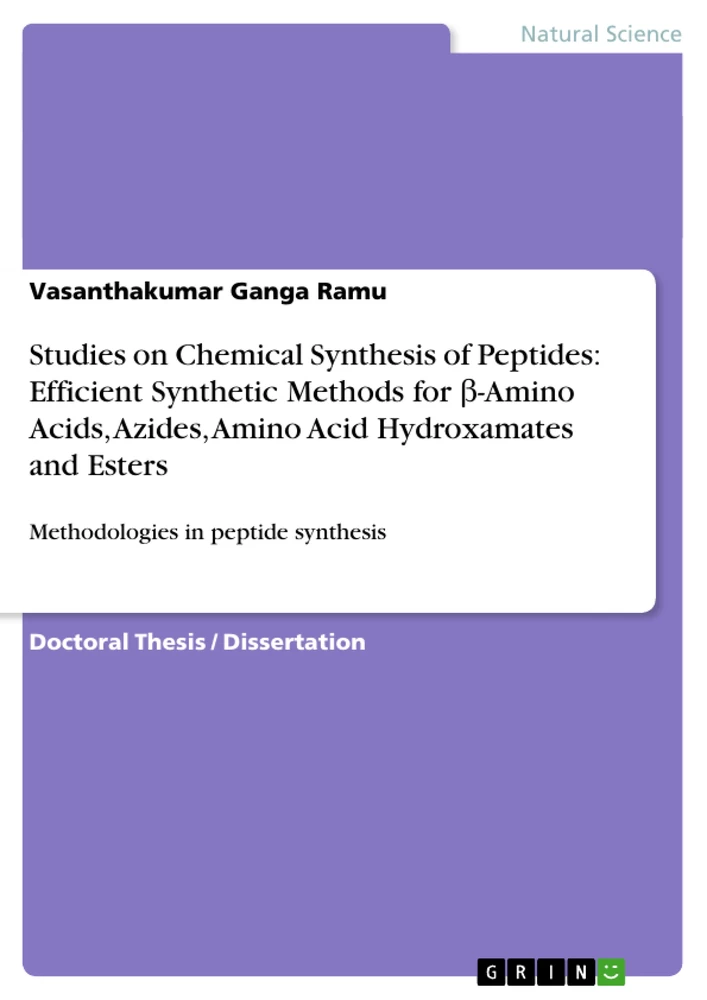
Contents
Chapter 1
Homologation of α-amino acids to β-amino acids using Boc2O through Arndt Eistert approach
1.1 Introduction
1.2 Present work
1.3 Experimental
1.4 References
Chapter 2
Synthesis of β-amino acids using TsCl as a carboxylic group activating agent
2.1 Introduction
2.2 Present work
2.3 Experimental
2.4 References
Chapter 3
Stereospecific homologation of urethane protected α-amino acids to their higher homologs using HBTU
3.1 Introduction
3.2 Present work
3.3 Experimental
3.4 References
Chapter 4
Fmoc-amino acid azides : Synthesis, isolation, characterization, stability and application to synthesis of peptides
4.1 Introduction
4.2 Present work
4.3 Experimental
4.4 References
Chapter 5
Direct synthesis of Fmoc protected amino acid hydroxamates from acid chlorides mediated by MgO
5.1 Introduction
5.2 Present work
5.3 Experimental
5.4 References
Chapter 6
Microwave assisted facile synthesis of amino acid benzyl ester p-toluenesulfonate and hydrochloride salts
6.1 Introduction
6.2 Present work
6.3 Experimental
6.4 References
Chapter 7
Efficient synthesis of peptides employing Fmoc amino acid chlorides and N-silylated amino acid esters
7.1 Introduction
7.2 Present work
7.3 Experimental
7.4 References
Research Objectives and Topics
The thesis aims to develop efficient and stereospecific chemical methods for the synthesis of various peptide derivatives, specifically β-amino acids, amino acid azides, hydroxamates, and benzyl esters. The core focus is on creating mild, high-yielding synthetic pathways that maintain configurational integrity and prevent racemization during the coupling processes.
- Homologation of α-amino acids to β-amino acids using Arndt-Eistert approach.
- Application of coupling reagents like HBTU and activation methods using TsCl and Boc2O.
- Synthesis and stability studies of Fmoc-amino acid azides as effective coupling agents.
- Utilization of microwave irradiation for facile synthesis of amino acid derivatives.
- Development of methods for peptide synthesis using N-silylated amino acid esters.
Excerpt from the Book
1.2 Present work
The use of Boc2O as a tert-butoxy carbonylating agent for the protection of amino group in peptide chemistry in particular, alcohols, and thiols, etc., in general is well documented. Further, Mahapatra et al., recently used Boc2O for the synthesis of six Boc-protected dipeptide esters. Our study demonstrates its use in stereospecific homologation of urethane protected α-amino acids to their β-amino acids.
It has been found that the reaction of diazomethane with Boc-/Z-/Fmoc-α-amino acids could be carried out using Boc2O at 0 °C in presence of an equimolar quantity of pyridine and catalytic amount of DMAP. The reaction proceeds through the formation of carbonic-carbonic mixed anhydride. The addition of DMAP results in formation of the reactive intermediate tert-butoxycarbonyl-4-dimethylamino pyridinium tert-butyl carbonate, which facilitates the nucleophillic addition of amino acid carboxylate anion at the tert-butoxy carbonyl group of the pyridinium system, and consequently activates the amino acid carbonyl towards acylation of diazomethane. It is also observed that the rate of reaction is sluggish in the absence of DMAP.
Summary of Chapters
Homologation of α-amino acids to β-amino acids using Boc2O through Arndt Eistert approach: This chapter describes a new method for the homologation of α-amino acids to their corresponding β-amino acids using Boc2O as an activating agent in the Arndt-Eistert reaction.
Synthesis of β-amino acids using TsCl as a carboxylic group activating agent: This chapter outlines the utility of TsCl as a reagent for carboxylic group activation in the synthesis of N-protected β-amino acids.
Stereospecific homologation of urethane protected α-amino acids to their higher homologs using HBTU: This chapter focuses on the use of HBTU for the rapid and stereospecific homologation of Fmoc-/Boc-α-amino acids.
Fmoc-amino acid azides : Synthesis, isolation, characterization, stability and application to synthesis of peptides: This chapter discusses the synthesis, isolation, and stability of Fmoc-amino acid azides and their role as effective, optically pure coupling agents in peptide synthesis.
Direct synthesis of Fmoc protected amino acid hydroxamates from acid chlorides mediated by MgO: This chapter details a simple and efficient method for preparing O-unacylated Fmoc-amino acid hydroxamates using magnesium oxide.
Microwave assisted facile synthesis of amino acid benzyl ester p-toluenesulfonate and hydrochloride salts: This chapter presents a rapid, eco-friendly method for synthesizing amino acid benzyl esters using microwave irradiation.
Efficient synthesis of peptides employing Fmoc amino acid chlorides and N-silylated amino acid esters: This chapter explores the use of N-silylated amino acid esters and Fmoc-amino acid chlorides for the efficient synthesis of peptides while avoiding base-induced side reactions.
Keywords
β-Amino acids, Peptide synthesis, Homologation, Arndt-Eistert, HBTU, Fmoc-amino acid azides, Hydroxamic acids, Microwave-assisted synthesis, N-silylated amino acid esters, Racemization, Coupling reagents, Carboxylic acid activation, MgO, Benzyl esters, Stereospecificity.
Frequently Asked Questions
What is the primary focus of this thesis?
The thesis focuses on developing efficient, high-yielding, and stereospecific synthetic methods for various peptide building blocks and derivatives, including β-amino acids, amino acid azides, hydroxamates, and protected peptides.
What are the central themes of this research?
The central themes include the improvement of chemical activation techniques for amino acids, the use of environmentally friendly microwave irradiation, the synthesis of shelf-stable intermediates, and the minimization of racemization during peptide coupling.
What is the main goal or research question of the work?
The primary goal is to establish simpler and more efficient laboratory routes for the synthesis of protected amino acids and peptide fragments that are essential for biomimetic and pharmacological research.
Which scientific methods are primarily used?
The research primarily utilizes synthetic organic chemistry techniques, including the Arndt-Eistert homologation, Curtius rearrangement, and microwave-assisted esterification, supported by analytical methods such as IR spectroscopy, NMR (1H and 13C), and HPLC.
What topics are covered in the main body of the work?
The main body covers several chapters dedicated to specific synthetic strategies, ranging from the homologation of α-amino acids to β-derivatives, to the use of novel reagents like HBTU and MgO to facilitate peptide bond formation and hydroxamate synthesis.
Which keywords characterize this work?
The work is characterized by terms such as peptide synthesis, β-amino acids, homologation, stereospecificity, microwave-assisted synthesis, and coupling agents.
How does the author avoid racemization in the synthesis of β-amino acids?
The author demonstrates that using Boc2O and HBTU in the presence of specific additives, along with careful temperature control, allows for the acylation of diazomethane and subsequent Wolff rearrangement without significant racemization.
What is the advantage of using microwave irradiation in this research?
Microwave irradiation serves as a rapid, facile, and environmentally friendly method that drastically reduces reaction times and improves yields, while offering selectivity compared to traditional thermal heating methods.
Ende der Leseprobe aus 180 Seiten
- nach oben
- Arbeit zitieren
- Vasanthakumar Ganga Ramu (Autor:in), 2004, Studies on Chemical Synthesis of Peptides: Efficient Synthetic Methods for β-Amino Acids, Azides, Amino Acid Hydroxamates and Esters, München, Page::Imprint:: GRINVerlagOHG, https://www.diplomarbeiten24.de/document/179845

neugierig - aktuell - relevant
Entdecken Sie hilfreiche Tipps und Tricks rund ums Studium!

Entdecken Sie hilfreiche Tipps und Tricks rund ums Studium!
Ihre Hausarbeit / Abschlussarbeit:

- - Publikation als E-Book und Buch
- - Hohes Honorar auf die Verkäufe
- - Für Sie komplett kostenlos - mit ISBN
- - Es dauert nur 5 Minuten
- - Jede Arbeit findet Leser

- © GRIN Publishing GmbH.
- Alle Inhalte urheberrechtlich geschützt. Kopieren und verbreiten untersagt.
- info@grin.com
- AGB
- Open Publishing
Der GRIN Verlag hat sich seit 1998 auf die Veröffentlichung akademischer eBooks und Bücher spezialisiert. Der GRIN Verlag steht damit als erstes Unternehmen für User Generated Quality Content. Die Verlagsseiten GRIN.com, Hausarbeiten.de und Diplomarbeiten24 bieten für Hochschullehrer, Absolventen und Studenten die ideale Plattform, wissenschaftliche Texte wie Hausarbeiten, Referate, Bachelorarbeiten, Masterarbeiten, Diplomarbeiten, Dissertationen und wissenschaftliche Aufsätze einem breiten Publikum zu präsentieren.
Kostenfreie Veröffentlichung: Hausarbeit, Bachelorarbeit, Diplomarbeit, Dissertation, Masterarbeit, Interpretation oder Referat jetzt veröffentlichen!
Folgen Sie GRIN auf


- GRIN Verlag GmbH
-
- Nymphenburger Str. 86
- 80636
- Munich, Deutschland
- +49 89-550559-0
- +49 89-550559-10
- info@grin.com
-
