
präsentiert von

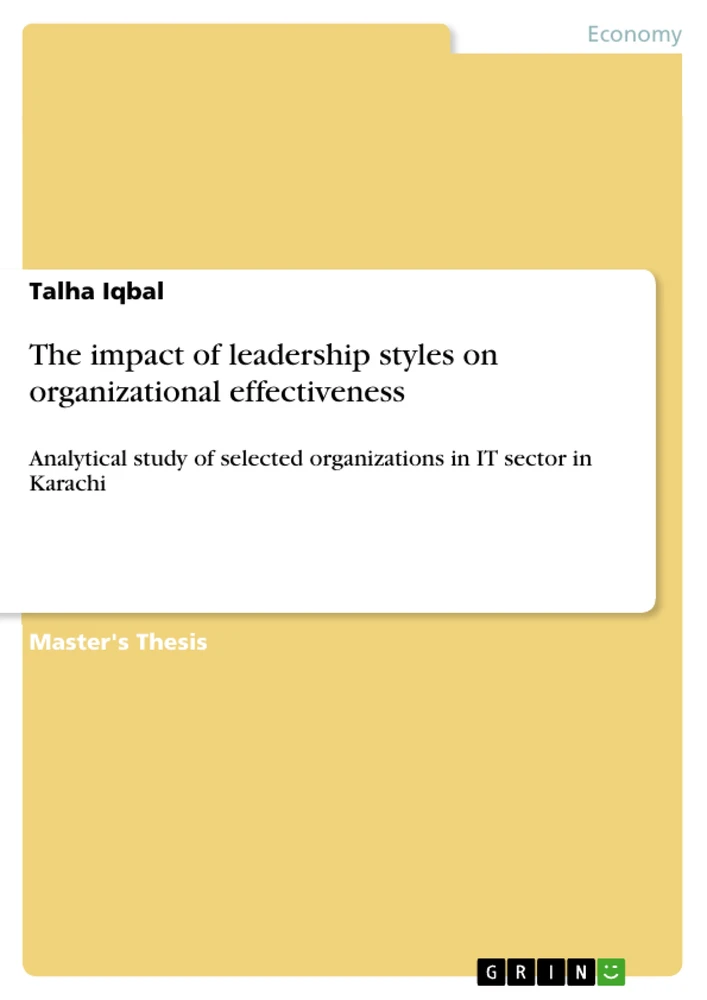
Table of Contents
1. Introduction
1.1. Introduction
1.2. Background
1.3. Objectives
1.4. Significance
1.5. Problem Statement/Research Question
2. Literature Review
3. Conceptual/Theoretical Framework
3.1. Conceptual/Theoretical Framework
3.1.1. Inventory of variables
3.1.2. Schematic diagram
3.1.3. Direction of relationship
3.1.4. Explanation of established relationship among variables
3.1.5. Inventory of propositions in a sequential order
3.2. Hypotheses
3.3. Operationalization
4. Research Methodology
4.1. Technical procedures
4.1.1. Research Design
4.1.2. Data Collection Methods
4.1.3. Sample Design
4.1.4. Data Collection Tools/Instruments
4.1.5. Fieldwork/Data Collection
4.1.6. Data Processing & Analysis
4.2. Scaling
4.3. Limitations of the Research
5. Data Analysis and Interpretation
5.1. Variables and Measures
5.2. Validity and reliability of variables and measures
5.3. Results
6. Conclusion and Recommendations
7. Supplementary Parts
7.1. Glossary
7.2. References
7.3. Annexure(s)
Research Objectives and Key Topics
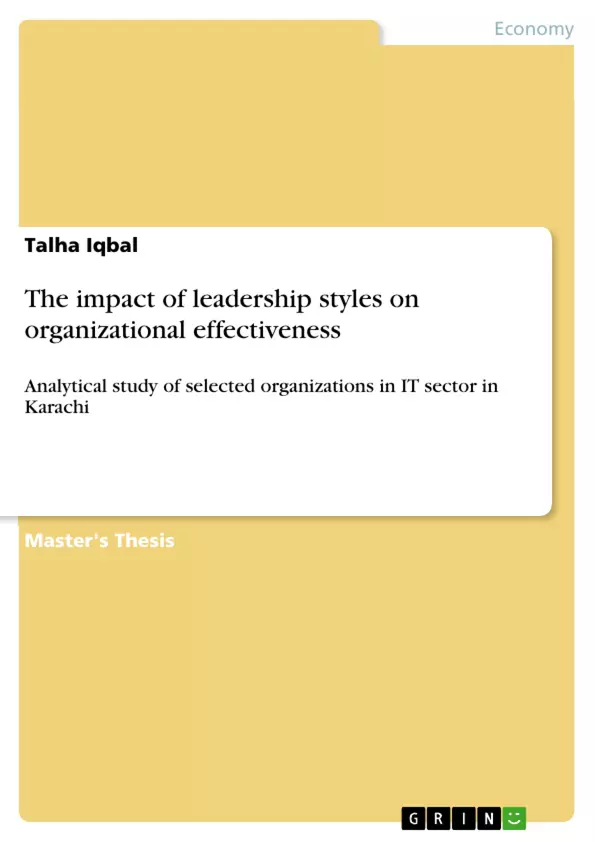
The primary aim of this dissertation is to examine the influence of various leadership styles on the organizational effectiveness of IT firms based in Karachi. The research seeks to identify the dominant leadership approaches in the local IT sector and determine which specific styles contribute most effectively to organizational performance metrics, ultimately providing actionable guidance for local IT managers.
- Analysis of leadership styles (Autocratic, Participative, Laissez-faire, Transformational).
- Evaluation of organizational effectiveness within the IT sector.
- Statistical assessment of the relationship between leadership behavior and organizational outcomes.
- Identification of best practices for organizational management in local IT environments.
Excerpt from the Book
Theoretical concepts of Leadership styles
In 1939, psychologist Kurt Lewin gathered a group of people to identify different styles of leadership that were authoritarian, democratic and laissez-fair leadership. School children were assigned with each type of leader and researchers then noted the response of children against each style of leadership.
From his perspective Authoritarian leaders, also known as autocratic leaders, provide clear expectations for what should be done, when it should be done, and how it should be done. Children responded with more productivity and less creativity manner against this leadership.
Furthermore Lewin's found that Participative leadership (also known as Democratic leadership) was generally an effective leadership style. This kind of leader offered guidance to group members and also took input from other group members. Participative leaders involved group members in decision making ideas but sustain the final words over decision making process. This process kept group members motivated. Children in this group were less productive then authoritarian group but their contribution was of much higher quality.
On further proceeding with the study, Lewin investigated that children under delegation (Laissez-Faire) were the least productive of all three groups. Children in this group also made more demands on leader and showed little co-operation and were not independent as well. Laissez-Faire Leaders did not provide guidance to group members and leave decision making on team .This leadership is only suitable when team is very expert.
Summary of Chapters
1. Introduction: Outlines the historical context of leadership and introduces the research problem regarding its impact on organizational effectiveness in the IT sector.
2. Literature Review: Provides a comprehensive overview of existing theories on leadership styles and organizational effectiveness, placing the study in a historical and academic context.
3. Conceptual/Theoretical Framework: Defines the research model, detailing the dependent and independent variables and establishing the hypotheses to be tested.
4. Research Methodology: Describes the analytical approach, including survey design, sampling methods among IT firms in Karachi, and the statistical tools used for analysis.
5. Data Analysis and Interpretation: Presents the empirical findings, including reliability tests, descriptive statistics, and correlation/regression analyses of the data.
6. Conclusion and Recommendations: Summarizes the key findings and provides practical advice for IT leaders regarding the implementation of transformational leadership styles.
7. Supplementary Parts: Contains references, the glossary, and links to the survey instruments used during the research.
Keywords
Leadership Styles, Organizational Effectiveness, IT Sector, Karachi, Transformational Leadership, Autocratic Leadership, Participative Leadership, Laissez-faire, Employee Morale, Statistical Analysis, Management Sciences, Performance Improvement, Regression Analysis, Survey Research, Organizational Change.
Frequently Asked Questions
What is the core focus of this research?
The dissertation primarily explores how different leadership styles impact the overall organizational effectiveness of IT companies operating within Karachi, Pakistan.
What are the primary leadership styles analyzed?
The study evaluates four major leadership styles: Autocratic, Participative, Laissez-faire, and Transformational.
What is the main objective of the study?
The aim is to identify which leadership style is most conducive to organizational effectiveness in the local IT industry and to provide recommendations for current and aspiring IT leaders.
Which research methodology was employed?
The researcher conducted an analytical, explanatory case study using a questionnaire-based online survey to gather primary data from IT professionals.
What does the main body of the work cover?
The main sections include a literature review, the development of a conceptual framework, a detailed methodology chapter, and a rigorous statistical analysis using regression and correlation techniques.
What are the characterizing keywords for this paper?
The research is characterized by terms such as Leadership Styles, Organizational Effectiveness, IT Sector, Transformational Leadership, and Performance Improvement.
Which leadership style did the study identify as most effective?
The study concluded that the Transformational leadership style yields the highest levels of organizational effectiveness in the local IT industry.
Are there situations where autocratic leadership is recommended?
Yes, the findings suggest that an autocratic style may be beneficial in specific cases, particularly when managing young or fresh employees who require direct guidance and clear explanations.
How was organizational effectiveness measured?
Effectiveness was measured using dimensions such as employee morale, organizational competitive position, customer satisfaction, management satisfaction, and the ability to adapt to organizational change.
How does the researcher define the role of IT leaders?
Leaders are seen as catalysts for motivating employees and molding groups into effective, productive teams that provide a competitive advantage in the IT marketplace.
Ende der Leseprobe aus 40 Seiten
- nach oben
- Arbeit zitieren
- Talha Iqbal (Autor:in), 2011, The impact of leadership styles on organizational effectiveness, München, Page::Imprint:: GRINVerlagOHG, https://www.diplomarbeiten24.de/document/180421

neugierig - aktuell - relevant
Entdecken Sie hilfreiche Tipps und Tricks rund ums Studium!

Entdecken Sie hilfreiche Tipps und Tricks rund ums Studium!
Ihre Hausarbeit / Abschlussarbeit:

- - Publikation als E-Book und Buch
- - Hohes Honorar auf die Verkäufe
- - Für Sie komplett kostenlos - mit ISBN
- - Es dauert nur 5 Minuten
- - Jede Arbeit findet Leser

- © GRIN Publishing GmbH.
- Alle Inhalte urheberrechtlich geschützt. Kopieren und verbreiten untersagt.
- info@grin.com
- AGB
- Open Publishing
Der GRIN Verlag hat sich seit 1998 auf die Veröffentlichung akademischer eBooks und Bücher spezialisiert. Der GRIN Verlag steht damit als erstes Unternehmen für User Generated Quality Content. Die Verlagsseiten GRIN.com, Hausarbeiten.de und Diplomarbeiten24 bieten für Hochschullehrer, Absolventen und Studenten die ideale Plattform, wissenschaftliche Texte wie Hausarbeiten, Referate, Bachelorarbeiten, Masterarbeiten, Diplomarbeiten, Dissertationen und wissenschaftliche Aufsätze einem breiten Publikum zu präsentieren.
Kostenfreie Veröffentlichung: Hausarbeit, Bachelorarbeit, Diplomarbeit, Dissertation, Masterarbeit, Interpretation oder Referat jetzt veröffentlichen!
Folgen Sie GRIN auf


- GRIN Verlag GmbH
-
- Nymphenburger Str. 86
- 80636
- Munich, Deutschland
- +49 89-550559-0
- +49 89-550559-10
- info@grin.com
-
