
präsentiert von

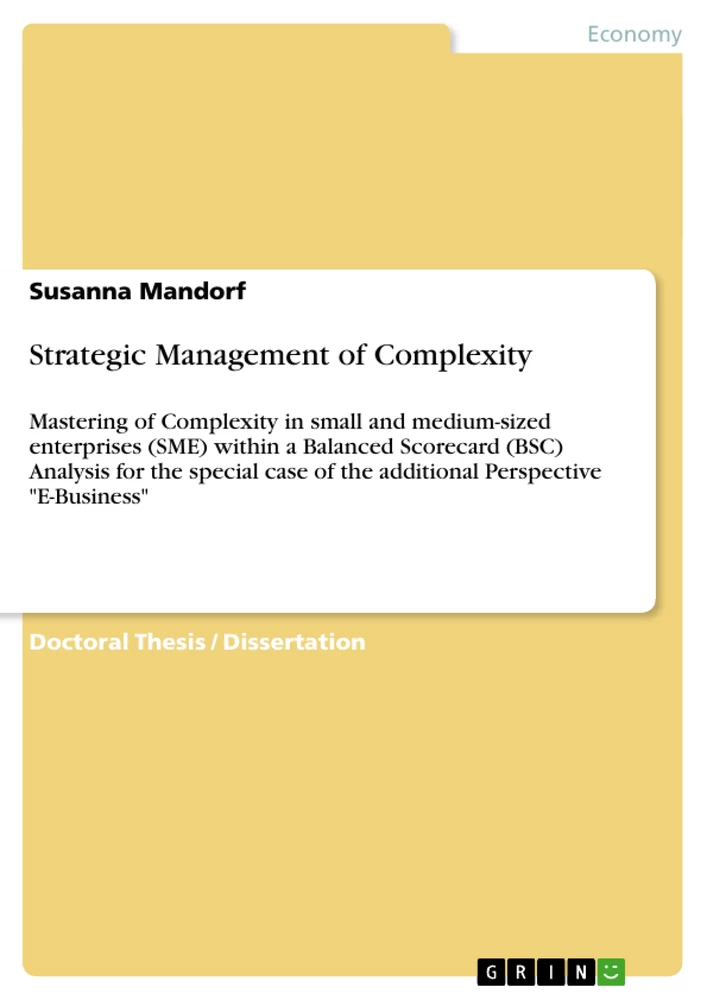
Table of Contents
1. Introduction
1.1. Issues of the Thesis
1.2. Structure of the Thesis
2. Complexity as a typical Characteristic of Companies
2.1. Complexity as a Phenomenon of Nature
2.2. Typical Mistakes by Managing Complexity
2.3. Complex Qualities of Companies
3. Choice of a Strategic Framework
3.1. The Holistic Approach as a Framework for Analysis
3.1.1. Break with the Reduction of Complexity
3.1.2. Increasing Importance of the Soft Skills
3.1.3. Information Systems with Holistic Character
3.2. The Balanced Scorecard as a Holistic Approach
3.1.1. Fundamentals of the BSC Analysis
3.2.2. Transfer of the Strategy
4. Necessity of a Fifth Perspective “E-Business”
4.1. Reason: Complexity of the E-Business
4.1.1. E-Business as a Complex Managing Method
4.1.2. Complex Characteristics of E-Commerce (Internet)
4.2. Enlargement of the BSC-Analysis
4.2.1. Advantages of an additional Perspective and Formal Conditions
4.2.2. Consequences of the Enlargement for the BSC-Architecture
4.3. Fundamentals of a BSC-Analysis of the E-Business Perspective
4.3.1. Strategic Business Areas of the E-Business
4.3.2. Typical E-Business Strategies
5. Case Study of a Real Estate SME
5.1. Analysis of the E-Business Perspective
5.1.1. Strategic Business Areas of E-Business
5.1.2. Analysis of the Value-Chains that contain E-Business-Elements
5.2. Cause-and-Effect Relations of the E-Business Perspective
5.2.1. Relevant Goals System
5.2.2. Possible Measures
5.2.3. Choice of Initiatives
5.3. Implementation of the BSC-Analysis
5.3.1. Design of a Ratio System
5.3.2. Evaluation
5.3.3. Interpretation
6. Results and Outlooks
Objective and Research Focus
The thesis aims to address the challenges small and medium-sized enterprises (SMEs) face when transitioning from traditional brick-and-mortar structures to digital, click-and-mortar models. It explores the management of increased complexity in the digital economy by proposing an extension of the Balanced Scorecard (BSC) framework, specifically by integrating an additional "E-Business" perspective to better align strategic initiatives with new market realities.
- Managing complexity in SMEs within the digital economy.
- Strategic framework and the holistic approach of the Balanced Scorecard.
- Integration of a fifth "E-Business" perspective into the standard BSC model.
- Empirical analysis and case study of an SME in the real estate sector.
- Development of strategic goals and initiatives tailored for e-business processes.
Excerpts from the Book
1.1. Issues of the Thesis
We stand at the beginning of the age of digital revolution. Now it is also time for small and medium sized enterprises (SME) to manage the step from the brick-and-mortar structure to the click-and-mortar structure. Some of them should be able to adjust to the organization structure of virtual companies.
The author was working as a managing director of a medium-sized enterprise in the real estate sector for many years and tried to bring the company from the brick-and-mortar status to a modern company that uses IT and business intelligence methods to restructure for the challenges of the new century. This thesis is about the author’s experiences, when she introduced a new information system using e-business and tried to develop her company into a learning enterprise.
She saw that many SME failed in that restructuring and lost their market position because of ignorance against the need of the new market processes. Everything changed because of the introduction of digital economy. Most of the SME had no clear strategy for such a change and despaired with the choice of a strategic management tool for such a restructuring. They had to manage a lot of difficulties, like less qualified personnel, a low capital assets and capacities, and they had to overcome many internal and external barriers against a structural change of the business processes.
Summary of Chapters
1. Introduction: This chapter highlights the challenges SMEs face in the digital revolution and introduces the motivation for extending the Balanced Scorecard to better manage organizational complexity.
2. Complexity as a typical Characteristic of Companies: This section explores complexity as a fundamental phenomenon in natural and organizational systems, detailing common management errors and the qualities that make companies complex.
3. Choice of a Strategic Framework: The chapter advocates for a holistic management approach over simple reductionist models, positioning the Balanced Scorecard as an effective tool for integrating soft facts and overall organizational strategy.
4. Necessity of a Fifth Perspective “E-Business”: This section justifies the addition of an "E-Business" dimension to the BSC, examining how digital economy characteristics require new strategic business areas and management methods.
5. Case Study of a Real Estate SME: A detailed practical application of the proposed framework, analyzing the corporate structure, value chains, and implementation of specific e-business goals and initiatives within a real estate firm.
6. Results and Outlooks: The final chapter reflects on the findings, concluding that the extended BSC model successfully helps SMEs navigate complex market conditions and serves as a vital success factor for survival in the digital economy.
Keywords
Balanced Scorecard, Complexity Management, E-Business, SME, Digital Economy, Strategic Management, Value Chain, Soft Facts, Intangible Assets, Innovation, Information Systems, Business Intelligence, Performance Measurement, Organizational Change, Strategic Initiatives.
Frequently Asked Questions
What is the primary focus of this work?
The work focuses on how SMEs can successfully navigate the complexities of the digital revolution by applying a holistic management framework specifically tailored to include e-business strategies.
What are the central themes of the research?
Central themes include the management of organizational complexity, the evolution of strategic management, the role of IT in business processes, and the adaptation of the Balanced Scorecard for SMEs.
What is the core objective of the research?
The primary goal is to provide a practical example of how to expand the classical four-perspective Balanced Scorecard by adding a fifth "E-Business" perspective to better support organizational restructuring.
Which methodology is employed in this thesis?
The author uses a combination of literature analysis for the theoretical framework and a longitudinal case study of a real estate SME to demonstrate the practical implementation of the extended BSC.
What is covered in the main part of the thesis?
The main part encompasses the theoretical discussion of complexity, the necessity of the e-business perspective, and a comprehensive real-world case study detailing the design, evaluation, and interpretation of strategic initiatives.
How would you describe the key characteristics of the proposed model?
The key characteristics involve a holistic, balanced approach that integrates both quantitative financial metrics and qualitative soft facts, allowing for adaptability and continuous learning within the company.
What role does the real estate case study play?
It serves as a practical testing ground to show how specific business units (e.g., purchase, brokerage, finance) can be optimized using e-business tools within the proposed Balanced Scorecard architecture.
What does the author conclude regarding the "E-Business" perspective?
The author concludes that adding an E-Business perspective is essential for SMEs to remain competitive, as it forces the organization to formally recognize and integrate digital processes into their strategic management.
Ende der Leseprobe aus 197 Seiten
- nach oben
- Arbeit zitieren
- Dr. Susanna Mandorf (Autor:in), 2009, Strategic Management of Complexity, München, Page::Imprint:: GRINVerlagOHG, https://www.diplomarbeiten24.de/document/181100

neugierig - aktuell - relevant
Entdecken Sie hilfreiche Tipps und Tricks rund ums Studium!

Entdecken Sie hilfreiche Tipps und Tricks rund ums Studium!
Ihre Hausarbeit / Abschlussarbeit:

- - Publikation als E-Book und Buch
- - Hohes Honorar auf die Verkäufe
- - Für Sie komplett kostenlos - mit ISBN
- - Es dauert nur 5 Minuten
- - Jede Arbeit findet Leser

- © GRIN Publishing GmbH.
- Alle Inhalte urheberrechtlich geschützt. Kopieren und verbreiten untersagt.
- info@grin.com
- AGB
- Open Publishing
Der GRIN Verlag hat sich seit 1998 auf die Veröffentlichung akademischer eBooks und Bücher spezialisiert. Der GRIN Verlag steht damit als erstes Unternehmen für User Generated Quality Content. Die Verlagsseiten GRIN.com, Hausarbeiten.de und Diplomarbeiten24 bieten für Hochschullehrer, Absolventen und Studenten die ideale Plattform, wissenschaftliche Texte wie Hausarbeiten, Referate, Bachelorarbeiten, Masterarbeiten, Diplomarbeiten, Dissertationen und wissenschaftliche Aufsätze einem breiten Publikum zu präsentieren.
Kostenfreie Veröffentlichung: Hausarbeit, Bachelorarbeit, Diplomarbeit, Dissertation, Masterarbeit, Interpretation oder Referat jetzt veröffentlichen!
Folgen Sie GRIN auf


- GRIN Verlag GmbH
-
- Nymphenburger Str. 86
- 80636
- Munich, Deutschland
- +49 89-550559-0
- +49 89-550559-10
- info@grin.com
-
