
präsentiert von

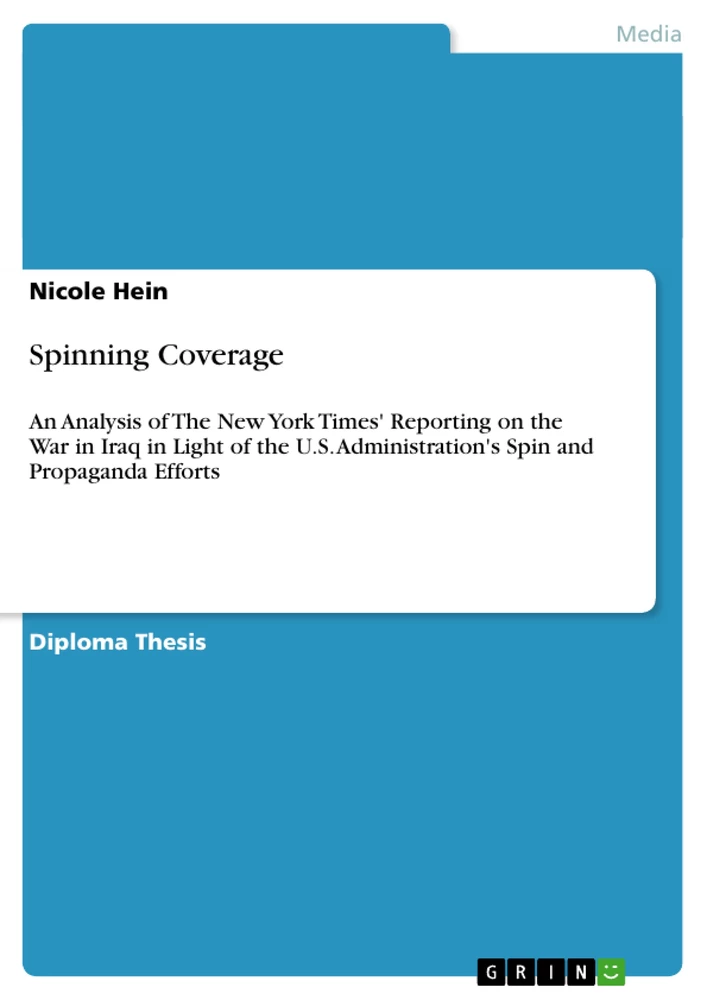
Table of Contents
1. Definitions
1.1 Marketing and Public Relations (PR)
1.2 Spin
1.3 Propaganda
1.4 Comparison
2. The Communication Campaign
2.1 Introduction to the Campaign
2.2 General Line of Argumentation
2.3 Claim 1: Iraq Has Weapons of Mass Destruction
2.3.1 WMD: Opposing Voices
2.3.2 WMD: White House Reaction
2.4 Claim 2: Iraq Has a Nuclear Program
2.4.1 Nuclear Program: Opposing Voices
2.4.2 Nuclear Program: White House Reaction
2.5 Claim 3: Iraq Has Ties to Al Qaeda
2.5.1 Al Qaeda: Opposing Voices
2.5.2 Al Qaeda: White House Reaction
2.6 Excursus: Iraq on the Record
2.7 Spin and Propaganda Techniques
2.8 A Broader Perspective: The Campaign’s Additional Strategies and Tactics
3. Methodology
3.1 The New York Times
3.2 Research Question and Hypotheses
3.3 Examination Period
3.4 Examination Subject
3.5 Type of Examination
3.6 Analysis Composition
4. Editorials
4.1 Argumentation
4.1.1 Stage 1: August to Mid-February
4.1.2 Stage 2: Mid-February to Start of War
4.1.3 Stage 3: Commencement of War to July
4.2 Analysis
4.2.1 Prewar Phase: Content
4.2.2 Prewar Phase: Rhetoric
4.2.3 Prewar Phase: Assessing the Coverage
4.2.4 War Phase: Content
4.2.5 War Phase: Rhetoric
4.2.6 War Phase: Assessing the Coverage
4.3 Final Assessment of the Editorial Coverage
5. Front Page
5.1 Evidence
5.2 Opposition
5.3 Iraq
5.4 Policies
5.5 Communication Campaign
5.6 War Period
5.7 Excursus: The News Analysis
5.8 Author’s Influence
5.9 Miscellaneous Aspects
5.10 Final Assessment of the Front Page Coverage
6. Conclusion
6.1 Comparison of Editorials and Front Page Articles
6.2 Answering Research Question and Hypotheses
7. Closing Remarks
Objectives & Core Themes
This thesis examines whether the reporting of The New York Times on the Iraq conflict was influenced by the communication campaign of the U.S. administration, focusing on whether the newspaper maintained objectivity or adopted the government's rhetoric. The central research question explores if and how the coverage shifted throughout the campaign and whether the editorial team engaged in critical self-reflection regarding their role in the run-up to war.
- The influence of U.S. government spin and propaganda on elite media coverage.
- The evolution of editorial stances from the prewar phase to the post-invasion period.
- Discrepancies in critical scrutiny between front-page news articles and opinionated editorials.
- The impact of administrative communication tactics (e.g., embedding journalists, "rally around the flag" rhetoric) on media objectivity.
- The accountability and self-correction processes within major publications post-conflict.
Auszug aus dem Buch
Spin and Propaganda Techniques
Simply stating allegations − even as grave as they were − probably would have convinced only few people of their accuracy, though. As shown above, the administration was quite aware that some of its claims were entirely unsubstantiated, so it employed a plethora of propaganda and spin techniques in order to make the media − and, therefore, the public − believe it anyway. In the following, a selection of the most prominent and consistently used argumentative and rhetorical techniques will be exemplified.
Cherry-picking: One of the most striking facts about the administration’s communication strategy was that it rarely acknowledged opinions contradicting its own arguments (a spin technique named ‘cherry-picking’). In fact, as has been shown in the previous chapters, they almost consistently only presented facts that supported its own cause, while ignoring unfavorable critique and rebuttals, sometimes even going so far as to cite evidence in misleading ways.
Presenting ambiguous information as if it was certain: Additionally, Washington often exaggerated the credibility of its sources, which − as it turned out for example with Curveball and Ibn al-Shaykh al-Libi − rather than being trustworthy informants were more likely imposters or had given their testimony under torture. When the evidence was thin, officials often veiled gaps in crucial intelligence, stretching information and presenting it as indisputable, as has happened especially in regard to Iraq’s alleged nuclear program (e.g. aluminum tubes, Niger allegation).
Summary of Chapters
1. Definitions: Provides theoretical foundations for key communication concepts, specifically distinguishing between public relations, spin, and propaganda within a political context.
2. The Communication Campaign: Details the three primary assertions used by the U.S. administration to justify war: WMD, nuclear programs, and ties to Al Qaeda, while highlighting the administration's strategic rhetoric.
3. Methodology: Outlines the qualitative and quantitative framework used to analyze The New York Times, explaining the criteria for sample selection and the limitations of the study.
4. Editorials: Analyzes the editorial position of the newspaper across three distinct stages, examining its evolution from cautious support to critical questioning of the administration's claims.
5. Front Page: Investigates front-page reporting, focusing on evidence handling, the use of sources, and whether news coverage adhered to standards of objectivity or succumbed to administrative influence.
6. Conclusion: Synthesizes the findings by comparing editorial and front-page approaches, ultimately evaluating the validity of the research hypotheses.
7. Closing Remarks: Reflects on the media's failure to maintain its "watchdog" role during the Iraq crisis and the limited nature of subsequent institutional self-reflection.
Keywords
The New York Times, Iraq War, U.S. Administration, Spin, Propaganda, Media Coverage, Public Relations, WMD, Foreign Policy, Journalism, Objectivity, Editorial, Communication Campaign, National Intelligence, Accountability.
Frequently Asked Questions
What is the primary focus of this analysis?
The work investigates how the White House's communication campaign regarding Iraq influenced the reporting of The New York Times, focusing on how the administration used spin and propaganda to secure public support.
Which thematic areas does the book explore?
The book explores the administration’s three main justifications for war (WMD, nuclear programs, and Al Qaeda ties), the rhetorical techniques used to support these claims, and the media's role in disseminating these assertions.
What is the central research question?
The research question asks whether the coverage of the Iraq conflict in The New York Times changed in response to the U.S. administration’s communication campaign, and if so, in what way.
Which research methods were employed?
The author used both quantitative and qualitative methods, examining editorials and front-page articles published between August 2002 and July 2003 to track shifts in tone and critical stance.
What is the main subject of the analysis in the chapters?
The main subject is the comparison between the editorial desk's argumentative stance and the front-page journalists' reporting style to determine the extent of administrative influence on media objectivity.
What are the primary keywords associated with this document?
Key terms include The New York Times, Iraq War, spin, propaganda, media coverage, U.S. administration, public relations, and journalistic accountability.
How did the editorial stance of the Times change during the period?
The editorial team began as cautious supporters of disarmament but grew increasingly critical as the administration's shifting rationales and lack of evidence for war became apparent.
What conclusion does the author reach regarding the media's self-reflection?
The author concludes that major media outlets, including the Times, largely failed to provide necessary critical scrutiny and that their eventual self-reflection was limited and defensive rather than thorough.
Ende der Leseprobe aus 118 Seiten
- nach oben
- Arbeit zitieren
- Nicole Hein (Autor:in), 2008, Spinning Coverage, München, Page::Imprint:: GRINVerlagOHG, https://www.diplomarbeiten24.de/document/181656

neugierig - aktuell - relevant
Entdecken Sie hilfreiche Tipps und Tricks rund ums Studium!

Entdecken Sie hilfreiche Tipps und Tricks rund ums Studium!
Ihre Hausarbeit / Abschlussarbeit:

- - Publikation als E-Book und Buch
- - Hohes Honorar auf die Verkäufe
- - Für Sie komplett kostenlos - mit ISBN
- - Es dauert nur 5 Minuten
- - Jede Arbeit findet Leser

- © GRIN Publishing GmbH.
- Alle Inhalte urheberrechtlich geschützt. Kopieren und verbreiten untersagt.
- info@grin.com
- AGB
- Open Publishing
Der GRIN Verlag hat sich seit 1998 auf die Veröffentlichung akademischer eBooks und Bücher spezialisiert. Der GRIN Verlag steht damit als erstes Unternehmen für User Generated Quality Content. Die Verlagsseiten GRIN.com, Hausarbeiten.de und Diplomarbeiten24 bieten für Hochschullehrer, Absolventen und Studenten die ideale Plattform, wissenschaftliche Texte wie Hausarbeiten, Referate, Bachelorarbeiten, Masterarbeiten, Diplomarbeiten, Dissertationen und wissenschaftliche Aufsätze einem breiten Publikum zu präsentieren.
Kostenfreie Veröffentlichung: Hausarbeit, Bachelorarbeit, Diplomarbeit, Dissertation, Masterarbeit, Interpretation oder Referat jetzt veröffentlichen!
Folgen Sie GRIN auf


- GRIN Verlag GmbH
-
- Nymphenburger Str. 86
- 80636
- Munich, Deutschland
- +49 89-550559-0
- +49 89-550559-10
- info@grin.com
-
