
präsentiert von

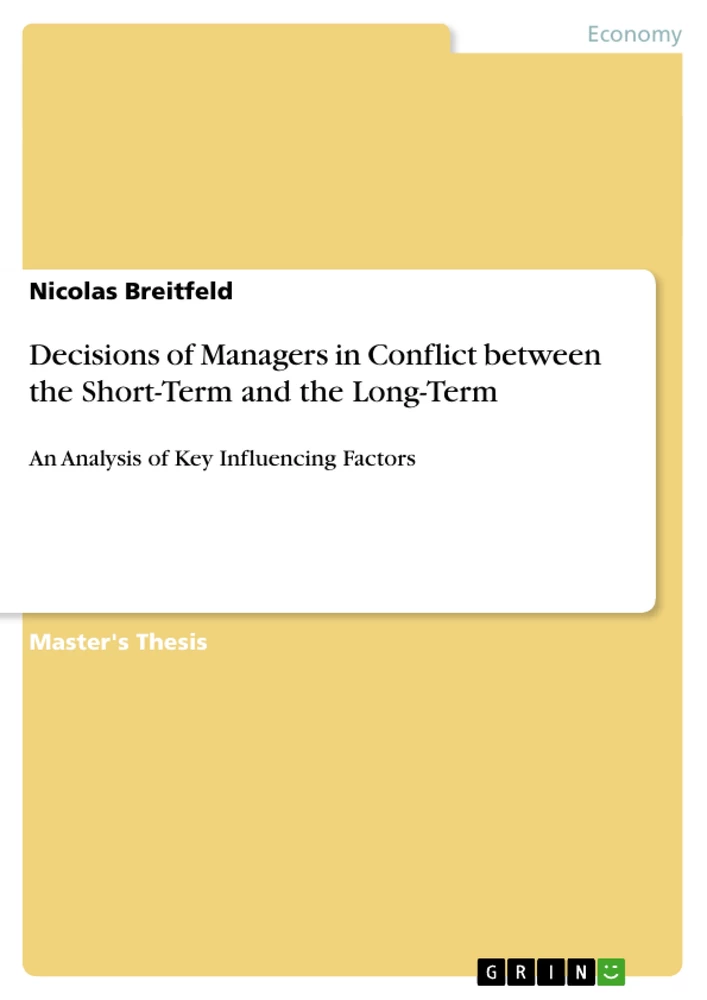
Table of Contents
1 Introduction
1.1 Management decisions – influenced by intertemporal choice
1.2 Research background
1.3 Research aim
1.4 Research question and objectives
1.5 Overview
2 Literature review
2.1 Introduction
2.2 Definitions
2.3 The starting point
2.4 Recent developments
2.5 Current state of research
2.5.1 Economic factors
2.5.2 Organizational factors
2.5.3 Individual factors
2.6 Measures
3 Research design and methodology
3.1 Research strategy
3.2 Design and methodology
3.3 Sources of data
3.4 Data analysis
3.5 Ethics
3.6 Applicability, reliability, replication and validity
3.6.1 Applicability
3.6.2 Reliability
3.6.3 Replication
3.6.4 Validity
3.6.5 Summary
4 Findings
4.1 Introduction, interview topic, and reaching an understanding
4.2 Influencing factors
4.3 Case studies
4.4 Summary
4.5 Measures
5 Analysis, discussion, interpretation
5.1 Relevant influencing factors
5.2 Relevance and grouping of influencing factors
5.3 Relevance of indirect factors
5.4 Relevance of direct factors
5.4.1 Economic factors
5.4.2 Organizational factors
5.4.3 Individual factors
5.5 Discussion of measures
5.5.1 Indirect factors
5.5.2 Economic factors
5.5.3 Organizational factors
5.5.4 Individual factors
6 Conclusion and recommendations
6.1 Conclusion
6.2 Highlights
6.3 Relevance
6.4 Recommendations
Research Goal and Thematic Focus
The primary goal of this research is to identify the most significant factors influencing managers when they are faced with decisions involving a conflict between short-term and long-term consequences (intertemporal choice) and to analyze their relevance in contemporary business settings.
- The impact of institutional investor pressure and financial markets on short-term decision-making.
- The role of corporate strategy and internal performance management systems in shaping managerial behavior.
- Individual psychological and socio-demographic factors that affect how managers interpret and resolve temporal conflicts.
- The influence of broader societal, political, and ethical developments on corporate decision-making frameworks.
- Evaluation of proposed measures to mitigate detrimental "short-termism" in corporate governance and management practice.
Excerpt from the Book
1.1 Management decisions – influenced by intertemporal choice
Decision-making – this is one of the main tasks of a manager. Often, this has to be done in complex situations and the results can lead to far ranging consequences.
One kind of decision is the choice between a short-term and a long-term alternative. But even in that particular instance there are many factors that influence a manager’s decision. For example, an orientation on the short-term is required in order to
• Satisfy shareholders by paying dividends
• Surpass a given financial quarterly guidance or previous results
• Reach bonus targets
• Secure a good reputation in his current position in a company
• …
In contrast, long-term orientation is needed for
• Investments in research and development (R&D) or new markets
• Long-term survival of the company
• Establishing a good relationship with and trust of stakeholders
• Sustainable development
• …
Summary of Chapters
1 Introduction: Introduces the core problem of intertemporal choice in management and outlines the exploratory research approach and objectives.
2 Literature review: Provides a comprehensive overview of existing research on short-termism, categorizing influencing factors into economic, organizational, and individual dimensions.
3 Research design and methodology: Details the qualitative research strategy, utilizing semi-structured interviews with managers across various industries and positions.
4 Findings: Presents the primary data collected from interviews, highlighting recurring themes regarding reasons for short-term orientation and common influencing factors.
5 Analysis, discussion, interpretation: Synthesizes the findings with the literature review, introducing a new framework of 'indirect' and 'direct' influencing factors.
6 Conclusion and recommendations: Summarizes the key research findings, discusses theoretical and practical relevance, and suggests future research directions.
Keywords
Short-termism, Intertemporal choice, Management decision-making, Corporate governance, Shareholder value, Financial markets, Organizational strategy, Managerial incentives, Behavioral finance, Sustainability, Corporate Social Responsibility, Performance management, Quarterly earnings, Investment decision, Leadership
Frequently Asked Questions
What is the core focus of this dissertation?
The dissertation examines how managers make decisions when they face a conflict between short-term gains and long-term company development, a challenge known in academic literature as the problem of intertemporal choice.
What are the primary thematic fields investigated?
The research explores economic drivers such as pressure from financial markets, organizational structures like corporate strategy and governance, and individual factors including managerial incentives and psychological biases.
What is the central research question?
The core question is: "What are the key factors that influence manager decision-making when conflict exists between the short-term and the long-term?"
Which scientific methodology is employed?
The research follows an explorative, qualitative approach. It combines an extensive review of existing management literature with primary data collected through semi-structured interviews with ten experienced managers.
What topics are covered in the main section?
The main part of the work analyzes the results of the interviews, groups the identified influencing factors into a new structure of "indirect" and "direct" factors, and discusses potential measures to improve long-term orientation.
Which keywords characterize this work?
Key terms include short-termism, intertemporal choice, corporate governance, shareholder value, performance management, and behavioral factors in managerial decision-making.
How do financial markets influence the specific short-term behavior of managers?
The study finds that institutional investor pressure and the expectation to meet quarterly earnings guidance force many managers to prioritize short-term financial results over long-term value creation to build credibility and maintain stock prices.
Does this work conclude that "short-termism" is always bad for a company?
No, the research suggests that a total avoidance of short-term goals is not practical. Instead, successful management requires a balance where long-term strategic objectives are supported by consistent operational management, rather than being sacrificed for immediate, superficial financial gains.
Ende der Leseprobe aus 80 Seiten
- nach oben
- Arbeit zitieren
- Nicolas Breitfeld (Autor:in), 2010, Decisions of Managers in Conflict between the Short-Term and the Long-Term, München, Page::Imprint:: GRINVerlagOHG, https://www.diplomarbeiten24.de/document/182404

neugierig - aktuell - relevant
Entdecken Sie hilfreiche Tipps und Tricks rund ums Studium!

Entdecken Sie hilfreiche Tipps und Tricks rund ums Studium!
Ihre Hausarbeit / Abschlussarbeit:

- - Publikation als E-Book und Buch
- - Hohes Honorar auf die Verkäufe
- - Für Sie komplett kostenlos - mit ISBN
- - Es dauert nur 5 Minuten
- - Jede Arbeit findet Leser

- © GRIN Publishing GmbH.
- Alle Inhalte urheberrechtlich geschützt. Kopieren und verbreiten untersagt.
- info@grin.com
- AGB
- Open Publishing
Der GRIN Verlag hat sich seit 1998 auf die Veröffentlichung akademischer eBooks und Bücher spezialisiert. Der GRIN Verlag steht damit als erstes Unternehmen für User Generated Quality Content. Die Verlagsseiten GRIN.com, Hausarbeiten.de und Diplomarbeiten24 bieten für Hochschullehrer, Absolventen und Studenten die ideale Plattform, wissenschaftliche Texte wie Hausarbeiten, Referate, Bachelorarbeiten, Masterarbeiten, Diplomarbeiten, Dissertationen und wissenschaftliche Aufsätze einem breiten Publikum zu präsentieren.
Kostenfreie Veröffentlichung: Hausarbeit, Bachelorarbeit, Diplomarbeit, Dissertation, Masterarbeit, Interpretation oder Referat jetzt veröffentlichen!
Folgen Sie GRIN auf


- GRIN Verlag GmbH
-
- Nymphenburger Str. 86
- 80636
- Munich, Deutschland
- +49 89-550559-0
- +49 89-550559-10
- info@grin.com
-
