
präsentiert von

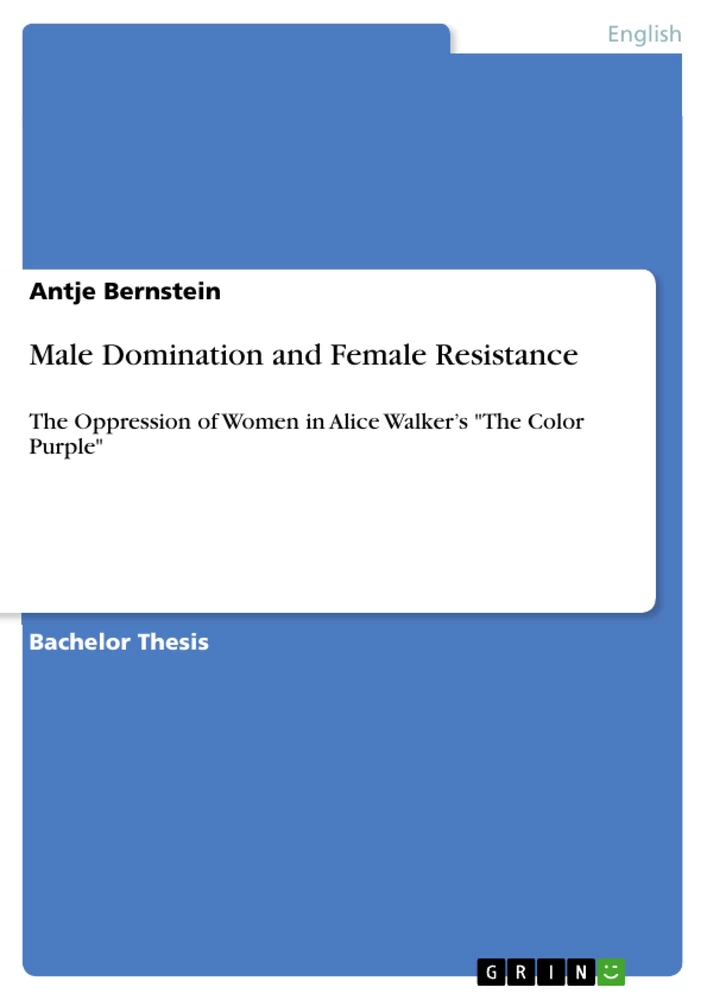
Table of Contents
1. Introduction
2. Male Domination: The Oppression of Women and their Response
2.1. Celie and Alphonso
2.2. Celie and Albert
2.3. Sofia and Harpo
2.4. Mary Agnes and Harpo
2.5. Conclusion
3. Making a Quilt - Creating a Network: Female Resistance
3.1. Celie and Shug
3.2. Celie and Sofia
3.3. Sofia and Mary Agnes
3.4. Conclusion
4. The Cycle of violence: Origins of Male Aggression
4.1. Albert and his father
4.2. Albert and Harpo
4.3. Conclusion
5. Conclusion
6. References and Further Reading
Objectives and Core Themes
This academic paper examines the dynamics of power, oppression, and resistance within Alice Walker’s novel The Color Purple, specifically focusing on the internal structures of black communities. The primary research goal is to investigate how female characters overcome systemic male domination and violence through the formation of solidarity networks, as well as to identify the origins of male aggression passed down through generations.
- The intersection of domestic violence and patriarchal control.
- The role of female solidarity and networks, symbolized by quilt-making.
- The cycle of male aggression and its roots in father-son relationships.
- The protagonist Celie’s personal evolution from silence to self-liberation.
Excerpt from the Book
2.1. Celie and Alphonso
At the age of fourteen Celie makes an experience she is not able to understand and that immediately puts an end to her innocent childhood. She is raped by the man whom she by then considers to be her father. Due to his wife’s refusal to fulfil her conjugal duties as a consequence of her recent giving birth to a child, Alphonso lays hands on his stepdaughter, who by that time is an inexperienced young girl whose whole life is about to change because of the abuse she has to endure. Hoping to find an explanation she turns to God, who is the only one she can turn to terrified by the threat of Alphonso to “[…] tell nobody but God. It’d kill your mammy.” (Walker 2004, p. 3). The fact that Alphonso calls Celie’s mother mammy provides a first insight into how he thinks about women as this word implies the thought of “[…] the turbaned, sassy, protective "mammies" who (according to the movies) ruled Southern plantation kitchens, as well as most of the rest of the plantation house affairs” (Rose) and thus create a connection to slavery. He threatens Celie to make her submit to his will. Nettie mentioned that “[…] you [Celie] said your life made you feel so ashamed you couldn’t even talk about it to God, you had to write it, bad as you thought your writing was” (p. 117). Left with nobody to turn to for guidance and help but God she starts writing down her experiences, which seems for her the only way to let out her inner thoughts and feelings. Notable is the fact that Celie is not complaining in her letters to God but she needs someone to talk to.
Summary of Chapters
1. Introduction: Outlines the focus on black-on-black violence and the necessity of solidarity as a tool for women to resist and survive within oppressive environments.
2. Male Domination: The Oppression of Women and their Response: Explores specific abusive relationships and how women navigate or resist the patriarchal control imposed by their male counterparts.
3. Making a Quilt - Creating a Network: Female Resistance: Analyzes how women build supportive, communal networks—symbolized by the quilt—to foster self-esteem and independence.
4. The Cycle of violence: Origins of Male Aggression: Investigates the transmission of violent, patriarchal behaviors through father-son dynamics and the influence of historical trauma.
5. Conclusion: Synthesizes the finding that change is possible through mutual solidarity, helping men and women redefine gender roles and pursue lives free from suppression.
6. References and Further Reading: Lists the academic literature and feminist theory utilized to analyze the novel.
Keywords
Alice Walker, The Color Purple, feminism, womanism, domestic violence, male domination, female resistance, patriarchy, solidarity, sisterhood, black literature, trauma, oppression, gender roles, epistolary novel.
Frequently Asked Questions
What is the primary focus of this paper?
The paper focuses on analyzing domestic oppression and female resistance within the African American community as depicted in Alice Walker’s The Color Purple.
Which central themes are explored in the work?
Key themes include male-on-female violence, the transformative power of female bonding, the cycle of aggressive behavior passed from father to son, and the journey toward personal independence.
What is the primary goal of the author in this paper?
The aim is to demonstrate that resistance against oppression is possible through solidarity and that recognizing the humanity of women can lead to an end of patriarchal cycles.
What scientific methods are applied here?
The author conducts a literary analysis, drawing upon feminist theory (such as works by bell hooks and Patricia Hill Collins) and the Oxford Companion to African American Literature to interpret character arcs.
What does the main body cover?
It covers individual case studies of abusive relationships, the development of a supportive network between female characters, and the psychological origins of male aggression.
Which terms characterize this research?
Core terms include "womanism," "sisterhood," "black-on-black violence," "patriarchy," and "self-liberation."
How does the author interpret the symbol of the quilt?
The quilt is interpreted as a symbolic network of love, support, and protection, connecting the women and marking their united resistance against male domination.
What role do fathers play in the "cycle of violence" chapter?
Fathers are depicted as architects of a cycle where male aggression is used to maintain power and control, a behavior which they pass down to their sons as a definition of masculinity.
How does Celie's relationship with Shug change her?
Shug serves as a mentor and confidant who helps Celie move from a state of passive silence and trauma to one of self-discovery and economic independence.
Is there hope for the male characters in the novel according to this paper?
Yes, the paper concludes that characters like Albert can break the cycle of violence by learning to respect women, though this requires a fundamental shift in their perception of masculinity.
Ende der Leseprobe aus 44 Seiten
- nach oben
- Arbeit zitieren
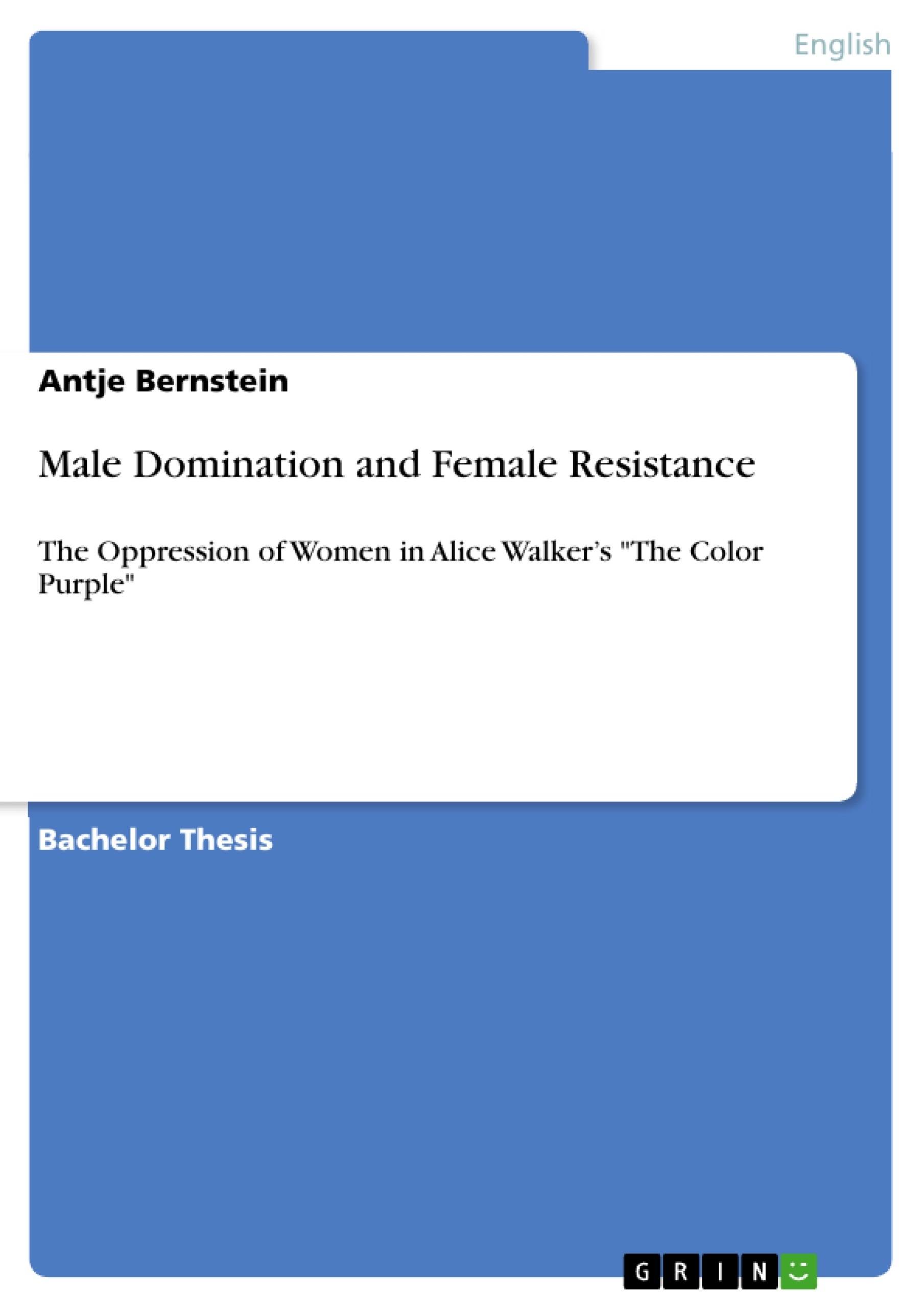
- Antje Bernstein (Autor:in), 2007, Male Domination and Female Resistance, München, Page::Imprint:: GRINVerlagOHG, https://www.diplomarbeiten24.de/document/182494

neugierig - aktuell - relevant
Entdecken Sie hilfreiche Tipps und Tricks rund ums Studium!

Entdecken Sie hilfreiche Tipps und Tricks rund ums Studium!
Ihre Hausarbeit / Abschlussarbeit:

- - Publikation als E-Book und Buch
- - Hohes Honorar auf die Verkäufe
- - Für Sie komplett kostenlos - mit ISBN
- - Es dauert nur 5 Minuten
- - Jede Arbeit findet Leser

- © GRIN Publishing GmbH.
- Alle Inhalte urheberrechtlich geschützt. Kopieren und verbreiten untersagt.
- info@grin.com
- AGB
- Open Publishing
Der GRIN Verlag hat sich seit 1998 auf die Veröffentlichung akademischer eBooks und Bücher spezialisiert. Der GRIN Verlag steht damit als erstes Unternehmen für User Generated Quality Content. Die Verlagsseiten GRIN.com, Hausarbeiten.de und Diplomarbeiten24 bieten für Hochschullehrer, Absolventen und Studenten die ideale Plattform, wissenschaftliche Texte wie Hausarbeiten, Referate, Bachelorarbeiten, Masterarbeiten, Diplomarbeiten, Dissertationen und wissenschaftliche Aufsätze einem breiten Publikum zu präsentieren.
Kostenfreie Veröffentlichung: Hausarbeit, Bachelorarbeit, Diplomarbeit, Dissertation, Masterarbeit, Interpretation oder Referat jetzt veröffentlichen!
Folgen Sie GRIN auf


- GRIN Verlag GmbH
-
- Nymphenburger Str. 86
- 80636
- Munich, Deutschland
- +49 89-550559-0
- +49 89-550559-10
- info@grin.com
-
