
präsentiert von

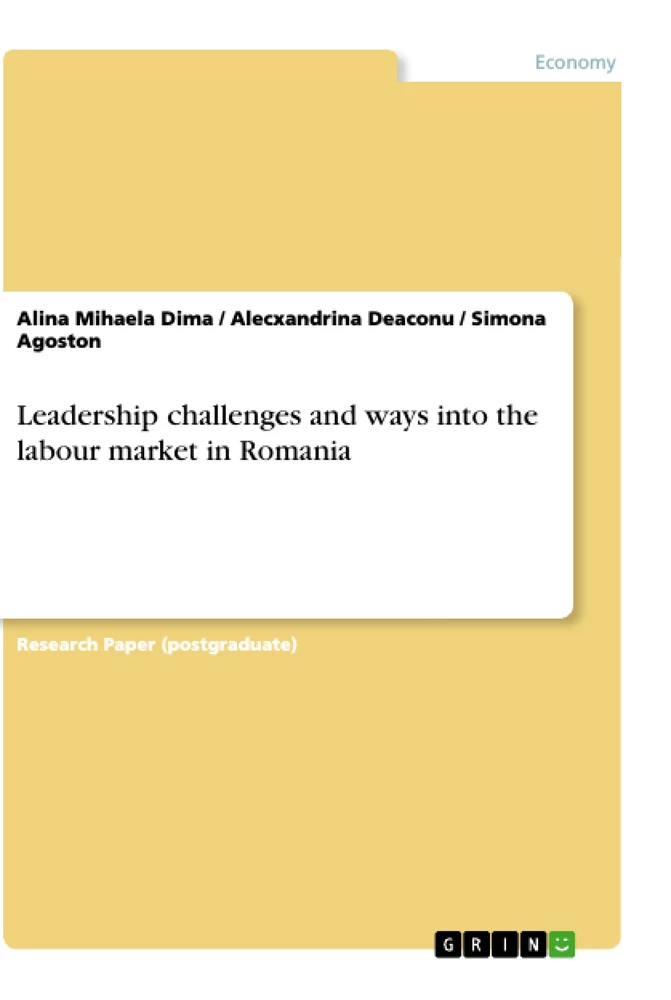
Table of Contents
1. VIEWS ON LEADERSHIP
1.1 Leadership definition
1.2 Leadership versus management
1.3 Traits and characteristics of leaders
2. LEADERSHIP CHALLENGES IN TODAY’S ACADEMIA
2.1 Literature review on leadership tendencies
2.2 Academic vs business leadership
2.3 Research methodology
2.4 Structural equation model of academic leadership
2.5 Conclusions
3. WOMEN VS. MEN LEADERS
3.1 Culture and leadership
3.2 Leadership and gender differences
3.3 Barriers to women leadership
3.4 Women in companies’ top positions and board rooms
3.5 Women in politics and public sector/civil service
4. WOMEN LEADERSHIP ROLES IN ROMANIAN BUSINESS. A WOMAN’S PERSPECTIVE
4.1 Leadership and transition
4.2 Businesswoman profile in Romanian society
4.3 Examples of women leadership in Romania
5. THE BRAIN DRAIN PHENOMENON AND THE QUANTITATIVE AND QUALITATIVE DEFICITS RISK IN THE ROMANIAN LABOR MARKET
5.1 The Specificity of the Romanian Labor Market
5.2 The “Brain drain” phenomenon in Europe and in Romania
5.3 Research on the “Brain drain” phenomenon in Romania
Objectives & Core Topics
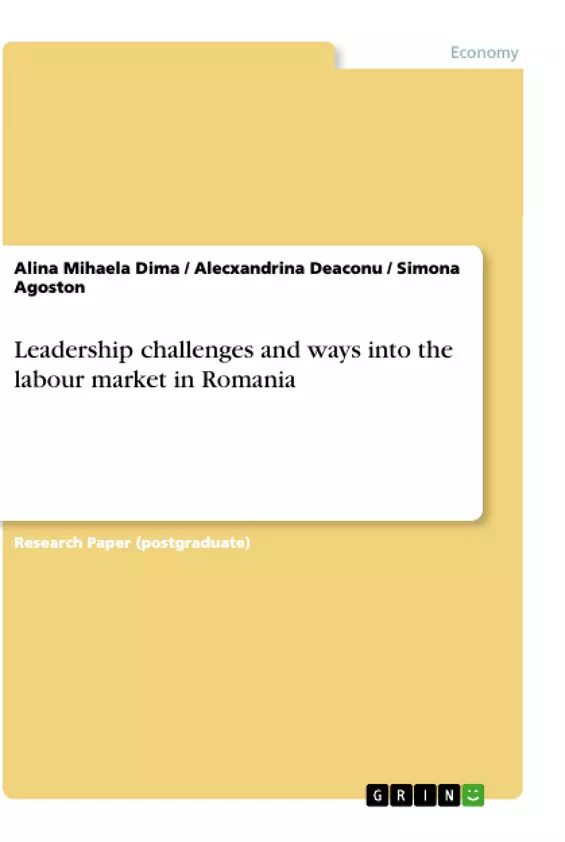
The primary objective of this work is to explore the multi-faceted landscape of leadership within the context of transition economies, specifically focusing on Romania. It investigates the intersection of traditional leadership models with modern business demands, the role of gender in leadership roles, and the socio-economic implications of brain drain on the labor market.
- Theoretical foundations of leadership and the distinction between management and leadership styles.
- Comparative analysis of academic versus business leadership models in higher education.
- Gender-based barriers to leadership and the challenges women face in professional environments.
- Quantitative and qualitative assessment of the brain drain phenomenon in Romania.
- Strategies for developing leadership capacity in transition economies.
Extract from the Book
Leadership versus management
The terms “leadership” and “management” are seen very differently by diverse people. Some individuals see these terms as synonyms and frequently use them interchangeably throughout phrases and sentences. Others approach them as extreme opposites; so extreme, in fact, that they would argue that you cannot be a good manager and a good leader at the same time. Still other people reside somewhere in the middle and realize that while there is a difference between leadership and management, with the right knowledge an individual can successfully navigate both from the same position.
Today’s groups, organizations, and teams need both effective leaders and effective managers to run a successful operation. While some obvious similarities can be found between leadership and management, there are also some striking differences (for example management is often more task-oriented and leadership is often considered more inspirational and visionary).
Leadership and management share many similarities. Both leadership and management involve influence, working with people, and working with effective goal management. However, the fields of leadership and management can also be considered very different. According to John Kotter, leadership can be considered an age-old concept that has been around for centuries, while management is a concept developed in the last 100 years, in part from the rise of the industrial revolution.
Summary of Chapters
Chapter 1: Provides a foundational overview of leadership theories, defining the phenomenon and distinguishing between leadership and management.
Chapter 2: Examines leadership within the academic environment, specifically contrasting it with business leadership and testing a structural equation model of academic leadership.
Chapter 3: Explores cultural influences on leadership and investigates the impact of gender differences on leadership behavior and career opportunities.
Chapter 4: Focuses on the role of women in the Romanian business landscape, analyzing the profile of businesswomen and specific examples of female leadership.
Chapter 5: Analyzes the macro-economic risk of brain drain in the Romanian labor market, identifying migration trends and the impact of the loss of skilled human capital.
Keywords
Leadership, Management, Academia, Gender Differences, Romania, Brain Drain, Organizational Culture, Human Resources, Entrepreneurship, Transition Economies, Structural Equation Modeling, Career Advancement, Labor Market, Empowerment, Innovation.
Frequently Asked Questions
What is the core focus of this research?
The research focuses on the complexities of leadership within transition economies, using Romania as a primary case study to analyze leadership styles, gender dynamics, and labor market trends.
What are the primary thematic areas covered?
The work covers leadership theory, the contrast between academic and corporate management, gender-based discrimination in professional settings, the role of women entrepreneurs, and the impact of the brain drain phenomenon on national development.
What is the main goal of the study?
The main goal is to understand how classical leadership models are adapted and challenged in the Romanian context, providing insights into improving organizational effectiveness.
Which research methods are employed?
The work combines broad literature analyses with quantitative approaches like structural equation modeling and qualitative data from structured interviews and surveys.
What does the book cover in its main sections?
The main sections progress from general leadership theory and academic leadership challenges to a deep dive into gender roles in management and finally, an analysis of professional migration risks.
Which keywords define this study?
Keywords include leadership, transition economies, gender equality, brain drain, human resources, and organizational management.
How is the term "brain drain" defined in this context?
It is defined as the emigration of highly skilled or qualified professionals from a country, typically in search of better economic rewards or working conditions, leading to a loss of domestic human capital.
How does the transition period affect leadership in Romania?
The transition necessitated a shift from centralized, linear management styles to more proactive, flexible leadership models capable of operating in a competitive, market-driven environment.
Ende der Leseprobe aus 79 Seiten
- nach oben
- Arbeit zitieren
- Alina Mihaela Dima (Autor:in), Alecxandrina Deaconu (Autor:in), Simona Agoston (Autor:in), 2011, Leadership challenges and ways into the labour market in Romania, München, Page::Imprint:: GRINVerlagOHG, https://www.diplomarbeiten24.de/document/183606

neugierig - aktuell - relevant
Entdecken Sie hilfreiche Tipps und Tricks rund ums Studium!

Entdecken Sie hilfreiche Tipps und Tricks rund ums Studium!
Ihre Hausarbeit / Abschlussarbeit:

- - Publikation als E-Book und Buch
- - Hohes Honorar auf die Verkäufe
- - Für Sie komplett kostenlos - mit ISBN
- - Es dauert nur 5 Minuten
- - Jede Arbeit findet Leser

- © GRIN Publishing GmbH.
- Alle Inhalte urheberrechtlich geschützt. Kopieren und verbreiten untersagt.
- info@grin.com
- AGB
- Open Publishing
Der GRIN Verlag hat sich seit 1998 auf die Veröffentlichung akademischer eBooks und Bücher spezialisiert. Der GRIN Verlag steht damit als erstes Unternehmen für User Generated Quality Content. Die Verlagsseiten GRIN.com, Hausarbeiten.de und Diplomarbeiten24 bieten für Hochschullehrer, Absolventen und Studenten die ideale Plattform, wissenschaftliche Texte wie Hausarbeiten, Referate, Bachelorarbeiten, Masterarbeiten, Diplomarbeiten, Dissertationen und wissenschaftliche Aufsätze einem breiten Publikum zu präsentieren.
Kostenfreie Veröffentlichung: Hausarbeit, Bachelorarbeit, Diplomarbeit, Dissertation, Masterarbeit, Interpretation oder Referat jetzt veröffentlichen!
Folgen Sie GRIN auf


- GRIN Verlag GmbH
-
- Nymphenburger Str. 86
- 80636
- Munich, Deutschland
- +49 89-550559-0
- +49 89-550559-10
- info@grin.com
-
