
präsentiert von

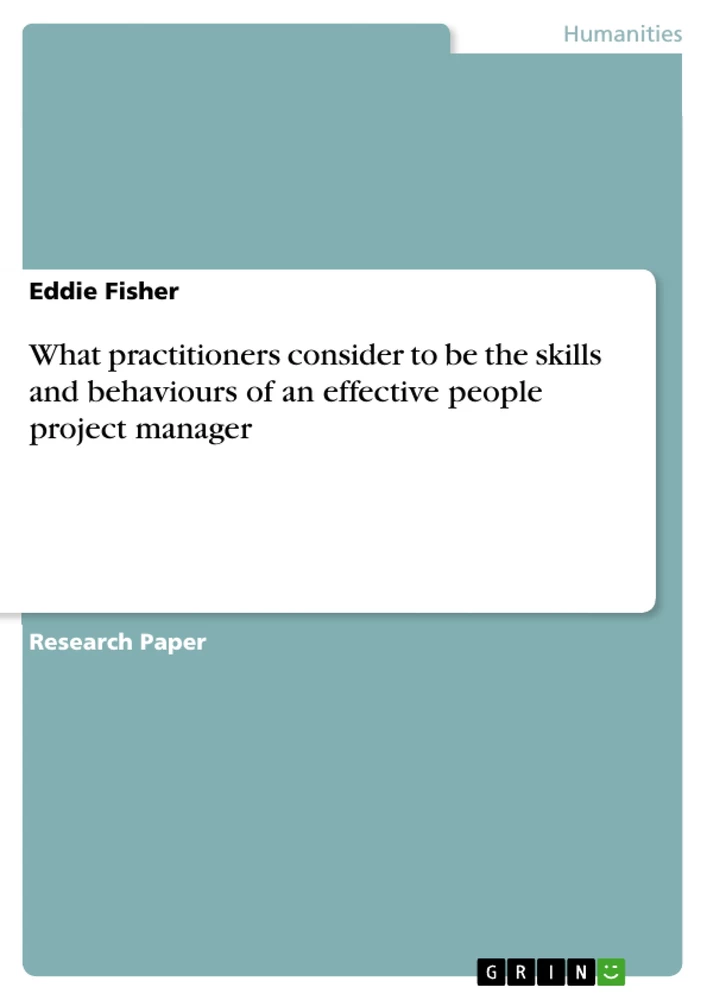
Table of Contents
1. Introduction
1.1 Introduction
1.2 Literature Review
1.3 Main Research Questions
2. Research Methodology
2.1 Method
2.2 Data Analysis
3. Results
3.1 Face to Face Interviews
3.2 Focus Group Meetings
4. Discussion
5. Conclusions
Objectives & Topics
This paper aims to identify and define the specific people skills and associated behaviours that project management practitioners consider essential for an effective project manager. It bridges the gap between academic theory and practical application by evaluating how these competencies contribute to successful project delivery in diverse professional environments.
- Identification of critical people management skills for project managers.
- Definition of associated behaviours required to make skills effective.
- Examination of the interplay between cultural awareness and project success.
- The importance of moving beyond technical skills toward people-oriented leadership.
- Practical insights from cross-industry expert interviews and focus groups.
Excerpt from the book
3.2 Focus Group Meetings
The focus group made a major contribution to validate and to check the reliability of the research data from the literature review and the face to face interviews to suggest what makes an effective people project manager. The face to face meetings per se did not elicit this new valuable knowledge on their own. The group confirmed, through in depth discussions based on their combined years of practical experience, what they consider the skills and behaviours of an effective people project manager are. The focus group members identified associated behaviours for each of the competences they considered project managers need to apply to make these work for them, applying their own experiences to consider how these could be applied. This is crucial. Knowing about and acquiring competences, in itself, is no guarantee for success. Project managers need to apply these, observe the outcomes and likely changes the application has on people and then consider whether to modify them to make them work even better. This is a continuous process that the focus group recognised as being important: 'Project managers need to be seen to be leading the project team through an appropriate manner and self-confidence (the how is important, not going over the top)' (Melissa).
Summary of Chapters
1. Introduction: Outlines the increasing importance of project management and the research necessity for understanding effective people-management skills.
2. Research Methodology: Describes the constructivist interpretivist approach, utilizing literature review, interviews, and focus groups to gather practitioner-based evidence.
3. Results: Details the specific findings from interviews and focus groups regarding essential skills like conflict management, cultural awareness, and emotional intelligence.
4. Discussion: Analyzes the research limitations and the crucial finding that behaviors are the primary drivers for making people skills effective.
5. Conclusions: Summarizes that people management is critical and presents a set of six specific skills and behaviors for effective project leadership.
Keywords
Project Management, People Skills, Behaviours, Effective Management, Leadership, Conflict Management, Cultural Awareness, Team Building, Authentizotic Behaviour, Emotional Intelligence, Practitioner Research, Project Teams.
Frequently Asked Questions
What is the core focus of this research paper?
The paper explores the people management skills and specific associated behaviors that practitioners identify as essential for an effective project manager.
What are the primary thematic areas covered?
The central themes include people management, leadership styles, communication, conflict resolution, cultural awareness, and the behavioral attributes that underpin technical project management.
What is the main objective of this study?
The primary goal is to suggest which people skills are most important for project managers and to define the specific behaviors that practitioners associate with those skills to drive project success.
Which scientific methods are applied in this work?
The study employs a constructivist interpretivist research paradigm, utilizing a combination of literature reviews, individual face-to-face interviews, and focus group meetings with ten project management practitioners.
What does the main body of the text discuss?
It covers existing management theory, detailed practitioner insights regarding real-world experiences, and the analysis of how specific behavioral traits differentiate effective managers from others.
Which keywords best characterize this work?
Key terms include People Skills, Behaviours, Project Management, Leadership, Cultural Awareness, and Conflict Management.
Why is the distinction between 'skills' and 'associated behaviours' highlighted?
The research emphasizes that merely possessing a skill is insufficient; the specific "how" (the behavior) is the catalyst that makes a skill effective in real-world scenarios.
What role did the focus group play in the research outcome?
The focus group was crucial for validating the findings from the literature review and interviews, and for identifying the specific behaviors that practitioners found most effective through their combined practical experiences.
Ende der Leseprobe aus 27 Seiten
- nach oben
- Arbeit zitieren
- Dr Eddie Fisher (Autor:in), 2011, What practitioners consider to be the skills and behaviours of an effective people project manager, München, Page::Imprint:: GRINVerlagOHG, https://www.diplomarbeiten24.de/document/184084


neugierig - aktuell - relevant
Entdecken Sie hilfreiche Tipps und Tricks rund ums Studium!

Entdecken Sie hilfreiche Tipps und Tricks rund ums Studium!
Ihre Hausarbeit / Abschlussarbeit:

- - Publikation als E-Book und Buch
- - Hohes Honorar auf die Verkäufe
- - Für Sie komplett kostenlos - mit ISBN
- - Es dauert nur 5 Minuten
- - Jede Arbeit findet Leser

- © GRIN Publishing GmbH.
- Alle Inhalte urheberrechtlich geschützt. Kopieren und verbreiten untersagt.
- info@grin.com
- AGB
- Open Publishing
Der GRIN Verlag hat sich seit 1998 auf die Veröffentlichung akademischer eBooks und Bücher spezialisiert. Der GRIN Verlag steht damit als erstes Unternehmen für User Generated Quality Content. Die Verlagsseiten GRIN.com, Hausarbeiten.de und Diplomarbeiten24 bieten für Hochschullehrer, Absolventen und Studenten die ideale Plattform, wissenschaftliche Texte wie Hausarbeiten, Referate, Bachelorarbeiten, Masterarbeiten, Diplomarbeiten, Dissertationen und wissenschaftliche Aufsätze einem breiten Publikum zu präsentieren.
Kostenfreie Veröffentlichung: Hausarbeit, Bachelorarbeit, Diplomarbeit, Dissertation, Masterarbeit, Interpretation oder Referat jetzt veröffentlichen!
Folgen Sie GRIN auf


- GRIN Verlag GmbH
-
- Nymphenburger Str. 86
- 80636
- Munich, Deutschland
- +49 89-550559-0
- +49 89-550559-10
- info@grin.com
-
