
präsentiert von

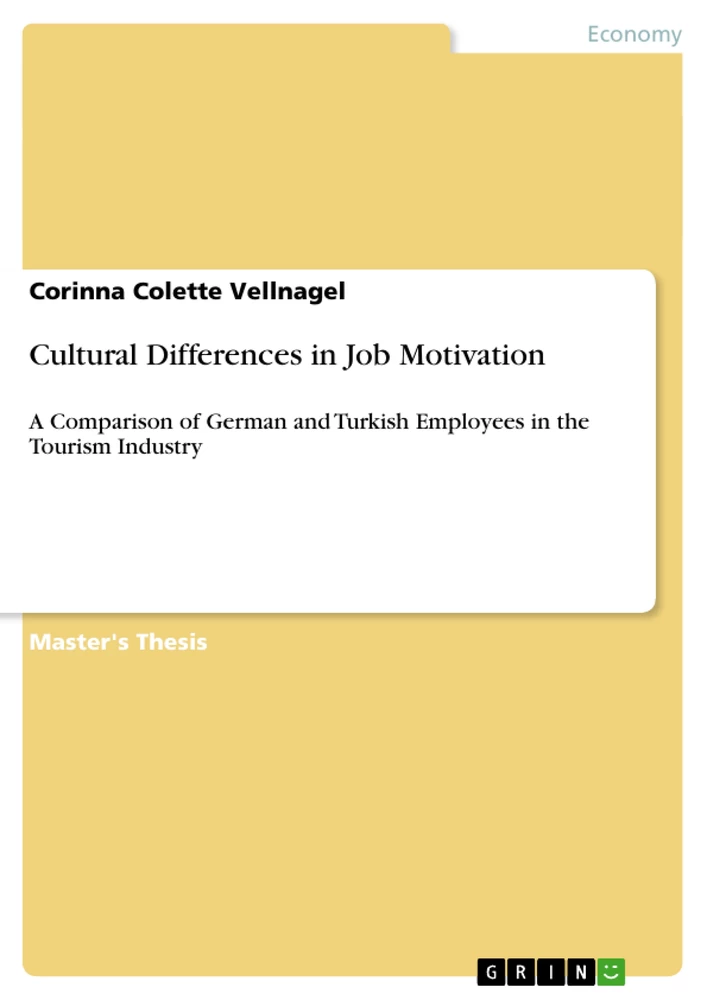
Table of Content
1 Introduction
1.1 Overview
1.2 Aims and Motivation of this Study
1.3 Structure
2 Theoretical Background
2.1 Motivation
2.1.1 Definition
2.1.2 Motivation and Communication
2.1.3 Overview of Motivation Theories
2.1.3.1 Content Theories
2.1.3.1.1 Maslow’s Hierarchy of Needs
2.1.3.1.2 Herzberg’s Two-Factor Theory
2.1.3.2 Process Theories
2.1.3.2.1 Adam’s Equity Theory
2.1.3.2.2 Vroom’s Expectancy Theory
2.1.4 Summary
2.2 Cultural Classifications
2.2.1 Hofstede’s Definition of Culture
2.2.2 Hall’s Cultural Model
3 Methodology
3.1 Rationale for the Choice of Quantitative Research Method
3.2 Questionnaire
3.2.1 Sampling
3.2.2 Participants
3.2.3 Questionnaire Design
3.2.4 Translation
3.2.5 Piloting
3.2.6 Statistical Data Analysis
3.3 Ethical Guidelines
3.4 Limitations
4 Analysis and Discussion
4.1 Cultural Classification
4.1.1 Germany
4.1.2 Turkey
4.2 Analysis and Interpretation
4.3 Applicability of Herzberg’s Two-Factor Theory in Turkey
5 Conclusion
5.1 Summary
5.2 Contribution of this Study
5.3 Recommendation for Future Research
5.4 Limitations
Research Objectives and Themes
The primary aim of this dissertation is to investigate cross-cultural differences in job motivation among German and Turkish employees within the tourism industry, while testing the applicability of western motivation theories in a non-western context.
- Cross-cultural comparison of German and Turkish work motivation.
- Evaluation of Herzberg’s Two-Factor Theory in Turkey and Germany.
- Analysis of factors influencing work choice, performance, and job satisfaction.
- Investigation of cultural dimensions (Hofstede and Hall) as drivers of workplace behavior.
- Assessment of the role of leadership styles and communication on employee motivation.
Excerpt from the Book
2.1.3.2.1 Adam’s Equity Theory
In 1963 John Stacey Adams, an American behavioural psychologist, developed the Equity Theory which is “possibly the most readily understandable psychological process” (Riley:2000, p.26). This theory, which underlines the importance of social processes within organisations, is based on the assumption that people aim to maximise their outcome of their efforts. However, the outcome should not stand in gross disproportion to the input necessary for the attainment. According to the Equity Theory the aim of every human being is to attain a state of equilibrium/balance within which the own relative outcomes QA equate the relative outcomes QB of a reference person (Scholz:2000, p.891 et seqq.; Staehle:1999, p.239 et seqq.).
Hence, individuals strive for balanced and equitable exchange relationships. A subjective balance exists when an individual’s input/output relation corresponds to the one of a comparative instance (Wiltz:1999). Examples of inputs and outcomes could be:
INPUTS: Time, Effort, Loyalty, Hard work, Commitment, Skill, Enthusiasm, Flexibility.
OUTCOMES: Job security, Salary, Employee benefit, Expenses, Reputation, Praise, Recognition, Responsibility.
Summary of Chapters
1 Introduction: This chapter provides an overview of work motivation, the study's aim to compare German and Turkish employees in the tourism sector, and the organizational structure of the dissertation.
2 Theoretical Background: This section details core motivation theories (Maslow, Herzberg, Adams, Vroom) and establishes the cultural frameworks of Hofstede and Hall for cross-cultural analysis.
3 Methodology: The chapter explains the rationale for using a quantitative survey approach, detailing sampling strategies, questionnaire design, and limitations of the research.
4 Analysis and Discussion: This section presents the findings, comparing German and Turkish workplace attitudes, leadership preferences, and communication styles while evaluating the applicability of Herzberg’s theory.
5 Conclusion: The final chapter summarizes the main findings, outlines the contribution of the research to the field, and provides recommendations for future studies.
Keywords
Job motivation, tourism industry, cross-cultural, Germany, Turkey, Herzberg’s Two-Factor Theory, Hofstede, organizational behavior, leadership, cultural dimensions, equity theory, expectancy theory, quantitative research, employee satisfaction, work performance.
Frequently Asked Questions
What is the core focus of this research?
The research focuses on investigating culture-specific job motivation among employees in the German and Turkish tourism industries.
What are the primary themes of the study?
Key themes include cross-cultural behavioral differences, the applicability of western management theories in non-western settings, leadership styles, and workplace rewards.
What is the central research question?
The study asks what motivates employees in Turkey and Germany, what influences their performance, and whether western motivation theories (like Herzberg’s) apply effectively to these cultures.
Which scientific methodology was employed?
The author utilized a quantitative research method, specifically a survey-based approach, to collect data from both German and Turkish participants.
What does the main body of the work cover?
The main body covers a theoretical review of motivation and cultural models, detailed methodology, and a comparative analysis of survey results regarding responsibility, feedback, and rewards.
Which keywords characterize this work?
The work is characterized by terms such as cross-cultural motivation, organizational behavior, tourism sector, Herzberg’s theory, and cultural dimensions.
Why was the tourism industry chosen as the context?
It was chosen because it features unique characteristics like high labor turnover, a significant exchange of emotions between staff and guests, and diverse cultural workforce dynamics.
How does the study evaluate Herzberg's theory?
The study tests Herzberg’s Two-Factor Theory by analyzing if his strict segregation of "motivators" and "hygiene factors" holds true for the specific workplace experiences of Turkish and German tourism employees.
Ende der Leseprobe aus 99 Seiten
- nach oben
- Arbeit zitieren
- M.A. Corinna Colette Vellnagel (Autor:in), 2011, Cultural Differences in Job Motivation, München, Page::Imprint:: GRINVerlagOHG, https://www.diplomarbeiten24.de/document/184893

neugierig - aktuell - relevant
Entdecken Sie hilfreiche Tipps und Tricks rund ums Studium!

Entdecken Sie hilfreiche Tipps und Tricks rund ums Studium!
Ihre Hausarbeit / Abschlussarbeit:

- - Publikation als E-Book und Buch
- - Hohes Honorar auf die Verkäufe
- - Für Sie komplett kostenlos - mit ISBN
- - Es dauert nur 5 Minuten
- - Jede Arbeit findet Leser

- © GRIN Publishing GmbH.
- Alle Inhalte urheberrechtlich geschützt. Kopieren und verbreiten untersagt.
- info@grin.com
- AGB
- Open Publishing
Der GRIN Verlag hat sich seit 1998 auf die Veröffentlichung akademischer eBooks und Bücher spezialisiert. Der GRIN Verlag steht damit als erstes Unternehmen für User Generated Quality Content. Die Verlagsseiten GRIN.com, Hausarbeiten.de und Diplomarbeiten24 bieten für Hochschullehrer, Absolventen und Studenten die ideale Plattform, wissenschaftliche Texte wie Hausarbeiten, Referate, Bachelorarbeiten, Masterarbeiten, Diplomarbeiten, Dissertationen und wissenschaftliche Aufsätze einem breiten Publikum zu präsentieren.
Kostenfreie Veröffentlichung: Hausarbeit, Bachelorarbeit, Diplomarbeit, Dissertation, Masterarbeit, Interpretation oder Referat jetzt veröffentlichen!
Folgen Sie GRIN auf


- GRIN Verlag GmbH
-
- Nymphenburger Str. 86
- 80636
- Munich, Deutschland
- +49 89-550559-0
- +49 89-550559-10
- info@grin.com
-
