
präsentiert von

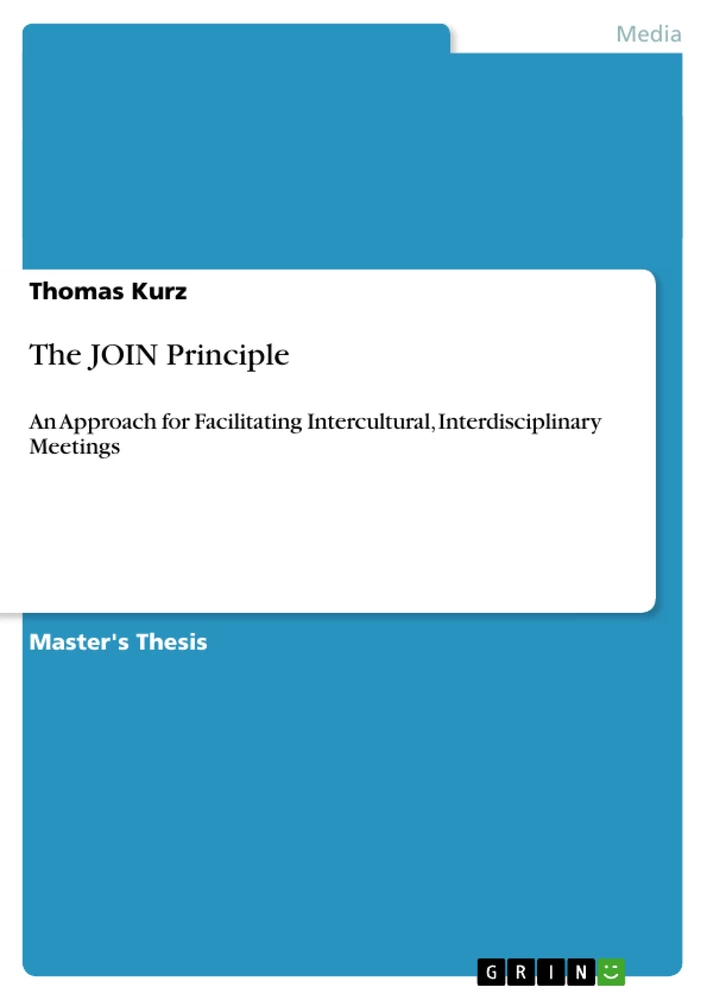
Table of Contents
1. Introduction
2. Intercultural Communication
2.1 Cultural Dynamics
2.1.1 Definition and History
2.1.2 Cultural Dimensions
2.1.3 Diversity
2.1.4 Usage of Culture in this thesis
2.2 The Nature of intercultural Communication
2.2.1 Culture and Communication
2.2.2 Communication basics
2.2.3 Nonverbal Communication
2.2.4 Conclusions
2.3 Language
2.4 Ethics and Human Values
2.5 Conflict
2.6 Interpersonal Behaviour
3. Organisational Dynamics
3.1 Meetings and Workshops
3.2 Group Communication and Group Dynamics
3.2.1 Individual
3.2.2 Group
3.2.3 Group Interaction
3.3 Management and Leadership
3.4 Extra-hierarchical Facilitation
3.4.1 The extra-hierarchical Facilitator
3.4.2 The Facilitation Methodology
3.4.3 The Facilitation Process
3.4.4 The Facilitation Enabler - Trust
4. Facilitation Methodologies
4.1 Research Question
4.2 Approaches in Intercultural Facilitation
4.3 Selection of Approaches
4.4 Theme-Centered Interaction
4.4.1 Ruth Cohn
4.4.2 The Four Factor Model
4.4.3 Advanced Theory of TCI
4.4.4 TCI Group Phases
4.4.5 Interculturality and Diversity
4.5 Reteaming
4.5.1 The Approach
4.5.2 Solution-Oriented Questions
4.5.3 Step-by-Step Process
5. JOIN
5.1 The JOIN Principle
5.1.1 Key Facts and Application Area
5.1.2 Basic Set-Up
5.1.3 Behaviour of the Facilitator
5.1.4 Risks
5.2 The 9+2 Elements of JOIN
5.2.1 Preparation
5.2.2 Warm-Up
5.2.3 Visions Glossary
5.2.4 Concrete Goals
5.2.5 Ranking and Support
5.2.6 Solutions Talk
5.2.7 Challenges Acknowledgment
5.2.8 Feedback
5.2.9 JoinTheDots
5.2.10 Follow Ups
5.2.11 Wrap-Up
6. Evaluation
6.1 Research Questions
6.2 Empirical Methodology
6.2.1 Set-Up
6.2.2 Sample Description
6.3 Execution and Assessment
6.3.1 Course of Research
6.3.2 Analysis of Responses
6.4 Discussion of Results
6.4.1 Interpretation
6.4.2 Recommendations
7. Conclusion and Outlook
Objectives and Research Focus
This master thesis aims to develop and test a novel facilitation approach called 'JOIN' designed specifically for intercultural and interdisciplinary meetings. The research addresses how such a methodology can be structured to improve the efficiency and quality of collaboration in diverse professional environments, while managing the complexities inherent in intercultural communication and group dynamics.
- Theoretical foundation in culture, communication, and organizational dynamics.
- Comprehensive analysis and synthesis of Theme-Centred Interaction (TCI) and Reteaming methodologies.
- Development of the 'JOIN' principle as a practical handbook for facilitation.
- Empirical evaluation of the approach through five independent field-test workshops.
- Documentation of group phases, associated fears, and potential facilitators' interventions.
Excerpt from the Book
Cultural Dynamics
The term 'culture' is as commonly as ambiguously used within and also between languages. It occupied philosophers and thinkers, e.g. Leibnitz, Voltaire, Herder, Wilhelm von Humboldt, Kant, Freud, Jung, Adorno, Marcuse and Luhmann (Maletzke 1996, p. 15). Heringer (2004, p. 158) highlights, that culture is not finished, but it constantly changes and therefore is a dynamic process. The section on cultural dynamics discusses the various cultural definitions and diametrically opposite dimensions and closes with a definition of culture for the thesis at hand.
The following analysis of the history and definitions of culture has two main objectives: First, the word must be defined, in order to understand the subsequent chapters. Second, and equally important, it acts as an example for how difficult it is to find a common understanding between languages, disciplines, and mind-sets.
Besides the common understanding, Williams (1983a, p. xviii) emphasises the importance of development and history of the term. “Where culture meant a state or habit of the mind, or the body of intellectual and moral activities, it means now, also, a whole way of life. This development, like each of the original meanings and the relations between them, is not accidental, but general and deeply significant” Williams (1983a, p. xviii).
Summary of Chapters
1. Introduction: This chapter introduces the research motivation, background, and the development of the JOIN facilitation approach within an intercultural context.
2. Intercultural Communication: This chapter provides a theoretical framework for understanding culture, communication, and their interdependencies, identifying key issues such as cultural dimensions, language, and conflict.
3. Organisational Dynamics: This chapter focuses on the organisational context, discussing meetings, workshops, and the role of leadership in group dynamics and extra-hierarchical facilitation.
4. Facilitation Methodologies: This chapter reviews existing theories in facilitation, specifically TCI and Reteaming, establishing them as the foundation for the JOIN methodology.
5. JOIN: This chapter details the JOIN principle, offering a comprehensive handbook-style guide to its application, phases, and elements.
6. Evaluation: This chapter documents the empirical testing of the JOIN methodology across five workshops, analyzing participant feedback and providing recommendations for improvement.
7. Conclusion and Outlook: This chapter summarizes the main findings of the research and provides suggestions for future scientific inquiry into intercultural facilitation.
Keywords
Intercultural Communication, Interdisciplinary Meetings, Facilitation, JOIN Principle, Theme-Centred Interaction, TCI, Reteaming, Group Dynamics, Organisational Management, Diversity, Cultural Dimensions, Nonviolent Communication, Facilitator Attitude, Workshop Design, Empirical Evaluation.
Frequently Asked Questions
What is the core purpose of this research?
The thesis aims to create a practical, humanistic facilitation approach ('JOIN') specifically designed to handle the complexities of intercultural and interdisciplinary meetings, where traditional management techniques often fail.
Which methodologies are combined to form 'JOIN'?
The JOIN approach is primarily based on the integration of Theme-Centred Interaction (TCI) for group leadership and the Reteaming methodology for structured, solution-oriented process management.
What is the primary research question?
The research asks what form a suitable approach for facilitating intercultural and interdisciplinary meetings could take and whether this methodology is effective in practical, real-world environments.
How was the approach evaluated?
The methodology was evaluated empirically through five field-test workshops held in different organisational and cultural contexts, with data collected via post-workshop questionnaires from 49 participants.
What role does the 'facilitator' play in JOIN?
The facilitator acts as an extra-hierarchical, neutral party focused on managing the communication process rather than the content, guided by the TCI principle of "selective authenticity."
What are the main components of the 'JOIN' process?
JOIN consists of 9+2 elements: preparation, warm-up, visions glossary, concrete goals, ranking and support, solutions talk, challenges acknowledgment, feedback, join-the-dots, follow-ups, and wrap-up.
Why is this thesis written in English if it references so much German literature?
The author chose English to make the content accessible to a broader, international audience, as much of the relevant TCI and facilitation literature cited in the work was previously only available in German.
What does 'dynamic balance' mean in the context of TCI?
Dynamic balance refers to the necessity of including opposite poles in life and facilitation—such as individual versus group needs—to maintain concentration, foster growth, and handle complex group interactions effectively.
How does the 'JoinTheDots' step work?
JoinTheDots connects individual contributions from group members to create a collaborative picture of team effort, promoting commitment through symbolic actions and small, achievable promises.
Ende der Leseprobe aus 248 Seiten
- nach oben
- Arbeit zitieren
- Thomas Kurz (Autor:in), 2010, The JOIN Principle, München, Page::Imprint:: GRINVerlagOHG, https://www.diplomarbeiten24.de/document/188622

neugierig - aktuell - relevant
Entdecken Sie hilfreiche Tipps und Tricks rund ums Studium!

Entdecken Sie hilfreiche Tipps und Tricks rund ums Studium!
Ihre Hausarbeit / Abschlussarbeit:

- - Publikation als E-Book und Buch
- - Hohes Honorar auf die Verkäufe
- - Für Sie komplett kostenlos - mit ISBN
- - Es dauert nur 5 Minuten
- - Jede Arbeit findet Leser

- © GRIN Publishing GmbH.
- Alle Inhalte urheberrechtlich geschützt. Kopieren und verbreiten untersagt.
- info@grin.com
- AGB
- Open Publishing
Der GRIN Verlag hat sich seit 1998 auf die Veröffentlichung akademischer eBooks und Bücher spezialisiert. Der GRIN Verlag steht damit als erstes Unternehmen für User Generated Quality Content. Die Verlagsseiten GRIN.com, Hausarbeiten.de und Diplomarbeiten24 bieten für Hochschullehrer, Absolventen und Studenten die ideale Plattform, wissenschaftliche Texte wie Hausarbeiten, Referate, Bachelorarbeiten, Masterarbeiten, Diplomarbeiten, Dissertationen und wissenschaftliche Aufsätze einem breiten Publikum zu präsentieren.
Kostenfreie Veröffentlichung: Hausarbeit, Bachelorarbeit, Diplomarbeit, Dissertation, Masterarbeit, Interpretation oder Referat jetzt veröffentlichen!
Folgen Sie GRIN auf


- GRIN Verlag GmbH
-
- Nymphenburger Str. 86
- 80636
- Munich, Deutschland
- +49 89-550559-0
- +49 89-550559-10
- info@grin.com
-
