
präsentiert von

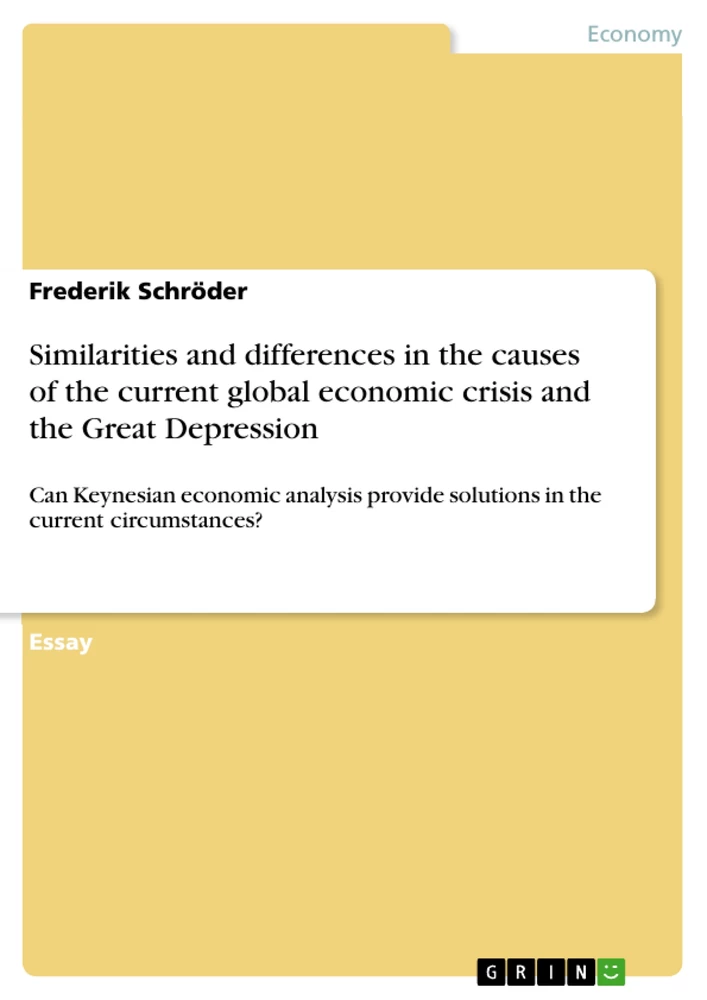
Table of Contents
1. Similarities and differences between the causes of the Great Depression and the current global economic crisis
2. To what extent can Keynesian economic analysis provide solutions in the current circumstances?
Objectives and Topics
The work examines the parallels and disparities between the triggers of the Great Depression of the 1930s and the global economic crisis of 2009, while evaluating the applicability of Keynesian economic strategies to mitigate the ongoing financial downturn.
- Comparative analysis of asset market bubbles (stock market vs. housing market).
- Role of monetary policy and central bank interventions.
- The impact of protectionism and fiscal responses on global trade and output.
- Keynesian strategies for stimulating aggregate demand in liquidity-constrained environments.
- Restoration of financial market confidence and lending mechanisms.
Excerpt from the Book
Similarities and differences between the causes of the Great Depression and the current global economic crisis
Both the current global economic crisis and the Great Depression were prompted by the burst of asset market bubbles. The Great Depression’s origin can be traced back to the burst of the stock market bubble while the current crisis resulted from the collapse of the housing market.
From 1922 to 1929 the world witnessed a period of extremely rapid growth; the American Economy grew by 5.5% on average per year and unemployment decreased to 3.5%. The prevalent conviction that growth would be uninterrupted and the belief that the “secret to continual prosperity was found” set the scene for the start of the Great Depression. During 1928 and 1929 confidence about future earnings, general optimism and an abundance of savings from the preceding and ongoing period of prosperity led to a speculative rally at Wall Street.
Investors were buying securities based on the expectation of a continuation of rising prices. This caused the Dow Jones to rise by 30% within ten months prior to September 1929. This “great speculative orgy” had to come to an end sooner or later. After the hysteria to participate and profit in the bull market it was realized that industrial production had stopped growing in June 1929 due to fairly tight monetary policy. As a result confidence plummeted, panicking shareholders began selling culminating in the stock market crash on Black Tuesday, October the 24th 1929.
Chapter Summaries
Similarities and differences between the causes of the Great Depression and the current global economic crisis: This chapter outlines the historical origins of the 1929 crash and compares them with the mechanics of the 2008 housing market collapse, highlighting shared issues like asset bubbles and policy failures.
To what extent can Keynesian economic analysis provide solutions in the current circumstances?: This chapter evaluates the effectiveness of fiscal and monetary interventions, arguing that traditional stimulus measures must be specifically targeted at liquidity-constrained agents to restore market functionality.
Keywords
Great Depression, Global Economic Crisis, Asset Bubbles, Keynesian Economics, Monetary Policy, Fiscal Stimulus, Aggregate Demand, Financial Instability, Stock Market Crash, Housing Market, Liquidity, Unemployment, Credit Crunch, Protectionism, Economic Policy.
Frequently Asked Questions
What is the core focus of this research?
The work primarily explores the structural parallels between the Great Depression and the 2008 global economic crisis and assesses whether Keynesian economic theory offers viable policy solutions for current recovery efforts.
What are the primary themes discussed in this paper?
Key themes include the causes of speculative bubbles, the consequences of tight monetary policy, the dangers of protectionism, and the efficacy of fiscal stimuli in a modern financial environment.
What is the main research question of the document?
The research asks how the causes of the current economic crisis compare to those of the Great Depression and to what degree Keynesian economic analysis can facilitate effective solutions today.
Which scientific methodology does the author employ?
The author employs a comparative historical analysis, contrasting empirical data and economic outcomes from the 1930s with modern economic data and policy responses to the 2008 crisis.
What topics are addressed in the main body of the text?
The body covers the origins of asset bubbles, the role of central bank mismanagement, the impact of the Hawley-Smoot Tariff, and the limitations of interest rate cuts when confidence in the financial system has collapsed.
Which keywords best describe the research?
Key terms include Great Depression, Keynesian economics, asset bubbles, aggregate demand, financial crisis, and fiscal stimulus.
How does the author characterize the role of credit rating agencies in the current crisis?
The author notes that complex derivative products and misaligned incentives (where agencies were paid by the issuer) contributed to "ratings inflation," leading to the mispricing of risk and the subprime mortgage collapse.
Why does the author argue that direct government spending might be ineffective?
The paper suggests that direct government spending is often slow to implement and tends to benefit specific industries, which does not provide the immediate and widespread stimulus to aggregate demand required during a deep recession.
Ende der Leseprobe aus 9 Seiten
- nach oben
- Arbeit zitieren
- Frederik Schröder (Autor:in), 2009, Similarities and differences in the causes of the current global economic crisis and the Great Depression, München, Page::Imprint:: GRINVerlagOHG, https://www.diplomarbeiten24.de/document/189030

neugierig - aktuell - relevant
Entdecken Sie hilfreiche Tipps und Tricks rund ums Studium!

Entdecken Sie hilfreiche Tipps und Tricks rund ums Studium!
Ihre Hausarbeit / Abschlussarbeit:

- - Publikation als E-Book und Buch
- - Hohes Honorar auf die Verkäufe
- - Für Sie komplett kostenlos - mit ISBN
- - Es dauert nur 5 Minuten
- - Jede Arbeit findet Leser

- © GRIN Publishing GmbH.
- Alle Inhalte urheberrechtlich geschützt. Kopieren und verbreiten untersagt.
- info@grin.com
- AGB
- Open Publishing
Der GRIN Verlag hat sich seit 1998 auf die Veröffentlichung akademischer eBooks und Bücher spezialisiert. Der GRIN Verlag steht damit als erstes Unternehmen für User Generated Quality Content. Die Verlagsseiten GRIN.com, Hausarbeiten.de und Diplomarbeiten24 bieten für Hochschullehrer, Absolventen und Studenten die ideale Plattform, wissenschaftliche Texte wie Hausarbeiten, Referate, Bachelorarbeiten, Masterarbeiten, Diplomarbeiten, Dissertationen und wissenschaftliche Aufsätze einem breiten Publikum zu präsentieren.
Kostenfreie Veröffentlichung: Hausarbeit, Bachelorarbeit, Diplomarbeit, Dissertation, Masterarbeit, Interpretation oder Referat jetzt veröffentlichen!
Folgen Sie GRIN auf


- GRIN Verlag GmbH
-
- Nymphenburger Str. 86
- 80636
- Munich, Deutschland
- +49 89-550559-0
- +49 89-550559-10
- info@grin.com
-
