
präsentiert von

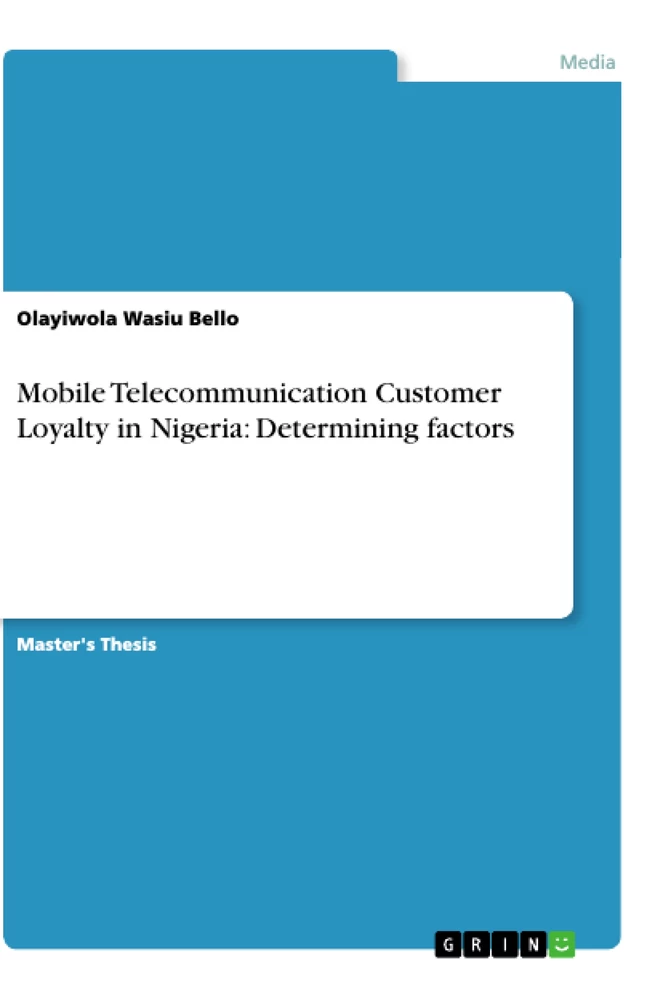
Table of Contents
1. INTRODUCTION
1.1 Background of the research
1.2 The Characteristics of Nigerian Mobile Telecom Market
1.2.1 The Current situation of Nigerian Mobile Telecom Industry
1.3 Statement of the Problem
1.4 Research Questions
1.5 Objectives of the Study
1.6 Justification for the Study
1.8 Scope and Delimitation
2. LITERATURE REVIEW
2.1 Conceptual Framework
2.1.1 Customer Loyalty
2.1.2 The Antecedents of Customer Loyalty
2.1.3 Customer Loyalty: Does it Really Work?
2.1.4 New Trend of Customer Loyalty
2.2 Customer satisfaction
2.2.1 The Definition of Customer Satisfaction
2.2.2 The Definition of Perceived Quality of Products and Service
2.2.3 Customer Loyalty and Perceived Quality
2.2.4 The Definition of Perceived Customer Value
2.2.5 Customer Loyalty and Customer Perceived Value
2.2.6 The Triad Relationship between Perceived Quality, Perceived Value and Customer Satisfaction, Customer Loyalty
2.3 Switching cost
2.3.1 Definition and Typology
2.3.2 Switching Cost and Customer Loyalty
2.4 Corporate Image
2.4.1 The definition of corporate image
2.4.2 Corporate Image and Customer Loyalty
2.5 Theoretical Framework
3. RESEARCH METHODOLOGY
3.1 Study Area
3.2 Method of Investigation
3.3 Sampling Procedures
3.4 Measurement of Variables
3.5 Research Instrument
3.6 Validation of Research Instrument and Testing
3.7 Method of Data Analysis
4. PRESENTATION, ANALYSIS AND INTERPRETATION OF DATA
4.1 Response Rate
4.2 Respondents’ Characteristics and Classification
4.3 Presentation and Analysis of Data According to Research Objectives
4.3.1 Factors that specifically affect the loyalty of mobile telecom users.
4.3.2 Influence of Gender, Age and Mobile Phone use Duration on Loyalty Variables
4.3.3 Performance of the telecom service providers against the identified factors.
4.3.4 How service providers can better enhance the loyalty of their customers.
5. SUMMARY, CONCLUSION AND RECOMMENDATION
5.1 Summary
5.2 Conclusion
6.2 Recommendation
Research Objectives & Key Themes
The primary objective of this thesis is to investigate the operational factors influencing customer loyalty within the Nigerian mobile telecommunications industry. The research aims to understand the variables affecting users, assess the performance of existing service providers against these factors, and identify strategic improvements to enhance customer retention.
- Analysis of key drivers for customer loyalty (e.g., service quality, switching costs, and corporate image).
- Evaluation of the specific characteristics and growth progression of the Nigerian mobile telecom market.
- Empirical investigation into customer satisfaction and its relation to perceived value and service quality.
- Assessment of the role of switching barriers in the absence of mobile number portability.
- Strategic recommendations for telecom operators to foster long-term customer relationships and sustainable growth.
Excerpt from the Book
1.1 Background of the research
With the increasing competition in the market, customer loyalty has become a decisive factor in long-term business profits. At its high, customer loyalty connotes the high entry barriers for the competitor to enter the market, and it significantly contributes to reduction in marketing costs. Attracting new customers requires a company to invest quite much time and money and this process always span a long period of time associated with uncertainties and risks.
The number of loyal customers as a sign of market share is more meaningful and significant than the total number of customers. More loyal customers translate to high profits. Loyal customers will continue to purchase or receive the product or service from the same enterprises and they will be willing to pay higher prices for the quality products and first-class services, thereby increasing sales revenue. From the afore mentioned, the focus of many enterprise managers at this point is on marketing management aspects to improve customer loyalty in order to gain the competitive advantage in the face of fierce competition. The importance of customer loyalty has been identified by many researchers and academicians in different commercial enterprises in years past (Ahn, 2006; Gerpott el al, 2001; Lee 2001). This importance in no doubt does not exclude the telecommunication industry and by extension the Nigerian telecoms industry.
Summary of Chapters
1. INTRODUCTION: Outlines the significance of customer loyalty in the telecommunications sector and introduces the Nigerian mobile market context and research objectives.
2. LITERATURE REVIEW: Examines theoretical foundations of customer loyalty, satisfaction, perceived quality, perceived value, switching costs, and corporate image.
3. RESEARCH METHODOLOGY: Describes the study area, data collection via questionnaire, sampling procedures, and statistical methods used for analysis.
4. PRESENTATION, ANALYSIS AND INTERPRETATION OF DATA: Analyzes the survey results regarding factors influencing loyalty and service provider performance, including demographic influences.
5. SUMMARY, CONCLUSION AND RECOMMENDATION: Summarizes the findings, provides conclusions on the drivers of loyalty in Nigeria, and offers specific recommendations for telecom operators.
Keywords
Customer Loyalty, Mobile Telecommunications, Nigeria, Customer Satisfaction, Perceived Quality, Switching Costs, Corporate Image, Network Coverage, Service Providers, Consumer Behavior, Customer Retention, Market Saturation, Mobile Number Portability, Service Delivery, Marketing Management
Frequently Asked Questions
What is the primary focus of this research?
The research focuses on identifying specific operational factors that drive customer loyalty within the Nigerian mobile telecommunications industry.
What are the main thematic areas covered?
The core themes include customer satisfaction, perceived service quality, perceived customer value, the impact of switching costs, and the influence of corporate image on customer retention.
What is the central research question?
The study addresses which factors influence the loyalty of mobile telecom customers in Nigeria and how well current service providers perform regarding these factors.
Which methodology was employed for this study?
The study utilizes a descriptive and inferential research design, employing a survey strategy with structured questionnaires administered to a sample of university students in Nigeria.
What does the main body of the work address?
The main body covers a comprehensive literature review of global loyalty models, followed by an empirical analysis of data collected from Nigerian mobile phone users to validate these models locally.
Which keywords best characterize this work?
Key terms include Customer Loyalty, Mobile Telecommunications, Nigeria, Perceived Quality, Switching Costs, and Customer Satisfaction.
How does the absence of Mobile Number Portability (MNP) affect the findings?
The research concludes that the lack of MNP creates an environment of "false loyalty," where customers stay with providers not out of choice, but due to the high inconvenience of changing numbers.
What role does "switching cost" play in the author's model?
Switching cost is presented as a critical factor that not only directly influences loyalty but also moderates the relationship between customer satisfaction and long-term retention.
Why are service centers and advertisements considered less significant by respondents?
The study suggests that customers rarely visit service centers and view advertisements as generic branding efforts that provide little additional value to their daily user experience.
Ende der Leseprobe aus 78 Seiten
- nach oben
- Arbeit zitieren
- Olayiwola Wasiu Bello (Autor:in), 2010, Mobile Telecommunication Customer Loyalty in Nigeria: Determining factors, München, Page::Imprint:: GRINVerlagOHG, https://www.diplomarbeiten24.de/document/192554

neugierig - aktuell - relevant
Entdecken Sie hilfreiche Tipps und Tricks rund ums Studium!

Entdecken Sie hilfreiche Tipps und Tricks rund ums Studium!
Ihre Hausarbeit / Abschlussarbeit:

- - Publikation als E-Book und Buch
- - Hohes Honorar auf die Verkäufe
- - Für Sie komplett kostenlos - mit ISBN
- - Es dauert nur 5 Minuten
- - Jede Arbeit findet Leser

- © GRIN Publishing GmbH.
- Alle Inhalte urheberrechtlich geschützt. Kopieren und verbreiten untersagt.
- info@grin.com
- AGB
- Open Publishing
Der GRIN Verlag hat sich seit 1998 auf die Veröffentlichung akademischer eBooks und Bücher spezialisiert. Der GRIN Verlag steht damit als erstes Unternehmen für User Generated Quality Content. Die Verlagsseiten GRIN.com, Hausarbeiten.de und Diplomarbeiten24 bieten für Hochschullehrer, Absolventen und Studenten die ideale Plattform, wissenschaftliche Texte wie Hausarbeiten, Referate, Bachelorarbeiten, Masterarbeiten, Diplomarbeiten, Dissertationen und wissenschaftliche Aufsätze einem breiten Publikum zu präsentieren.
Kostenfreie Veröffentlichung: Hausarbeit, Bachelorarbeit, Diplomarbeit, Dissertation, Masterarbeit, Interpretation oder Referat jetzt veröffentlichen!
Folgen Sie GRIN auf


- GRIN Verlag GmbH
-
- Nymphenburger Str. 86
- 80636
- Munich, Deutschland
- +49 89-550559-0
- +49 89-550559-10
- info@grin.com
-
