
präsentiert von

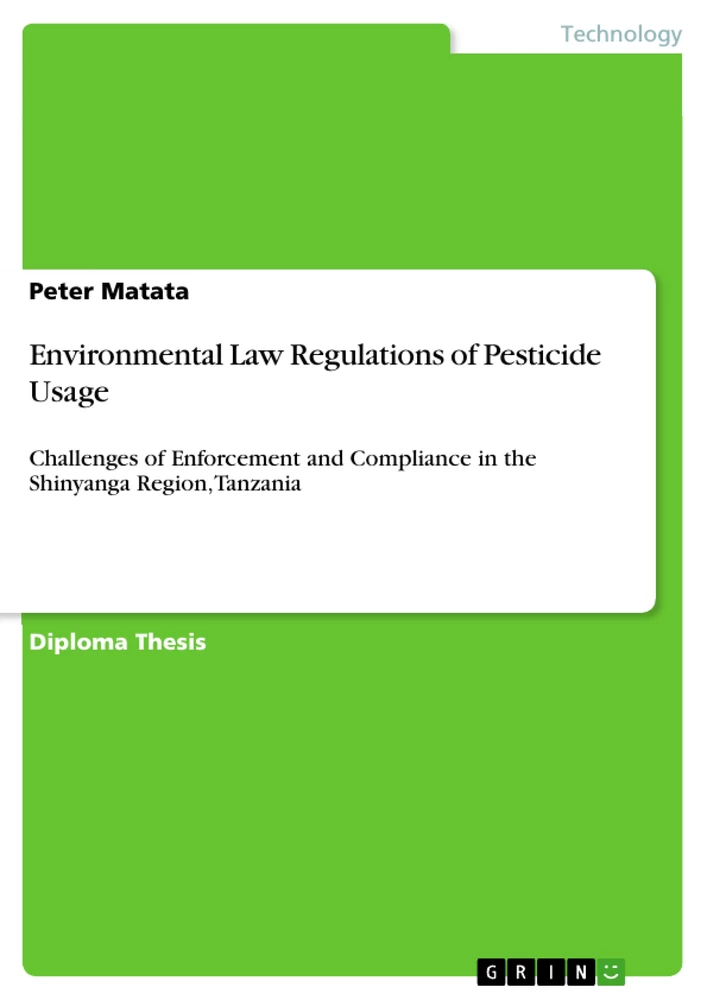
Table of Contents
1 Introduction
1.1 Problem statement
1.2 General objectives
1.3 Specific objectives
1.4 Research questions
1.5 Structure of the report
2 Research Methodology
2.1 Description of the study area
2.2 Methods
2.2.1 Problem identification
2.2.2 Sampling procedure
2.2.3 Pre-testing
2.2.4 Data collection
2.2.5 Primary data
2.2.6 Data analysis
3 Literature Review
3.1 Basic theories of compliance and enforcement
3.1.1 Fundamentals of enforcement
3.1.2 The importance of compliance and enforcement
3.1.3 Promoting compliance within the regulated community
3.1.4 Four approaches to compliance promotion
3.2 The table of eleven and its dimensions
3.3 The framework of enforcement
3.4 Institutional framework
3.5 Reasons influencing compliance
3.5.1 Reasons for enforcement failure
3.6 Significant issues for effectiveness of policy implementation
3.7 The agricultural industry and its environmental impact
3.7.1 The regulatory environment of agriculture
3.7.2 Hazardous practices on the environment
3.7.3 The agricultural chemical law (The plant protection Act, 1997) in Tanzania
4 Results and analysis
4.1 Results of government officials
4.2 Results of farmers
4.2.1 Analysis
4.2.2 Compliance estimate
4.3 Comparison in perception between enforcers and farmers
5 Discussion
6 Conclusion
6.1 Recommendation
6.2 Suggestion for further study
Research Objectives and Core Topics
This thesis assesses the effectiveness of environmental regulation and the quality of enforcement regarding agricultural chemical use in the Shinyanga region of Tanzania. The primary research objective is to analyze the gap between enforcement agencies and the regulated target group (farmers) in order to improve environmental management and compliance with the Plant Protection Act of 1997.
- Evaluation of current pesticide application regulations in Tanzania.
- Analysis of compliance and enforcement factors using the "Table of Eleven" model.
- Investigation of farmers' awareness, knowledge, and attitudes regarding regulatory compliance.
- Assessment of institutional limitations, resource constraints, and enforcement mechanisms.
- Identification of discrepancies in perceptions between government enforcers and the farming community.
Excerpt from the Book
3.1 Basic theories of compliance and enforcement
Compliance is the ultimate goal of any enforcement progarm.Compliance is essentially a state of being, when a regulated source achieved required environmental standards, regulations, by meeting expected behaviours in processes and practices (Tieterberg, 1992). One of primary goal for using policy instruments is to change human behaviour so that environmental requirements are complied with (Scholtz 1984). There are many factors affect compliance that is economic, political, personal, and technological as well as institutional credibility and other social factors. Enhancing compliance requires tools that empower citizens to participate in governance, including through access to justice, with opportunities to apply pressure on and through the judicial and legal systems (Tieterberg, 1992). The Aarhus Convention guarantees the rights of access to information, public participation in decision-making, and access to justice in environmental matters. These rights empower citizens to ensure that environmental laws are properly enforced and complied with, as well as foster norms that complement and support the law and good governance.
Building capacity of regulators and those they regulate: Strengthening efforts to build capacity is essential, to enhance both the ability of those in the regulated community to comply and the knowledge and capability of those seeking to secure compliance, judges, policymakers, and other governmental officials.
Enforcement is a set of actions that governments or others take to achieve compliance within the regulated community and to correct or halt situations that endanger the environment or public health. The term enforcement response usually applies to those authority specifically intended to convey legal sanction and/penalty (Tieterberg, 1992).Traditional enforcement programs encompass compliance monitoring and both informal and formal enforcement responses. However, deterrence is the most important underlying theory of enforcement. According to the concept of deterrence, a strong enforcement program deters the regulated community from violating. According to (Charlton,1985),to create deterrence there should be four elements(1) a credible likelihood of detection of the violation (2) appropriate severe sanction (3)swift and sure enforcement response (4) that each of these factors are be perceived as real.
Summary of Chapters
1 Introduction: Defines the problem of environmental degradation caused by agricultural chemicals in Tanzania and outlines the research questions and objectives.
2 Research Methodology: Details the site selection in Shinyanga, the application of the "Table of Eleven" model, and data collection methods including structured questionnaires for farmers and enforcers.
3 Literature Review: Explores theoretical frameworks of compliance, enforcement, deterrence theories, and the specific regulatory environment regarding Tanzania's Plant Protection Act of 1997.
4 Results and analysis: Presents the qualitative analysis of survey findings, comparing the perceptions of government enforcers and farmers across different dimensions of the "Table of Eleven".
5 Discussion: Synthesizes the research findings, identifying key gaps in awareness, enforcement resource allocation, and policy implementation that hinder effective compliance.
6 Conclusion: Summarizes the study's findings on the effectiveness of existing instruments and provides actionable recommendations for the government to improve enforcement and pesticide management.
Keywords
Effectiveness, Compliance, Enforcement, Agricultural Chemicals, Regulation, Pesticides, Shinyanga, Tanzania, Environmental Policy, Table of Eleven, Policy Implementation, Deterrence, Sustainability, Farmer Education, Enforcement Failure.
Frequently Asked Questions
What is the core focus of this Master of Science thesis?
The thesis focuses on evaluating the effectiveness of environmental regulations and the quality of enforcement regarding the use of agricultural chemicals (pesticides) among smallholder farmers in the Shinyanga region of Tanzania.
What are the primary themes investigated in this research?
The research investigates the factors influencing compliance behavior, the role of enforcement agencies, the legal framework (Plant Protection Act 1997), and the discrepancies in perception between regulators and the regulated farmers.
What is the central research question?
The research asks what enforcement instruments are used, which factors drive compliance or non-compliance behaviors, whether the "Table of Eleven" model is applicable for measuring compliance in this context, and how the government can improve enforcement effectiveness without hindering agricultural productivity.
Which scientific methodology is employed?
The study utilizes the "Table of Eleven" (T-11) model based on behavioral sciences to analyze compliance and non-compliance motives. Data was collected through structured interviews and questionnaires with 40 farmers and 15 government officials.
What does the main body of the work cover?
The main body covers the literature review on compliance theories, the methodology for data collection, a detailed results analysis segment utilizing T-11 dimensions, and a critical discussion of enforcement gaps.
Which keywords best describe this study?
The most relevant keywords include Effectiveness, Compliance, Enforcement, Agricultural Chemicals, Regulation, Tanzania, Shinyanga, and Environmental Management.
Why is the "Table of Eleven" model central to this study?
It provides a behavioral science framework to systematically assess why target groups comply or violate regulations, helping to map the strengths and weaknesses of the current enforcement system.
What is the primary conclusion regarding the effectiveness of the enforcement system in Shinyanga?
The study concludes that the enforcement system is currently weak, primarily due to insufficient awareness among farmers, a lack of resources for inspectors, and a perception that sanctions are not severe enough to act as a deterrent.
How do farmers and enforcers differ in their perceptions of non-compliance?
While both groups agree that knowledge of the law is low, enforcers often blame farmers' resistance to change, whereas farmers emphasize the complexity of the regulations and the lack of guidance or outreach from government officials.
What specific recommendations does the author provide to the Tanzanian government?
The author recommends increasing educational outreach through seminars and media, reviewing the current regulatory system to introduce more stringent penalties, and improving the operational capacity of regulatory institutions by hiring more extension workers and providing adequate transport for inspections.
Ende der Leseprobe aus 60 Seiten
- nach oben
- Arbeit zitieren
- Peter Matata (Autor:in), 2008, Environmental Law Regulations of Pesticide Usage, München, Page::Imprint:: GRINVerlagOHG, https://www.diplomarbeiten24.de/document/194843

neugierig - aktuell - relevant
Entdecken Sie hilfreiche Tipps und Tricks rund ums Studium!

Entdecken Sie hilfreiche Tipps und Tricks rund ums Studium!
Ihre Hausarbeit / Abschlussarbeit:

- - Publikation als E-Book und Buch
- - Hohes Honorar auf die Verkäufe
- - Für Sie komplett kostenlos - mit ISBN
- - Es dauert nur 5 Minuten
- - Jede Arbeit findet Leser

- © GRIN Publishing GmbH.
- Alle Inhalte urheberrechtlich geschützt. Kopieren und verbreiten untersagt.
- info@grin.com
- AGB
- Open Publishing
Der GRIN Verlag hat sich seit 1998 auf die Veröffentlichung akademischer eBooks und Bücher spezialisiert. Der GRIN Verlag steht damit als erstes Unternehmen für User Generated Quality Content. Die Verlagsseiten GRIN.com, Hausarbeiten.de und Diplomarbeiten24 bieten für Hochschullehrer, Absolventen und Studenten die ideale Plattform, wissenschaftliche Texte wie Hausarbeiten, Referate, Bachelorarbeiten, Masterarbeiten, Diplomarbeiten, Dissertationen und wissenschaftliche Aufsätze einem breiten Publikum zu präsentieren.
Kostenfreie Veröffentlichung: Hausarbeit, Bachelorarbeit, Diplomarbeit, Dissertation, Masterarbeit, Interpretation oder Referat jetzt veröffentlichen!
Folgen Sie GRIN auf


- GRIN Verlag GmbH
-
- Nymphenburger Str. 86
- 80636
- Munich, Deutschland
- +49 89-550559-0
- +49 89-550559-10
- info@grin.com
-
