
präsentiert von

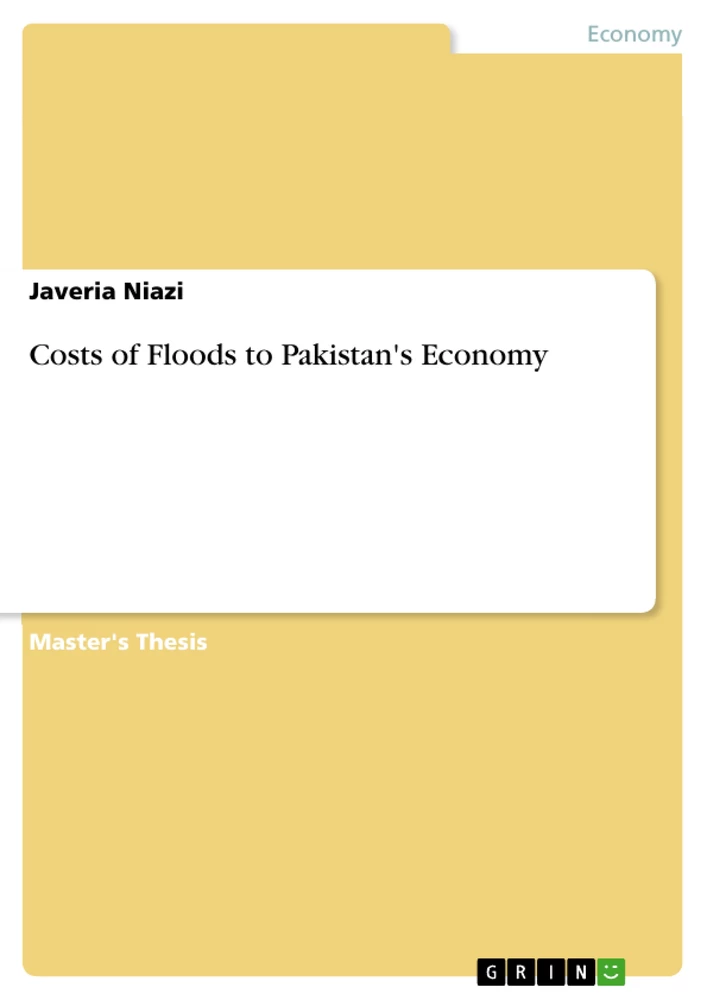
Table of Contents
Chapter 1: Introduction
Chapter 2: Literature Review
Chapter 3: Theoretical Framework and Empirical Results
Chapter 4: Simulation of the Model
Chapter 5: Conclusion and Policy Recommendation
Thesis Objective & Scope
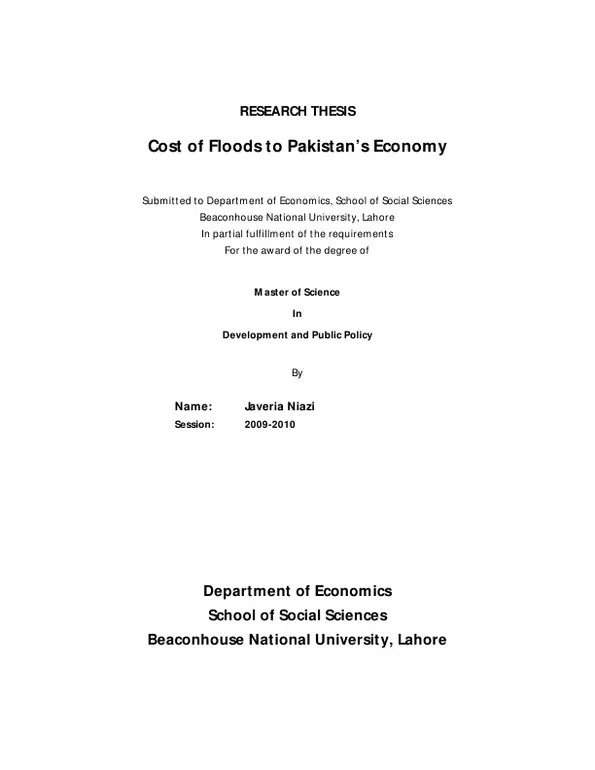
This thesis investigates the macroeconomic impact of the 2010 floods in Pakistan by quantifying both direct and indirect effects on key economic sectors. By employing a structural simultaneous equation model, the research aims to estimate output losses and forecast the economic outlook, ultimately informing policy recommendations for future disaster management.
- Review of global literature on the economic consequences of natural disasters.
- Development of a supply-side macroeconomic model to capture sectoral interdependencies.
- Estimation of production losses across agriculture, manufacturing, and services sectors.
- Simulation of various economic scenarios for fiscal years 2010-11 and 2011-12.
- Formulation of evidence-based policy strategies for disaster risk mitigation and economic recovery.
Excerpt from the Book
1.3 How it all Began
Beginning of the monsoon season is the most looked forward time as it brings the much needed rain to the arid region of Pakistan. But in 2010 we saw the highest recorded rainfall in a decade; submerging vast areas and causing people to evacuate these areas. The heavy rainfall began and continued for days in the regions of Balochistan followed closely by a second spell of heavy monsoon rains over Khyber Pakhtunkhwa, which commenced in the last week of July 2010 and persisted up till first few days of August. Khyber-Pakhtunkhwa (KPK); flooding the cities of Peshawar, Nowshera, Swat, Charsada, etc. and cutting off these areas from the rest of the province and closing all routes towards the flood affected areas.
These rains generated unmatched flood flows in the major as well as secondary and tertiary rivers, including the nullahs in KPK, Punjab and then Sindh. The local rivers and nullahs in Baluchistan also saw extraordinary floods. The river Indus, at some of the control points in Punjab and Sindh, along with River Swat, Panjkora and Kabul experienced historic flood flows.
The heavy rainfall caused the river banks to burst, flooding the low regions and those nearer to the banks. Many houses, schools, roads were either severely damaged or destroyed leaving the people without food, shelter and medical attention. With half the province of KPK under water barely surviving the blow from the natural disaster, the rainfall then hit Punjab and affected the Indus River Basin.
Summary of Chapters
Chapter 1: Introduction: Provides an overview of the 2010 flood catastrophe in Pakistan, detailing the regional impact and providing initial damage statistics while establishing the research aims.
Chapter 2: Literature Review: Synthesizes existing global research on the direct and indirect macroeconomic consequences of natural disasters and their effects on long-term growth and poverty.
Chapter 3: Theoretical Framework and Empirical Results: Introduces a formal structural model containing behavioral equations and identities to analyze sector-specific impacts and the overall influence on GDP.
Chapter 4: Simulation of the Model: Presents the results of various simulations run on E-views to forecast economic outcomes based on differing scenarios of loss and recovery.
Chapter 5: Conclusion and Policy Recommendation: Summarizes the findings regarding production losses and offers specific policy measures for enhancing disaster preparedness, risk management, and economic reconstruction.
Keywords
Pakistan, 2010 Floods, Macroeconomic Impact, GDP Growth, Structural Equation Model, Disaster Management, Agricultural Sector, Manufacturing Sector, Services Sector, Economic Recovery, Supply Side Model, Infrastructure Damage, Policy Recommendations, Reconstruction Costs, Economic Growth Rates
Frequently Asked Questions
What is the primary focus of this research?
The research focuses on assessing the macroeconomic impact of the 2010 floods in Pakistan, specifically analyzing how the disaster affected different sectors of the economy and the resulting impact on overall GDP.
What are the central themes discussed in this thesis?
The central themes include the history of natural disasters in Pakistan, the linkage between agricultural production and the wider economy, sectoral damage assessment, and the use of economic modeling to simulate growth scenarios.
What is the main objective or research question?
The primary objective is to quantify the cost of the floods to Pakistan's economy in terms of lost output and to provide a structural framework that traces indirect and secondary effects on the industrial and service sectors.
Which scientific methods are utilized?
The study utilizes a structural simultaneous equation model (a supply-side model) to capture interactions between sectors, alongside data analysis from the Economic Survey of Pakistan and simulations performed via E-views.
What content is covered in the main body of the work?
The main body covers the history of Pakistani disasters, a review of international literature on disaster economics, the specification of the economic model, results of simulations under different scenarios, and specific policy recommendations for disaster mitigation.
Which keywords characterize this study?
Key terms include Pakistan, 2010 Floods, GDP Growth, Macroeconomic Impact, Structural Equation Model, and Disaster Risk Management.
How does the author quantify the loss in the agricultural sector?
The author estimates the loss by examining the percentage of total cropped area affected (approximately 9%) and projecting a 5% net impact on the agricultural sector's value-added growth for the 2010-11 fiscal year.
What role do the 'identities' play in the model presented in Chapter 3?
The identities define the accounting relationships within the economy, such as the total GDP being the sum of the value-added contributions from the agricultural, manufacturing, and services sectors.
Ende der Leseprobe aus 58 Seiten
- nach oben
- Arbeit zitieren
- Javeria Niazi (Autor:in), 2010, Costs of Floods to Pakistan's Economy, München, Page::Imprint:: GRINVerlagOHG, https://www.diplomarbeiten24.de/document/198996

neugierig - aktuell - relevant
Entdecken Sie hilfreiche Tipps und Tricks rund ums Studium!

Entdecken Sie hilfreiche Tipps und Tricks rund ums Studium!
Ihre Hausarbeit / Abschlussarbeit:

- - Publikation als E-Book und Buch
- - Hohes Honorar auf die Verkäufe
- - Für Sie komplett kostenlos - mit ISBN
- - Es dauert nur 5 Minuten
- - Jede Arbeit findet Leser

- © GRIN Publishing GmbH.
- Alle Inhalte urheberrechtlich geschützt. Kopieren und verbreiten untersagt.
- info@grin.com
- AGB
- Open Publishing
Der GRIN Verlag hat sich seit 1998 auf die Veröffentlichung akademischer eBooks und Bücher spezialisiert. Der GRIN Verlag steht damit als erstes Unternehmen für User Generated Quality Content. Die Verlagsseiten GRIN.com, Hausarbeiten.de und Diplomarbeiten24 bieten für Hochschullehrer, Absolventen und Studenten die ideale Plattform, wissenschaftliche Texte wie Hausarbeiten, Referate, Bachelorarbeiten, Masterarbeiten, Diplomarbeiten, Dissertationen und wissenschaftliche Aufsätze einem breiten Publikum zu präsentieren.
Kostenfreie Veröffentlichung: Hausarbeit, Bachelorarbeit, Diplomarbeit, Dissertation, Masterarbeit, Interpretation oder Referat jetzt veröffentlichen!
Folgen Sie GRIN auf


- GRIN Verlag GmbH
-
- Nymphenburger Str. 86
- 80636
- Munich, Deutschland
- +49 89-550559-0
- +49 89-550559-10
- info@grin.com
-
