
präsentiert von

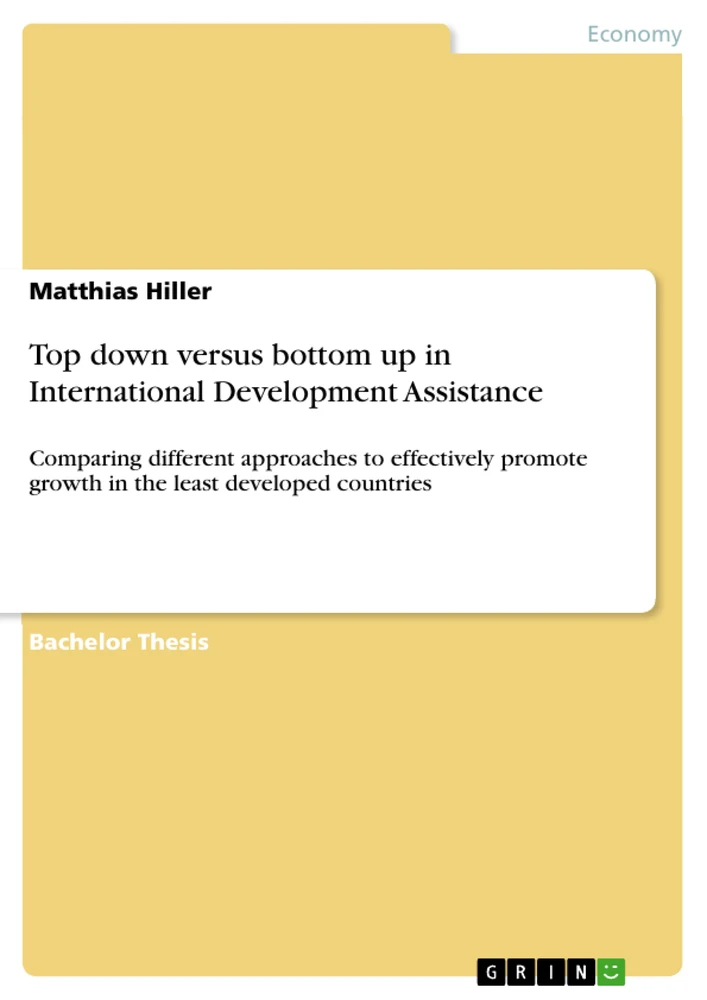
Table of Contents
1. Introduction
2. Top-down approach
2.1 Structural Adjustment Program and its demise
2.2 The Paris Declaration and the rise of Poverty Reduction Strategy Papers
3. Bottom-up approach
3.1 Participation in development assistance
3.2 One Dollar a week – discussing the income transfer
4. Top-down vs. bottom-up – fusing the findings
5. Outlook
Objectives and Core Topics
This thesis examines the fundamental debate in international development assistance between top-down and bottom-up approaches. The research investigates whether macroeconomic top-down models, such as the Structural Adjustment Program, or bottom-up measures, like participatory programs and cash transfers, are more effective in fostering sustainable economic growth and welfare in Least Developed Countries.
- Comparison of top-down versus bottom-up development strategies
- Evaluation of the Structural Adjustment Program (SAP) and its transition to Poverty Reduction Strategy Papers (PRSP)
- Analysis of participatory approaches in development assistance
- Critical assessment of conditional and unconditional cash transfers as bottom-up tools
Excerpt from the Book
3.1 Participation in development assistance
The participatory approach evolved almost simultaneously with development aid in the early 60s of the past century. Its role, however, has changed throughout these decades. No doubt, its height in importance has just been reached. Participation is an omnipresent term in debates on development assistance and treated as an ultima ratio. This fact is exemplified by the recommendation of the University of Washington Taskforce 2009 to the US government to focus on participation in development assistance.
The definitions of participation vary by the extent to which the primary stakeholders are included. This ranges from the simple voluntary work for the extrinsically installed project to an active dialogue throughout the entire preparation and implementation process of a project. To qualify for the bottom-up typical “self-help” and “self-reliance”, this Thesis dismisses a too wide idea of participation. Not uncommonly, participation is misused as a “cosmetic label” to disguise top-down concepts as more recipient-friendly.
Participation’s most elemental advantage is the use of local knowledge. Incorporating the beneficiaries is likely to indicate possible problems of a development project in advance and decrease the chance of failure. Avoiding mistakes and implementing more promising solution saves costs. Also the success rate rises due to the higher commitment of the participants. As Stiglitz (2002), a former chief economist of the World Bank, argues, outside programs lacking participation of the people the assistance is directed to are more prone to be met with resentment. Groups involved in processes that possibly led to adverse effects will instead bear these, as the unfavorable outcome is in part their product.
Summary of Chapters
1. Introduction: Presents the research scope, setting the stage for the contrast between top-down and bottom-up development strategies in Least Developed Countries.
2. Top-down approach: Explores macroeconomic growth models and the historical implementation and subsequent criticism of the Structural Adjustment Program (SAP) by the IMF.
2.1 Structural Adjustment Program and its demise: Details the economic rationale behind SAPs and why their focus on liberalization and austerity led to a shift towards Poverty Reduction Strategy Papers.
2.2 The Paris Declaration and the rise of Poverty Reduction Strategy Papers: Discusses the paradigm shift toward country ownership and partnership within the framework of the Paris Declaration.
3. Bottom-up approach: Shifts the focus to participatory development, examining the shift from donor-led planning to stakeholder-driven initiatives.
3.1 Participation in development assistance: Analyzes the strengths and limitations of involving local populations and the practical challenges of implementing participatory democracy.
3.2 One Dollar a week – discussing the income transfer: Examines the effectiveness and feasibility of cash transfers as a direct, bottom-up method for poverty alleviation.
4. Top-down vs. bottom-up – fusing the findings: Synthesizes the arguments from previous chapters to evaluate which approach is superior for long-term growth.
5. Outlook: Concludes that a balanced mix of structural frameworks and direct, bottom-up assistance is the most promising path forward.
Keywords
International development, Top-down approach, Bottom-up approach, Structural Adjustment Program, Poverty Reduction Strategy Papers, Participation, Cash transfers, Economic growth, Least Developed Countries, Foreign aid, Economic policy, Macroeconomics, Poverty alleviation, Aid effectiveness, Sustainability.
Frequently Asked Questions
What is the core subject of this thesis?
The thesis explores the tension between top-down development strategies—traditionally managed by institutions like the IMF—and bottom-up strategies that emphasize local participation and individual empowerment.
What are the primary thematic fields covered?
Key fields include macroeconomic policy, the evolution of international aid institutions, the role of participation in development projects, and the economic impact of direct cash transfers.
What is the central research question?
The work seeks to determine which development approach—top-down or bottom-up—is more effective in enabling Least Developed Countries to overcome poverty traps and achieve sustainable economic growth.
Which methodology is applied?
The research uses a qualitative analysis of economic models and development programs, comparing historical outcomes of top-down measures against the theoretical and empirical benefits of bottom-up interventions.
What content is discussed in the main body?
The main body traces the history of the Structural Adjustment Program, the transition to Poverty Reduction Strategy Papers, the philosophy behind participatory development, and a detailed comparison between conditional and unconditional cash transfers.
Which keywords best characterize this work?
The work is best defined by terms such as development aid, economic growth models, participatory approach, cash transfers, and aid effectiveness.
How does the author evaluate the "Structural Adjustment Program" (SAP)?
The author identifies that while SAPs were built on neoclassical economic foundations, they were often criticized for ignoring local context, undermining national sovereignty, and failing to deliver the expected poverty reduction.
What is the author's stance on "cash transfers" as a bottom-up tool?
Cash transfers are viewed as a highly promising bottom-up mechanism that respects recipient autonomy, although the author notes that they must be implemented carefully to avoid inflation and address the lack of infrastructure.
Ende der Leseprobe aus 38 Seiten
- nach oben
- Arbeit zitieren
- Matthias Hiller (Autor:in), 2010, Top down versus bottom up in International Development Assistance, München, Page::Imprint:: GRINVerlagOHG, https://www.diplomarbeiten24.de/document/200183

neugierig - aktuell - relevant
Entdecken Sie hilfreiche Tipps und Tricks rund ums Studium!

Entdecken Sie hilfreiche Tipps und Tricks rund ums Studium!
Ihre Hausarbeit / Abschlussarbeit:

- - Publikation als E-Book und Buch
- - Hohes Honorar auf die Verkäufe
- - Für Sie komplett kostenlos - mit ISBN
- - Es dauert nur 5 Minuten
- - Jede Arbeit findet Leser

- © GRIN Publishing GmbH.
- Alle Inhalte urheberrechtlich geschützt. Kopieren und verbreiten untersagt.
- info@grin.com
- AGB
- Open Publishing
Der GRIN Verlag hat sich seit 1998 auf die Veröffentlichung akademischer eBooks und Bücher spezialisiert. Der GRIN Verlag steht damit als erstes Unternehmen für User Generated Quality Content. Die Verlagsseiten GRIN.com, Hausarbeiten.de und Diplomarbeiten24 bieten für Hochschullehrer, Absolventen und Studenten die ideale Plattform, wissenschaftliche Texte wie Hausarbeiten, Referate, Bachelorarbeiten, Masterarbeiten, Diplomarbeiten, Dissertationen und wissenschaftliche Aufsätze einem breiten Publikum zu präsentieren.
Kostenfreie Veröffentlichung: Hausarbeit, Bachelorarbeit, Diplomarbeit, Dissertation, Masterarbeit, Interpretation oder Referat jetzt veröffentlichen!
Folgen Sie GRIN auf


- GRIN Verlag GmbH
-
- Nymphenburger Str. 86
- 80636
- Munich, Deutschland
- +49 89-550559-0
- +49 89-550559-10
- info@grin.com
-
