
präsentiert von

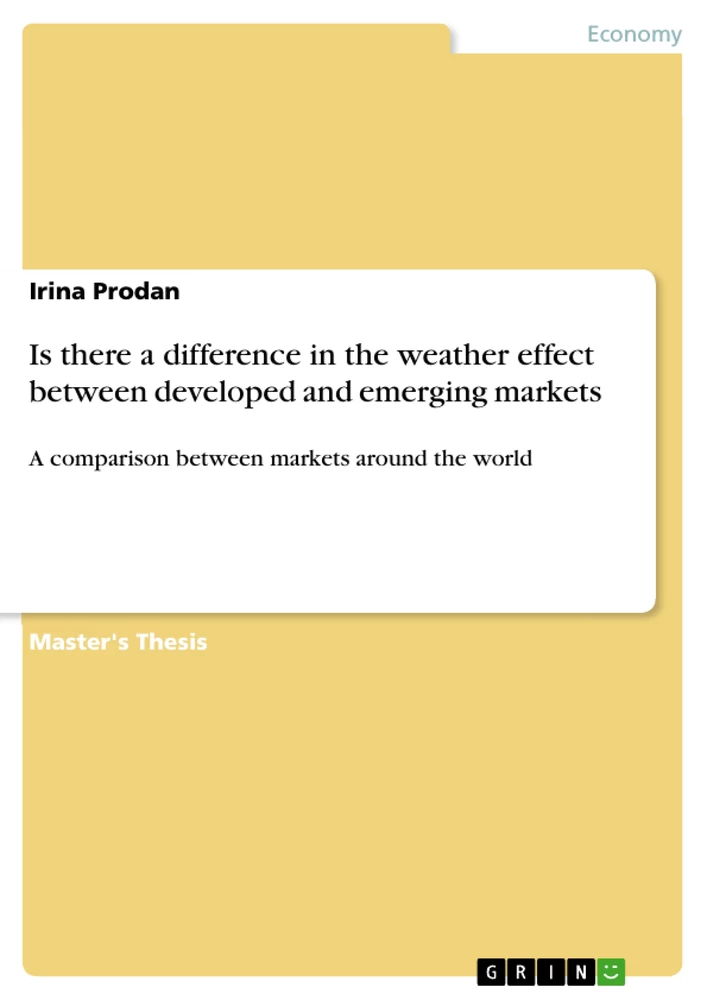
Table of Contents
1. Introduction
2. Literature review
2.1. Weather, mood and decision making behavior
2.2. Weather and the stock market
2.3. Two decades of weather effect literature: a lack of consensus
3. Data description
3.1. Data collection
3.2. Data analysis
4. Methodology and results
4.1. City-by-city tests
4.2. Joint tests
4.2.1. Pooled least squares regression
4.2.2. Binary regression
5. Robustness check
5.1. City-by-city tests
5.2. Joint tests
5.2.1. Pooled least squares regression
5.2.2. Binary regression
6. Potential explanations
7. Conclusion
8. References
9. Appendix
Research Objectives and Themes
This paper aims to investigate the "weather effect" on stock market returns by testing whether stock prices are influenced differently in developed versus emerging markets and how this phenomenon changes over time, potentially explaining the existing lack of consensus in financial literature.
- Analysis of the relationship between meteorological variables and stock market returns.
- Comparative study of 10 developed and 10 emerging countries between 1996 and 2011.
- Examination of market efficiency and the role of irrational investors.
- Evaluation of the "weather effect" evolution and its potential cyclical patterns.
Excerpt from the Book
1. Introduction
Advocates of the efficient market hypothesis argue that security markets are rational and that prices on these markets reflect the underlying economic fundamentals (Fama, 1970). Nevertheless, numerous market anomalies came to light over the past decades. A prominent complementary paradigm is that investors’ trading behavior is shaped by psychological influences which are considered irrational. Shiller (2003) argues that this division of the financial literature - behavioral finance - is one of the most vital research areas.
One renowned and frequently researched anomaly over the last two decades, especially in the last years, is the weather effect. This can be defined as the effect that weather, measured using a variety of quantitative meteorological variables, has on the stock market returns. As argued by behavioral finance, economic agents have bounded rationality, allowing subjective factors to influence their decision making process. The weather effect is a pertaining component of this theory that can be placed within the psychology block of behavioral economics (Barberis and Thaler, 2003).
The extensive literature upon the weather effect has led to conflicting results. Starting with Saunders (1993), a considerable number of studies have found evidence supporting the impact that weather has on investors’ mood and consequently on stock market activity. Further investigation and a variety of methodological approaches have revealed a lack of results consistency. The weather effect has been discovered to exist in many countries – United States, Taiwan, Thailand, Finland, but critics followed as well. Most opponent papers are in favor of a weak form of efficient market and claim that the existence of the weather effect is merely a result of inaccurate data definition, discontinuous records and data mining.
Summary of Chapters
1. Introduction: Presents the research background on market anomalies, defines the "weather effect" within behavioral finance, and outlines the study's objective to compare this effect across market development levels.
2. Literature review: Explores psychology-based links between weather and mood, and discusses financial studies connecting weather to investor behavior and stock returns, highlighting the prevailing lack of consensus.
3. Data description: Details the collection of daily stock indices and meteorological data for 20 countries, and outlines the statistical methods used to prepare the variables for empirical analysis.
4. Methodology and results: Employs individual, pooled, and binary regressions to assess the influence of weather on returns, accounting for calendar effects and market efficiency.
5. Robustness check: Re-evaluates the findings using alternative seasonal adjustment methods to ensure the validity and consistency of the primary results.
6. Potential explanations: Discusses the findings, suggesting that the weather effect is minimal, cyclical, and diminishes over time due to increasing market efficiency and the decline of irrational noise traders after the Internet bubble.
7. Conclusion: Summarizes the study’s findings, reaffirming the lack of a robust, systematic difference in the weather effect between developed and emerging markets and the overall weakening of this effect over the analyzed period.
8. References: Compiles the academic literature cited throughout the study.
9. Appendix: Provides supplementary tables and detailed information regarding the literature overview and country-specific data indices.
Keywords
Behavioral finance, weather effect, stock market returns, developed markets, emerging markets, market efficiency, volatility, irrational investors, Internet bubble, seasonal adjustment, psychological influences, stock index, regression analysis, financial anomalies, market segmentation.
Frequently Asked Questions
What is the core subject of this research paper?
The research examines the "weather effect," specifically the impact that various meteorological variables have on stock market returns across different countries.
What are the central thematic fields covered?
The paper bridges behavioral finance, market efficiency, and empirical econometrics to analyze investor behavior, mood, and their subsequent impact on stock market dynamics.
What is the primary goal of the study?
The main objective is to determine if the weather effect manifests differently in emerging versus developed markets and to investigate if this effect has evolved or diminished over the period 1996-2011.
Which scientific methodology is employed?
The researchers use individual, pooled, and binary (logit) regressions, incorporating seasonal adjustment, dummy variables for calendar effects, and robustness checks with different methods of deseasonalization.
What topics are discussed in the main body?
The main body focuses on existing literature, the collection and analysis of meteorological and financial data, empirical results from various regression models, and discussions on market efficiency and psychological factors.
Which keywords characterize this paper?
Key terms include behavioral finance, weather effect, stock market returns, market efficiency, emerging markets, and irrational investors.
Why is the year 2001 considered a turning point in this study?
The researchers identify 2001 as a structural break point corresponding to the post-Internet bubble period, where the number of irrational noise traders decreased, leading to a decline in the weather effect's significance.
Is there a significant difference in how weather affects developed and emerging markets?
No. The study finds no systematic evidence of a significant difference in the weather effect between the two types of markets; both show that the impact is minimal and tends to fade over time.
Ende der Leseprobe aus 51 Seiten
- nach oben
- Arbeit zitieren
- Irina Prodan (Autor:in), 2012, Is there a difference in the weather effect between developed and emerging markets, München, Page::Imprint:: GRINVerlagOHG, https://www.diplomarbeiten24.de/document/200409

neugierig - aktuell - relevant
Entdecken Sie hilfreiche Tipps und Tricks rund ums Studium!

Entdecken Sie hilfreiche Tipps und Tricks rund ums Studium!
Ihre Hausarbeit / Abschlussarbeit:

- - Publikation als E-Book und Buch
- - Hohes Honorar auf die Verkäufe
- - Für Sie komplett kostenlos - mit ISBN
- - Es dauert nur 5 Minuten
- - Jede Arbeit findet Leser

- © GRIN Publishing GmbH.
- Alle Inhalte urheberrechtlich geschützt. Kopieren und verbreiten untersagt.
- info@grin.com
- AGB
- Open Publishing
Der GRIN Verlag hat sich seit 1998 auf die Veröffentlichung akademischer eBooks und Bücher spezialisiert. Der GRIN Verlag steht damit als erstes Unternehmen für User Generated Quality Content. Die Verlagsseiten GRIN.com, Hausarbeiten.de und Diplomarbeiten24 bieten für Hochschullehrer, Absolventen und Studenten die ideale Plattform, wissenschaftliche Texte wie Hausarbeiten, Referate, Bachelorarbeiten, Masterarbeiten, Diplomarbeiten, Dissertationen und wissenschaftliche Aufsätze einem breiten Publikum zu präsentieren.
Kostenfreie Veröffentlichung: Hausarbeit, Bachelorarbeit, Diplomarbeit, Dissertation, Masterarbeit, Interpretation oder Referat jetzt veröffentlichen!
Folgen Sie GRIN auf


- GRIN Verlag GmbH
-
- Nymphenburger Str. 86
- 80636
- Munich, Deutschland
- +49 89-550559-0
- +49 89-550559-10
- info@grin.com
-
