
präsentiert von

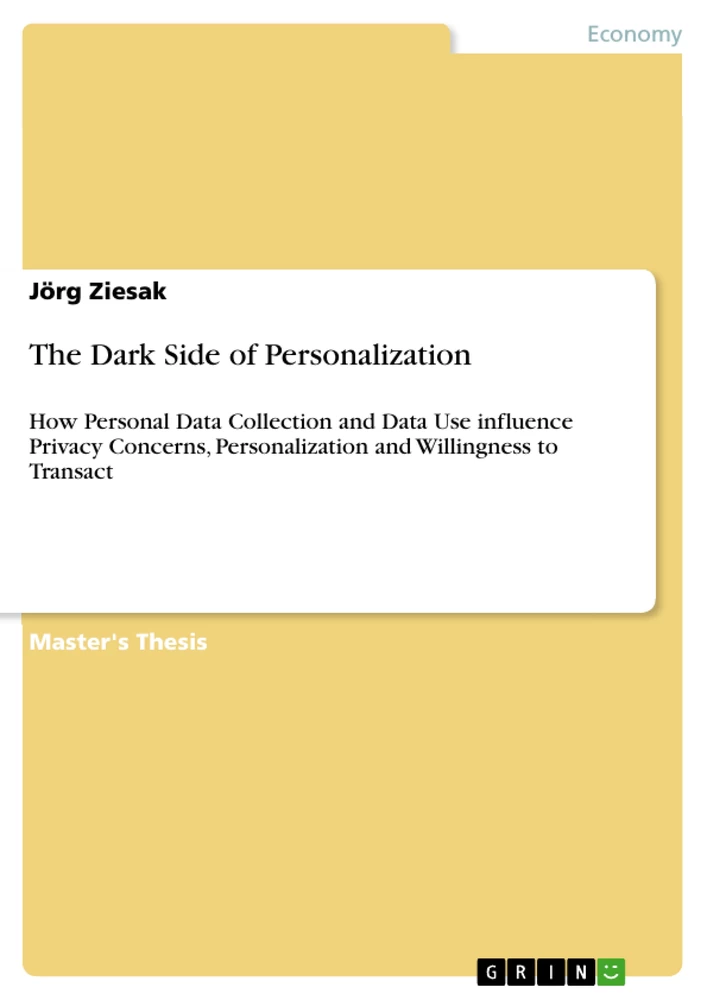
Table of Contents
1 Introduction
2 Literature Background
2.1 Personalization vs. Customization
2.2 Personalization in an Online Marketing Environment
3 Conceptual Framework and Hypotheses
3.1 Privacy Concerns and CFIP
3.2 Control of Personal Data and CFIP
3.3 Data Gathering Method – Overt and Covert Approach
3.4 Use of Data – Authorized Primary Use or Unauthorized Secondary Use
3.5 Willingness to Transact
3.6 Customers’ Value of Online Personalization
3.7 Risk Beliefs of Online Personalization
3.8 Perceived Usefulness of Online Personalization
3.9 Moderating Role of Trust Beliefs between Use of Data and CFIP
4 Research Design
4.1 Data Collection Process
4.2 Sample Description
4.3 Questionnaire Design
4.4 Measures
4.5 Scale Validity and Reliability
4.6 Data Analysis and Results
4.7 Model Evaluation
4.8 Main Effects and Path Coefficients
4.9 Indirect Effects
4.10 Moderation Analysis
5 Discussion and Conclusion
5.1 Theoretical Implications
5.2 Managerial Implications
5.3 Limitations and Future Research
Research Objectives & Key Topics
This study investigates the complex relationship between online personalization and consumer privacy by examining how different data collection methods and usage purposes affect users' concerns, their perceptions of risk and value, and their ultimate willingness to conduct transactions online.
- The impact of overt versus covert data collection on privacy concerns.
- The effect of authorized primary versus unauthorized secondary data use.
- The role of the "privacy calculus" (risk-value analysis) in user decision-making.
- Influences on perceived usefulness and customer value regarding personalization.
- The moderation role of trust in the online merchant.
Excerpt from the Book
3.3 Data Gathering Method – Overt and Covert Approach
Nowadays, the use of customer information is one of the most important success factors in e-business. Nevertheless, the challenge of accumulating these knowledge data in a way customers feel comfortable with is still prevalent (Awad & Krishnan, 2006). Personal information can be gathered in two methods: overt and covert, so with and without the knowledge of the user. Montgomery et al. (2009) defines this overt/covert approach as active (to inform him or to post direct questions to the consumer) and passive (to make inferences based on transaction, clickstream or e-mail data) learning about customers. The type of data gathering has a direct connection to the control of personal information data. Knowledge that a website is collecting information about users for personalization – so an overt approach – therefore is an elementary prerequisite for control. Contrariwise, if users do not know about the fact that data about them is being collected, users have no control of it.
Research that included an overt vs. covert approach in combination with online personalization has been very limited. Xu et al. (2009) analyzed in a study on personalized mobile marketing how covert or overt personalization influence the perceived benefits and risks of information disclosure. They find that personalization increases the perceived value of information disclosure through both collecting methods and that perceived risk [value] has a negative [positive] impact on the value of information disclosure. Most striking is that personalization is only positively related to perceived risk of information disclosure when the data is gathered covertly, because there was no significant increase in perceived risk in an overt state.
Summary of Chapters
1 Introduction: Provides an overview of the growing conflict between the benefits of online personalization for marketers and the rising privacy concerns among consumers.
2 Literature Background: Distinguishes between personalization and customization, and establishes the context of data collection in online marketing environments.
3 Conceptual Framework and Hypotheses: Develops the research model, focusing on CFIP (Concerns for Information Privacy), data collection methods, and the psychological factors influencing the willingness to transact.
4 Research Design: Describes the online survey methodology, sample characteristics (Amazon Mechanical Turk), and the structural equation modeling (SEM) approach used to test the hypotheses.
5 Discussion and Conclusion: Interprets the empirical findings, highlights the theoretical and managerial implications, and identifies limitations alongside avenues for future research.
Keywords
Personalization, Privacy Concerns, Online Data Collection, Unauthorized Secondary Use, Willingness to Transact, CFIP, Risk Beliefs, Perceived Usefulness, Customer Value, Dataveillance, Privacy Calculus, Trust Beliefs, Online Marketing, Information Privacy, Consumer Behavior.
Frequently Asked Questions
What is the primary focus of this research?
The research explores the "dark side" of online personalization, specifically how data collection and usage practices influence consumer privacy concerns and their subsequent willingness to engage in online transactions.
What are the central themes discussed in this paper?
Key themes include the distinction between overt and covert data gathering, the difference between primary and secondary data use, and how these factors impact a user's perceived risk, value, and willingness to share personal information.
What is the core research question or objective?
The study aims to determine the effects of various data collection and usage methods on consumer privacy concerns, and whether these concerns trigger a risk-value analysis that ultimately influences the user's decision to transact.
Which scientific methods were employed?
The author developed a conceptual framework and tested it empirically through an online survey with 162 participants recruited via Amazon Mechanical Turk, followed by a structural equation modeling (SEM) analysis.
What is covered in the main body of the work?
The main body covers the literature review on personalization, the formation of the conceptual model and hypotheses, the detailed research design including questionnaire structure, and a comprehensive analysis of the results and implications.
Which keywords best describe this study?
The study is characterized by terms such as personalization, privacy concerns, online data collection, unauthorized secondary use, willingness to transact, and the privacy calculus.
How does the overt vs. covert approach influence privacy concerns?
Surprisingly, the study found that privacy concerns were lower when data was collected covertly and higher when consumers were explicitly informed about the collection process, challenging the common assumption that transparency always reduces concerns.
Does trust in an online merchant mitigate the impact of secondary data use?
No, the study results indicate that trust beliefs do not significantly moderate the relationship between unauthorized secondary data use and concerns for information privacy; users remain concerned even if they trust the merchant.
What role does the risk-value analysis play in the findings?
The risk-value analysis, or "privacy calculus," determines the willingness to transact. If users perceive personalization as useful and valuable, they are more willing to transact, but this is mediated by their risk beliefs and privacy concerns.
Ende der Leseprobe aus 58 Seiten
- nach oben
- Arbeit zitieren
- Jörg Ziesak (Autor:in), 2012, The Dark Side of Personalization, München, Page::Imprint:: GRINVerlagOHG, https://www.diplomarbeiten24.de/document/201663

neugierig - aktuell - relevant
Entdecken Sie hilfreiche Tipps und Tricks rund ums Studium!

Entdecken Sie hilfreiche Tipps und Tricks rund ums Studium!
Ihre Hausarbeit / Abschlussarbeit:

- - Publikation als E-Book und Buch
- - Hohes Honorar auf die Verkäufe
- - Für Sie komplett kostenlos - mit ISBN
- - Es dauert nur 5 Minuten
- - Jede Arbeit findet Leser

- © GRIN Publishing GmbH.
- Alle Inhalte urheberrechtlich geschützt. Kopieren und verbreiten untersagt.
- info@grin.com
- AGB
- Open Publishing
Der GRIN Verlag hat sich seit 1998 auf die Veröffentlichung akademischer eBooks und Bücher spezialisiert. Der GRIN Verlag steht damit als erstes Unternehmen für User Generated Quality Content. Die Verlagsseiten GRIN.com, Hausarbeiten.de und Diplomarbeiten24 bieten für Hochschullehrer, Absolventen und Studenten die ideale Plattform, wissenschaftliche Texte wie Hausarbeiten, Referate, Bachelorarbeiten, Masterarbeiten, Diplomarbeiten, Dissertationen und wissenschaftliche Aufsätze einem breiten Publikum zu präsentieren.
Kostenfreie Veröffentlichung: Hausarbeit, Bachelorarbeit, Diplomarbeit, Dissertation, Masterarbeit, Interpretation oder Referat jetzt veröffentlichen!
Folgen Sie GRIN auf


- GRIN Verlag GmbH
-
- Nymphenburger Str. 86
- 80636
- Munich, Deutschland
- +49 89-550559-0
- +49 89-550559-10
- info@grin.com
-
