
präsentiert von

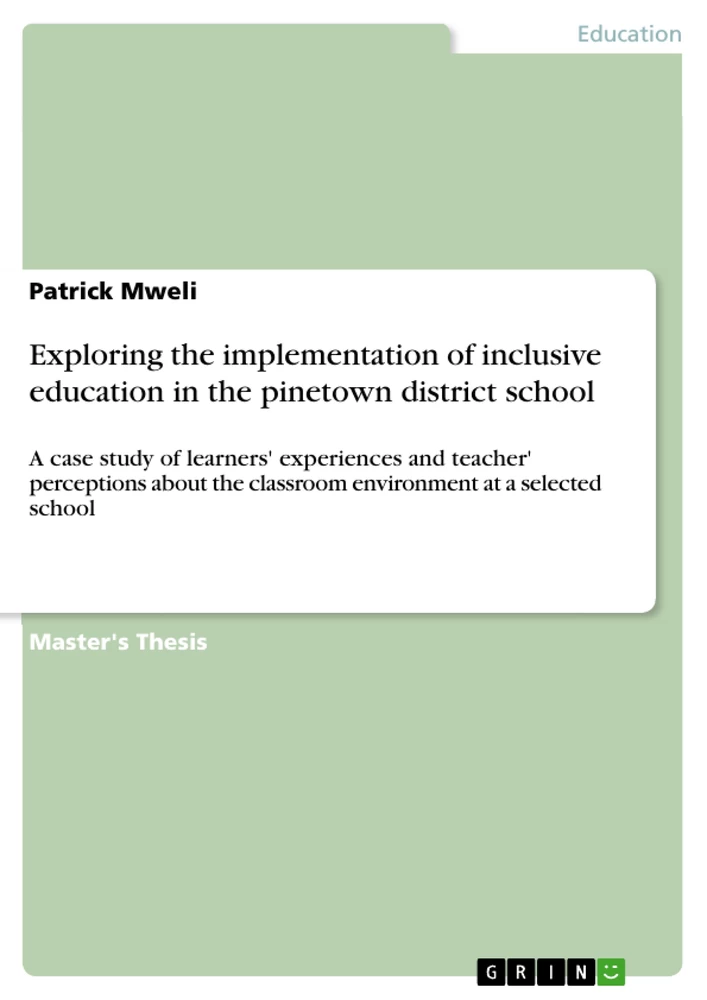
Table of Contents
Chapter 1: Background to the study
1.1. Rationale of the study
1.2. Problem statement
1.3. What the thesis presents
1.3.1. Learners’ experiences within the classroom
1.3.2. Teachers’ role in facilitating inclusion
1.3.3. Relationship between learning and development
1.4. Focus and purpose of the study
1.5. Key research questions
1.6. Arrangement of the chapters
Chapter 2: Research findings underpinning the study
2.1. Introduction
2.2. Inclusion
2.3. Learning experiences
2.4. Learning environments
2.5. Inclusive education
2.6. Parental involvement in inclusive education
2.7. Conclusion
Chapter 3
Section A: Conceptual and Theoretical considerations
3.1. Introduction
3.2. Inclusion within the classroom
3.3. Asset-Based theory within Social Constructivism
Section B: Research design and Methodology
3.4. Research methodology
3.5. Research design
3.5.1. Research field
3.5.2. Participants
3.5.3. Data collection techniques
3.5.3.1. Focus group interviews
3.5.3.2. Semi-structured interviews
3.5.4. Process of data analysis
3.5.5. Trustworthiness
3.5.6. Ethical consideration
3.6. Conclusion
Chapter 4: Findings
4.1. Introduction
4.2. Social interaction within the classroom context
4.3. Learners’ classroom experiences
4.3.1. Interaction and relationships amongst learners
4.3.2. Learners account of their experiences during the learning process
4.3.2.1. Inequalities within the classroom
4.3.2.2. Learner support during the learning process
4.4. Capacity development for teachers and learning resources
4.5. Conclusion
Chapter 5: Conclusion and Recommendations
5.1. Conclusion
5.2. Recommendations
Research Objectives & Topics
This study explores the implementation of inclusive education in Pinetown district schools by analyzing learners' classroom experiences and teachers' perceptions of the learning environment to determine how effectively inclusive practices are integrated into daily school life.
- Implementation of inclusive education in the South African context.
- Learners’ lived experiences and feelings of belonging within the classroom.
- Teachers’ perceptions, attitudes, and the impact of their pedagogical practices.
- The role of the classroom environment in supporting or hindering inclusive learning.
- Vygotsky’s Zone of Proximal Development (ZPD) and Asset-Based theory as analytical frameworks.
Excerpt from the Book
1.2. Problem Statement
Large numbers of learners who experience learning difficulties and experiencing disability are included and are being accommodated in classrooms, hence, the context in which learning and teaching takes place requires a considerable change to cater for learners’ diverse needs within the classroom. Lomofsky, Roberts, and Mvambi, (1999) alluded to the above idea when stating that teaching has become more demanding and challenging to educators. This refers to the way the classroom environment is organized to include learners who have been marginalized by the previous education apartheid system.
How teachers deal with the situation and how they view the classroom context is a matter of concern in this study. The reason for such a concern is that, as stated by Green, Forrester, Mvambi, Janse Van Vuuren, and du Toit, (1999) teachers are the ones who make learning possible. Teachers are the implementers of the curriculum in the classroom. Their practice impacts on the experiences learners have of the classroom environment. In other words the exploration of learners’ experiences in this study will in turn give us an understanding of how teachers implement inclusive curriculum in the classroom and how teachers themselves view their practice within the classroom.
Summary of Chapters
Chapter 1: Background to the study: This chapter introduces the study's rationale and problem statement, emphasizing the challenges of transitioning to an inclusive education system in post-apartheid South Africa.
Chapter 2: Research findings underpinning the study: An examination of existing literature regarding inclusion, learning environments, and the critical roles and attitudes of teachers in facilitating inclusive classrooms.
Chapter 3: This chapter outlines the conceptual framework, utilizing Vygotsky’s Zone of Proximal Development and Asset-Based theory, alongside a detailed methodology involving qualitative case studies.
Chapter 4: Findings: A discussion of the data gathered from learner focus groups and teacher interviews, analyzing the classroom realities, social interactions, and capacity development needs.
Chapter 5: Conclusion and Recommendations: A final synthesis of the findings, concluding that inclusive principles are not yet fully implemented and offering recommendations for in-depth teacher training and support services.
Keywords
Inclusive education, classroom environment, South Africa, learners' experiences, teachers' perceptions, Vygotsky, Zone of Proximal Development, Asset-Based theory, pedagogical practices, social constructivism, educational psychology, barriers to learning, teacher training, curriculum implementation, qualitative research.
Frequently Asked Questions
What is the primary focus of this research study?
The research explores the practical implementation of inclusive education within a selected school in the Pinetown district by examining the nexus between learners' classroom experiences and teachers' professional perceptions.
What are the central themes investigated?
Key themes include the impact of classroom design on learning, the role of teacher attitudes, the influence of peer interaction, and the challenges of adapting to an inclusive curriculum after the apartheid era.
What is the research goal?
The study aims to contribute to the successful implementation of inclusive education in South Africa by revealing the current barriers that prevent learners from achieving their full potential in inclusive classrooms.
Which scientific methodology is applied?
The research employs a qualitative case study approach, utilizing focus group interviews with learners and semi-structured interviews with teachers to gather in-depth, descriptive data.
What does the main body of the work cover?
The main chapters review literature on inclusion, establish theoretical frameworks (Social Constructivism and Asset-Based theory), detail the qualitative research design, and discuss the findings from participant interviews.
Which keywords characterize this work?
The work is characterized by terms such as Inclusive Education, Zone of Proximal Development (ZPD), classroom environment, teacher capacity development, and pedagogical mediation.
How does Vygotsky’s theory relate to this study?
Vygotsky's Zone of Proximal Development is used as a lens to understand how teachers mediate learning and how learners move from assisted tasks to independent competence within an inclusive setting.
What is the significance of the Asset-Based theory mentioned?
The Asset-Based approach is used to encourage teachers to move away from deficit-based views by identifying and utilizing the existing intrinsic and extrinsic strengths that every learner and classroom environment possesses.
Ende der Leseprobe aus 136 Seiten
- nach oben
- Arbeit zitieren
- Patrick Mweli (Autor:in), 2009, Exploring the implementation of inclusive education in the pinetown district school, München, Page::Imprint:: GRINVerlagOHG, https://www.diplomarbeiten24.de/document/201965

neugierig - aktuell - relevant
Entdecken Sie hilfreiche Tipps und Tricks rund ums Studium!

Entdecken Sie hilfreiche Tipps und Tricks rund ums Studium!
Ihre Hausarbeit / Abschlussarbeit:

- - Publikation als E-Book und Buch
- - Hohes Honorar auf die Verkäufe
- - Für Sie komplett kostenlos - mit ISBN
- - Es dauert nur 5 Minuten
- - Jede Arbeit findet Leser

- © GRIN Publishing GmbH.
- Alle Inhalte urheberrechtlich geschützt. Kopieren und verbreiten untersagt.
- info@grin.com
- AGB
- Open Publishing
Der GRIN Verlag hat sich seit 1998 auf die Veröffentlichung akademischer eBooks und Bücher spezialisiert. Der GRIN Verlag steht damit als erstes Unternehmen für User Generated Quality Content. Die Verlagsseiten GRIN.com, Hausarbeiten.de und Diplomarbeiten24 bieten für Hochschullehrer, Absolventen und Studenten die ideale Plattform, wissenschaftliche Texte wie Hausarbeiten, Referate, Bachelorarbeiten, Masterarbeiten, Diplomarbeiten, Dissertationen und wissenschaftliche Aufsätze einem breiten Publikum zu präsentieren.
Kostenfreie Veröffentlichung: Hausarbeit, Bachelorarbeit, Diplomarbeit, Dissertation, Masterarbeit, Interpretation oder Referat jetzt veröffentlichen!
Folgen Sie GRIN auf


- GRIN Verlag GmbH
-
- Nymphenburger Str. 86
- 80636
- Munich, Deutschland
- +49 89-550559-0
- +49 89-550559-10
- info@grin.com
-
