
präsentiert von

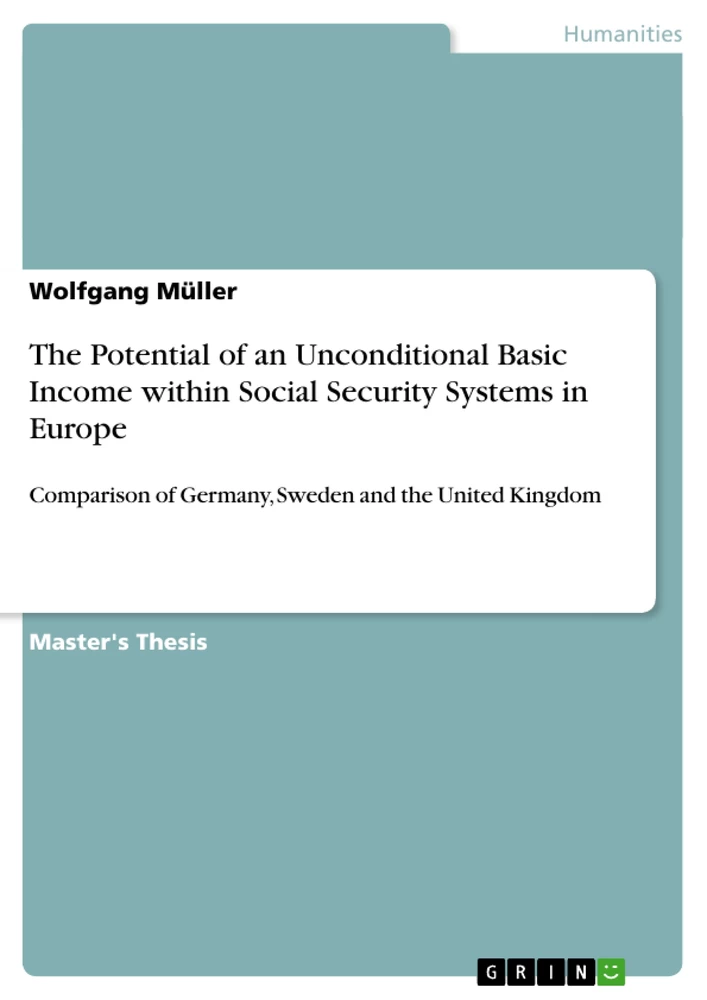
Table of Contents
1. INTRODUCTION
OBJECTIVE
OUTLINE
2. METHOD AND SELECTION
3. UNCONDITIONAL BASIC INCOME
DEFINITION
DESIRABILITY
4. WELFARE TYPES
WELFARE REGIMES
MIXED ECONOMY OF WELFARE
5. SOCIAL SECURITY
AIMS, OBJECTIVES AND FUNCTIONS
6. EFFECTIVENESS
POVERTY ALLEVIATION
INCOME REPLACEMENT
COMPENSATION
REDISTRIBUTION
RISK PROTECTION
SOCIAL COHESION
BEHAVIOURAL CHANGE
7. EFFICIENCY
TARGET EFFICIENCY
ECONOMIC EFFICIENCY
ADMINISTRATIVE EFFICIENCY
8. CONCLUSION
Research Objectives and Themes
This thesis investigates the hypothetical potential of an Unconditional Basic Income (UBI) to enhance the effectiveness and efficiency of social security systems in Germany, Sweden, and the United Kingdom, specifically in response to contemporary social and economic risks.
- Theoretical evaluation of UBI as a tool for poverty alleviation and social security reform.
- Comparative analysis of welfare regimes in the UK, Germany, and Sweden.
- Assessment of UBI's impact on effectiveness (poverty, risk, cohesion) and efficiency (cost, targeting, administration).
- Investigation into the interplay between UBI and existing labor-market-based benefit structures.
- Exploration of UBI's role in promoting individual autonomy and reducing paternalistic behavioral controls.
Excerpt from the Book
POVERTY ALLEVIATION
The examination of effective poverty tackling is a complicated task. There is no agreement about the concept of poverty. Many define poverty in relative terms while few prefer absolute terms. In liberal regimes, there is a tendency to define poverty on adequacy and in conservative and social democratic regimes on sufficiency. Walker suggests using adequacy and sufficiency synonymously (ibid.: 132) and concludes: "[A]dequacy refers to the resources necessary for a unit comprising one or more individuals to sustain a specified, usually minimal or modest, standard of living for specified period. In social security discourse, poverty is generally taken to equate with inadequacy, the antonym of adequacy" (ibid.: 135).
In this respect, reason, duration, kind of beneficiary and extent have to be decided to determine an adequate level for tackling poverty. Walker distinguishes between three main ways: First, normative judgement via the creation of budget standards that are defined by experts as necessary for households. Second, attitudinal assessment. Here, the public's attitudes and opinions are decisive. Third, arbitrary determination according to existing benefit levels, average incomes, etc. Each of these approaches has advantages and disadvantages (ibid.: 131-149). Since UBI should enable a life in dignity according to its definition, it would be possible to use these three main ways to determinate an adequacy or sufficiency standard. It would also be possible to decide it democratically. But since it has to be examined how UBI would affect existing policies that aim for poverty alleviation in relation to effectiveness, it will be assumed that UBI is adequate or sufficient regardless of determination.
Summary of Chapters
1. INTRODUCTION: Outlines the research problem regarding the incapacity of current European social security systems to address new social risks and presents UBI as a potential transformative solution.
2. METHOD AND SELECTION: Details the comparative research design using Germany, Sweden, and the UK as representative case studies and justifies the application of discourse analysis to theoretical UBI concepts.
3. UNCONDITIONAL BASIC INCOME: Defines UBI through various scholarly and organizational perspectives, emphasizing the critical requirements of universality and unconditionality.
4. WELFARE TYPES: Discusses Esping-Andersen’s welfare regime typology and Seeleib-Kaiser’s mixed economy of welfare to establish the ideological and institutional context for the study.
5. SOCIAL SECURITY: Examines the definitions, aims, objectives, and functions of social security systems within the European context to provide a framework for the subsequent analysis.
6. EFFECTIVENESS: Analyzes the potential for UBI to improve social security performance across dimensions like poverty alleviation, risk protection, and social cohesion.
7. EFFICIENCY: Evaluates UBI’s impact on the cost, targeting, and administrative efficiency of social security systems in the chosen countries.
8. CONCLUSION: Synthesizes the theoretical findings, suggesting that while UBI cannot fully replace all existing transfers, it offers significant improvements in effectiveness and administrative efficiency for European social security systems.
Keywords
Basic income, Welfare, Social Security, Social Risk, Poverty, Social Cohesion, Decommodification, Social Policy, Efficiency, Effectiveness, Unemployment, Redistribution, Paternalism, Labor Market, Welfare Regimes
Frequently Asked Questions
What is the core focus of this research?
The research examines the potential of an Unconditional Basic Income (UBI) to support and improve existing European social security systems in Germany, Sweden, and the UK.
What are the primary thematic areas covered?
The study covers welfare regime typologies, the definition and desirability of UBI, social security aims and functions, and the practical application of effectiveness and efficiency metrics in welfare policy.
What is the central research question?
The study asks whether and how the implementation of UBI could assist social security systems in achieving their goals more effectively and efficiently, particularly regarding poverty alleviation and social risk.
Which scientific methodology is employed?
The research utilizes a comparative, theory-based approach, applying discourse analysis to evaluate existing literature and policy frameworks, as empirical data for fully implemented UBI in Europe is currently unavailable.
What issues are addressed in the main part of the thesis?
The main part analyzes how UBI interacts with existing social policies, focusing on its capacity for poverty reduction, risk protection, redistribution, administrative simplification, and the potential to reduce behavioral control through means-testing.
Which keywords best characterize this work?
The study is defined by terms such as Basic income, Social Security, Welfare Regimes, Decommodification, Social Cohesion, Poverty Alleviation, and Efficiency.
How does UBI differ from current social security policies?
Unlike current schemes that rely on means-testing, contributions, and labor market participation, UBI is characterized by its universality and unconditionality, serving as a right rather than a conditional compensation.
What conclusions does the author draw regarding the UK versus Sweden?
The author concludes that Sweden’s welfare model might benefit from UBI’s ability to strengthen universal solidarity, while the UK’s model faces a more controversial prospect, balancing potential gains in individual autonomy against the challenge to its liberal ideology of low decommodification.
Ende der Leseprobe aus 78 Seiten
- nach oben
- Arbeit zitieren
- Wolfgang Müller (Autor:in), 2012, The Potential of an Unconditional Basic Income within Social Security Systems in Europe, München, Page::Imprint:: GRINVerlagOHG, https://www.diplomarbeiten24.de/document/204633

neugierig - aktuell - relevant
Entdecken Sie hilfreiche Tipps und Tricks rund ums Studium!

Entdecken Sie hilfreiche Tipps und Tricks rund ums Studium!
Ihre Hausarbeit / Abschlussarbeit:

- - Publikation als E-Book und Buch
- - Hohes Honorar auf die Verkäufe
- - Für Sie komplett kostenlos - mit ISBN
- - Es dauert nur 5 Minuten
- - Jede Arbeit findet Leser

- © GRIN Publishing GmbH.
- Alle Inhalte urheberrechtlich geschützt. Kopieren und verbreiten untersagt.
- info@grin.com
- AGB
- Open Publishing
Der GRIN Verlag hat sich seit 1998 auf die Veröffentlichung akademischer eBooks und Bücher spezialisiert. Der GRIN Verlag steht damit als erstes Unternehmen für User Generated Quality Content. Die Verlagsseiten GRIN.com, Hausarbeiten.de und Diplomarbeiten24 bieten für Hochschullehrer, Absolventen und Studenten die ideale Plattform, wissenschaftliche Texte wie Hausarbeiten, Referate, Bachelorarbeiten, Masterarbeiten, Diplomarbeiten, Dissertationen und wissenschaftliche Aufsätze einem breiten Publikum zu präsentieren.
Kostenfreie Veröffentlichung: Hausarbeit, Bachelorarbeit, Diplomarbeit, Dissertation, Masterarbeit, Interpretation oder Referat jetzt veröffentlichen!
Folgen Sie GRIN auf


- GRIN Verlag GmbH
-
- Nymphenburger Str. 86
- 80636
- Munich, Deutschland
- +49 89-550559-0
- +49 89-550559-10
- info@grin.com
-
