
präsentiert von

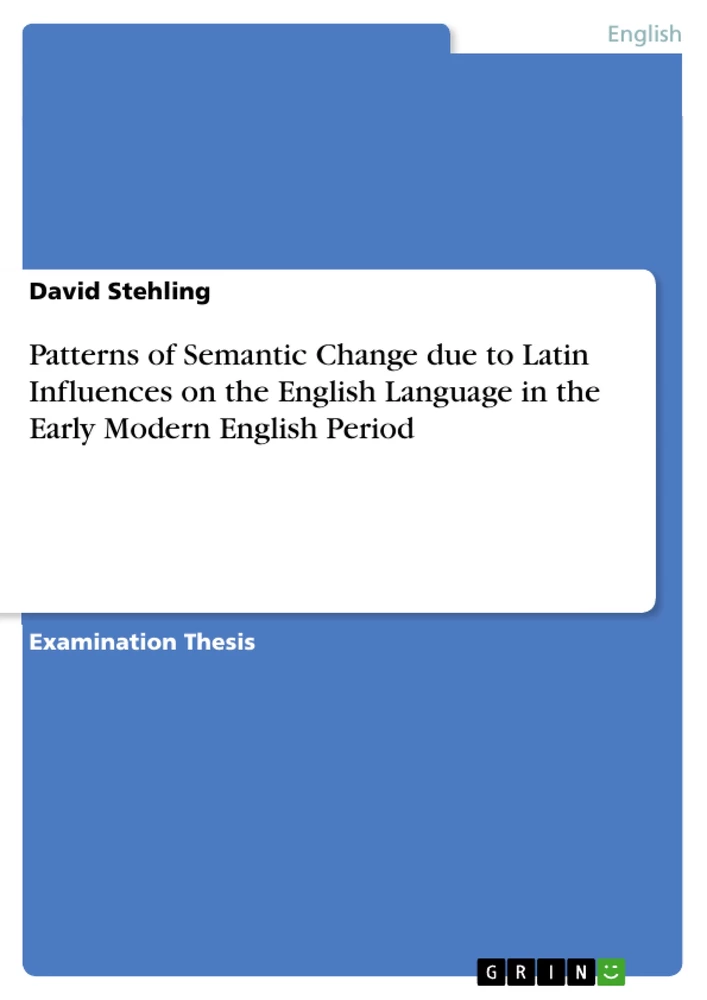
Table of Contents
1. Introduction
2. The Early Modern English Period
2.1 Time Frame
2.2 Setting
2.3 Growing Literacy
2.4 Standardisation
3. Latin versus English in the Early Modern English Period
3.1 The Integration of Latin Loanwords
3.2 The Inkhorn Controversy
4. Language Change
4.1 Lexical Change
4.2 Semantic Change
5. Patterns of Semantic Change due to Latin Influences on Early Modern English
5.1 The Method
5.2 The Oxford English Dictionary
5.3 Analysis in the Field of Human Anatomy
5.3.1 Backbone and Spine
5.3.2 Body and Corpus
5.3.3 Brain and Cerebrum
5.3.4 Finger and Digitus
5.3.5 Head and Caput
5.3.6 Midriff and Diaphragm
5.3.7 Navel and Umbilicum
5.3.8 Nostril and Nare
5.3.9 Throat and Fauces
5.3.10 Womb and Abdomen, Intestine, Uterus, Matrix
5.3.11 Interim Result
5.4 Analysis of other Subjects
5.4.1 Medicine
5.4.2 Botany
5.4.3 Architecture
5.4.4 Interim Result
6. Conclusion
Objectives and Research Themes
This paper examines how the influx of Latin loanwords during the Early Modern English period (15th–18th century) triggered specific semantic shifts in the English language, primarily within the field of human anatomy.
- Analysis of semantic change patterns caused by language contact.
- Investigation of synonymous couplets (native English vs. Latin-derived terms).
- Evaluation of the "Inkhorn Controversy" and attitudes toward Latinate vocabulary.
- Utilization of the Oxford English Dictionary to track meaning transfer and metaphoric extension.
- Comparative study of specialized technical register vs. general vernacular usage.
Excerpt from the Book
5.3.1 Backbone and Spine
The first couplet that is to be considered in this section consists of the English word backbone and the Latin-derived term spine. The former is a compound of the nouns back and bone, both having their roots in Old English and, to be more precise, in Germanic. The compound itself was first cited before 1300 in the glossary The Treatise of Walter de Bibbesworth with its sense “The vertebral column, the spine” and later in the Early Modern English period in A Newe Tracte or Treatyse Moost Profytable for all Husbande Men by John Fitzherbert.
The counterpart spine, as it appears as a synonym of backbone in the OED, is derived from the Latin word spina meaning “thorn, prickle, backbone”. Apart from other senses related to “prickle, thorn” in English, spine denoting “The spinal or vertebral column in man and vertebrates; the backbone” appeared first in Lanfranc’s Science of Cirurgie around 1400: “Of curis of woundis of þe spine ouþir spondilium” (OED: “spine, n.”). An Early Modern English quotation containing the term is, for instance, “Vnder the name of the Spine we comprehend all that which is extended from the first Racke bone of the Necke vnto the Coccyx or Rumpe” in Helkiah Crooke’s scientific work A description of the Body of Man (1615). Since the second half of the Early Modern English period, spine has also been used in a transferred and figurative way. Thus, it has come to denote “A part or formation having the function of a backbone”, such as in Robert Hooke’s Micrographia, or Some Physiological Descriptions of Minute Bodies Made by Magnifying Glasses (1665). In this example, spine was used to name a part of a leaf. The transferred and figurative denotation might also have had an impact on the English counterpart backbone and its meaning. In this way, the lexeme backbone was transferred as well and used as “A main support or axis, or chief substantial part”, “having the function of a backbone”, and, as a result, it overlapped with the respective meaning of spine, described above.
Summary of Chapters
1. Introduction: Discusses the nature of language change and the specific historical impact of Latin borrowings on English semantics.
2. The Early Modern English Period: Outlines the historical, socio-cultural, and linguistic developments defining the period from the 15th to the 18th century.
3. Latin versus English in the Early Modern English Period: Explores the tension between the prestige of Latin as a scholarly language and the growing status of English, including the Inkhorn Controversy.
4. Language Change: Provides the theoretical background on lexical and semantic change, focusing on borrowing, synonymy, and meaning transfer.
5. Patterns of Semantic Change due to Latin Influences on Early Modern English: The empirical core of the study, detailing the methodology and analyzing specific synonymous pairs in anatomy, medicine, botany, and architecture.
6. Conclusion: Summarizes the findings, confirming that meaning transfer and metaphoric extension were primary outcomes of Latin influence on the English lexicon.
Keywords
Early Modern English, Semantic Change, Latin Loanwords, Borrowing, Anatomy, Lexicology, Oxford English Dictionary, Metaphoric Extension, Synonymy, Language Contact, Terminology, Inkhorn Controversy, Historical Linguistics, Human Anatomy, Meaning Transfer.
Frequently Asked Questions
What is the primary objective of this research?
The research aims to determine patterns of semantic alteration in English words caused by the influx of Latin-derived equivalents between the 15th and 18th centuries.
Which lexical field is the main focus of the analysis?
The study primarily focuses on the field of human anatomy, though it also addresses medicine, botany, and architecture to illustrate broader patterns.
What is the "Inkhorn Controversy"?
It refers to the late 16th and early 17th-century debate regarding the influx of Latin and Greek loanwords into English, with some writers critiquing the usage of obscure terms as unnecessary affectation.
What methodology is employed to track semantic change?
The author uses the Oxford English Dictionary Online and the Historical Thesaurus of English to identify synonymous pairs and compare their diachronic semantic development.
What is "metaphoric extension" in this context?
It is a pattern where the meaning of a word is expanded to include new concepts based on perceived similarities, often influenced by the original Latin denotations.
How did Latin influence the English vernacular?
Latin borrowings often provided precise, specialized terms that filled semantic gaps, which subsequently caused native English synonyms to either shift their meaning or become restricted to non-scientific contexts.
How does the author define the "Early Modern English" time frame?
The author considers the period from the 15th century (introduction of the printing press) to the 18th century as the operational time frame for this study.
What did the analysis of the couplet "backbone" and "spine" reveal?
The analysis showed that the Latin-derived "spine" influenced "backbone" by causing it to be used in a transferred, figurative sense regarding structural support.
Why are "not naturalised" words discussed?
These terms, often identified in the OED, are discussed to show that they remained restricted to specialized technical or scientific registers compared to native equivalents.
What role does the Oxford English Dictionary play in this paper?
The OED serves as the primary data source, providing historical quotations and definitions necessary to establish the timeline of meaning changes for both Latin and English lexemes.
Ende der Leseprobe aus 68 Seiten
- nach oben
- Arbeit zitieren
- David Stehling (Autor:in), 2010, Patterns of Semantic Change due to Latin Influences on the English Language in the Early Modern English Period, München, Page::Imprint:: GRINVerlagOHG, https://www.diplomarbeiten24.de/document/205514

neugierig - aktuell - relevant
Entdecken Sie hilfreiche Tipps und Tricks rund ums Studium!

Entdecken Sie hilfreiche Tipps und Tricks rund ums Studium!
Ihre Hausarbeit / Abschlussarbeit:

- - Publikation als E-Book und Buch
- - Hohes Honorar auf die Verkäufe
- - Für Sie komplett kostenlos - mit ISBN
- - Es dauert nur 5 Minuten
- - Jede Arbeit findet Leser

- © GRIN Publishing GmbH.
- Alle Inhalte urheberrechtlich geschützt. Kopieren und verbreiten untersagt.
- info@grin.com
- AGB
- Open Publishing
Der GRIN Verlag hat sich seit 1998 auf die Veröffentlichung akademischer eBooks und Bücher spezialisiert. Der GRIN Verlag steht damit als erstes Unternehmen für User Generated Quality Content. Die Verlagsseiten GRIN.com, Hausarbeiten.de und Diplomarbeiten24 bieten für Hochschullehrer, Absolventen und Studenten die ideale Plattform, wissenschaftliche Texte wie Hausarbeiten, Referate, Bachelorarbeiten, Masterarbeiten, Diplomarbeiten, Dissertationen und wissenschaftliche Aufsätze einem breiten Publikum zu präsentieren.
Kostenfreie Veröffentlichung: Hausarbeit, Bachelorarbeit, Diplomarbeit, Dissertation, Masterarbeit, Interpretation oder Referat jetzt veröffentlichen!
Folgen Sie GRIN auf


- GRIN Verlag GmbH
-
- Nymphenburger Str. 86
- 80636
- Munich, Deutschland
- +49 89-550559-0
- +49 89-550559-10
- info@grin.com
-
