
präsentiert von

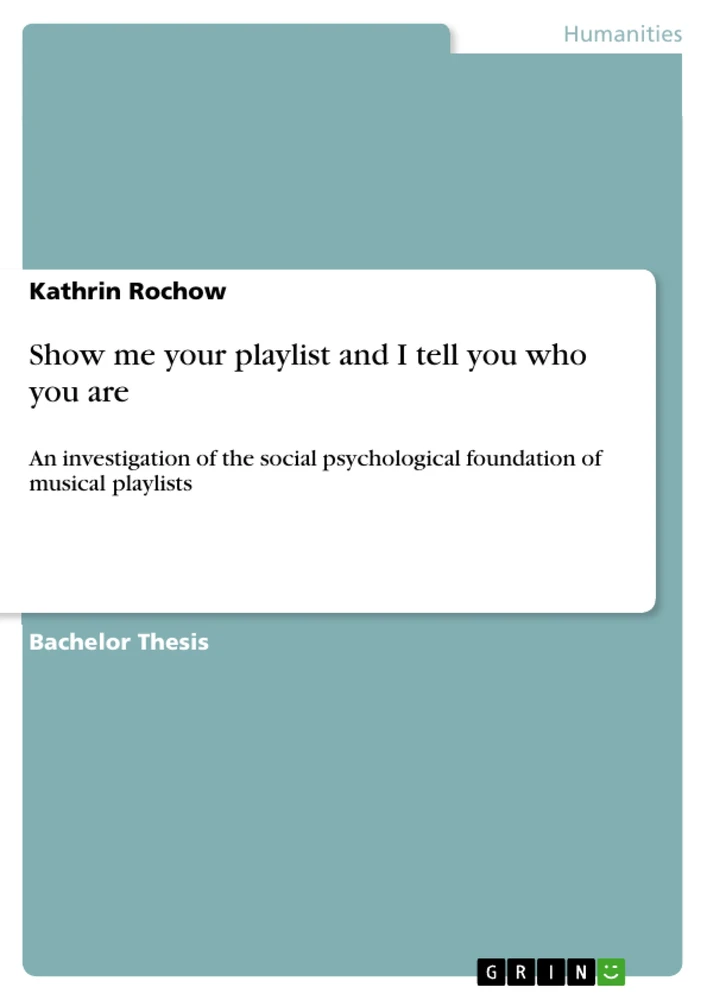
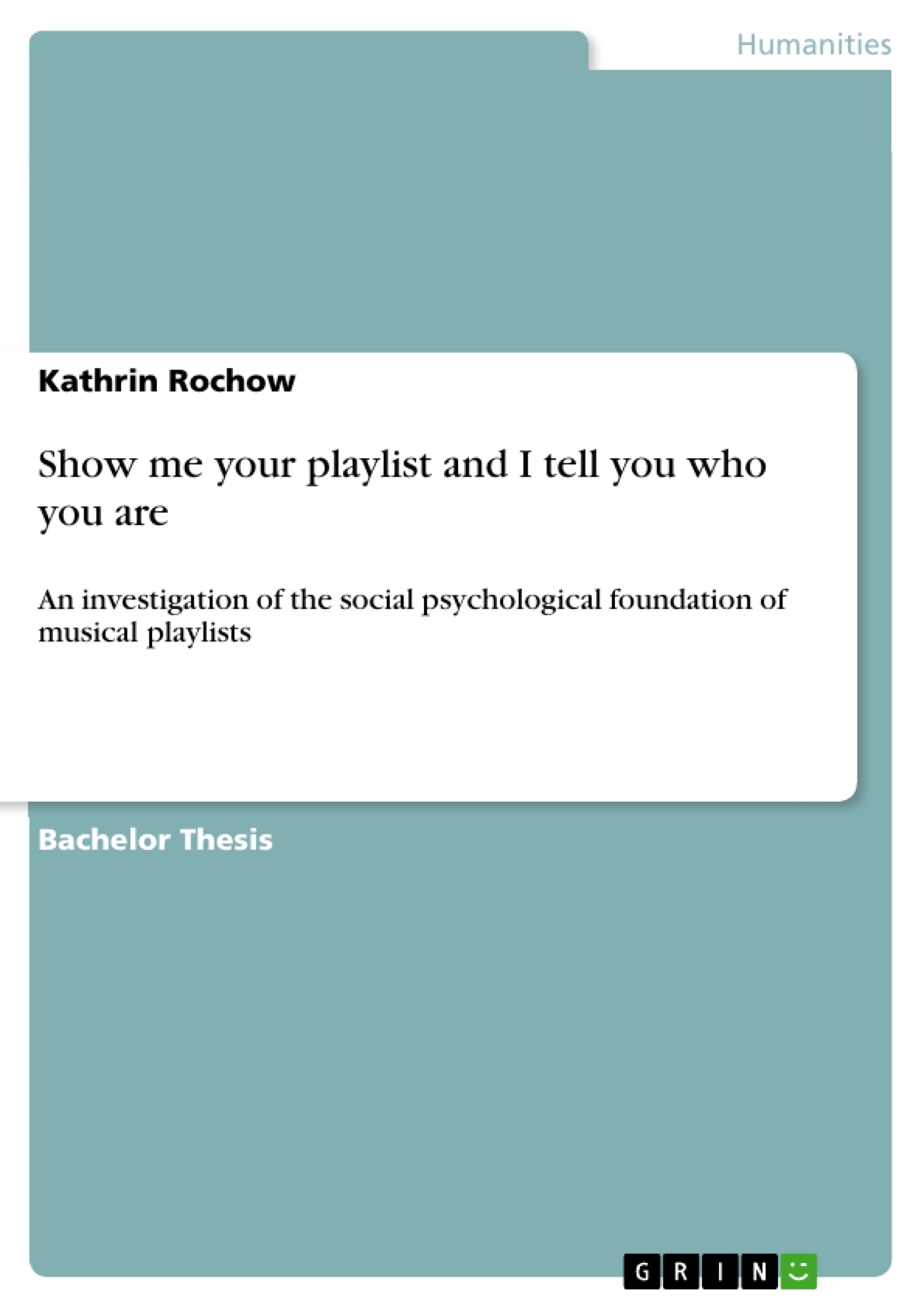
Table of Contents
1. INTRODUCTION
1.1 Purpose and the question of issue
1.2 Prior Research – what is music sociology and why is it important?
2. THEORETICAL FRAMEWORK
2.1 George Herbert Mead and Charles Horton Cooley
2.2 Key Concepts
2.2.1 The concept of self
2.2.2 The concept of medium
2.2.3 The emotional foundation of musical preferences
2.2.4 From mix-tape to playlist
3. METHOD
3.1 The gathering of data
3.3 Limitations
4. RESULT AND ANALYSIS
4.1 Analysing the playlist
4.2 The process of data analysis
4.3 The “I”-construction of a playlist
4.4 The playlist as a medium and social phenomenon
4.5 Interpreting playlists – listening to the sound of the self
5. CONCLUSION
Research Objectives and Themes
This study aims to investigate the social-psychological foundation of musical playlists and their role in facilitating social relations and communication within the digital realm. It explores how individuals use playlists as symbolic expressions of their "self" and how these compilations function as mediums for social interaction and self-construction.
- The social-psychological role of musical playlists in contemporary society.
- The playlist as a medium for communication and social interaction.
- The construction of the "self" through musical preferences and emotional judgements.
- The transformation of musical content from objective culture into subjective, social forms.
- The phenomenon of "playlistism" and musical voyeurism in digital social networks.
Excerpt from the Book
The “I”-construction of a playlist
As mentioned above, the understanding of how individuals construct musical playlists is vital to comprehend their appearance as social objects. The process of composing a musical playlist is based on uniquely subjective judgements, which was clearly recognizable during the interviews as well as in the focus group discussion. All four participants have well defined musical preferences although in a wide range of different musical genres. Thus choosing between 'good' and 'bad' music is inevitable for the respondents in order to orientate themselves in a proliferating music repertoire. However, the evaluation occurs mostly unconscious, since it is based on emotions as judgements.
By stating that 'nobody' choses music 'directly' while looking at 'all' the music, Marcus emphasizes the general difficulty in keeping track of a proliferating music repertoire. It seems to be a physical impossibility to browse through 'all' the music and base one's judgement thereupon. For Marcus, individual music choice does not occur directly, thus in a rather unconscious manner, which clearly refers to Solomon’s statement about emotions as judgements. However, instead of browsing through all the music, Marcus refers to other sources of decision guidance.
Summary of Chapters
1. INTRODUCTION: This chapter introduces the rise of digital music streaming and the emergence of the musical playlist as a key tool for organizing and sharing personal music, setting the stage for a social-psychological investigation.
2. THEORETICAL FRAMEWORK: This section provides the academic foundation, drawing on Mead, Cooley, Simmel, and Solomon to define concepts like the "self," the "medium," and the emotional basis of musical taste.
3. METHOD: The methodology chapter details the qualitative approach, describing the use of semi-structured interviews, focus groups, and the purposeful sampling of Swedish students to gather data.
4. RESULT AND ANALYSIS: This chapter analyzes interview excerpts and focus group discussions to demonstrate how playlists function as symbolic expressions of the self and social mediums.
5. CONCLUSION: The final chapter synthesizes findings, arguing that the playlist is both socially implicated and socially implicating, serving as a powerful tool for self-construction and cross-cultural communication.
Keywords
Musical Playlists, Social Psychology, Self-Construction, Digital Music, Music Sociology, Communication, Social Media, Identity Formation, Musical Preferences, Subjective Culture, Playlistism, Medium, Symbolic Expression, Social Interaction, Human Agency
Frequently Asked Questions
What is the core subject of this paper?
The paper examines the social-psychological foundation of musical playlists, analyzing how they function as social objects that facilitate communication and the expression of identity in the digital age.
What are the primary themes discussed?
Key themes include the self-construction process through music, the role of playlists as social mediums, the emotional foundation of musical preferences, and the social dynamics of sharing music online.
What is the main research question?
The study investigates how young adults utilize musical playlists in social interactions and whether these playlists can function as symbolic expressions of the "self" and as tools for social communication.
Which methodology was employed for the research?
The author utilized a qualitative approach, conducting four semi-structured individual interviews and four focus group discussions with Swedish students to analyze attitudes and experiences regarding playlist creation.
What does the main body of the work cover?
The main body moves from a theoretical framework based on social constructionism to an empirical analysis of interview and focus group data, concluding with an evaluation of how individuals construct their playlists.
Which keywords characterize the work?
Key terms include musical playlists, social psychology, self-construction, identity formation, digital music, communication, and music sociology.
What is "playlistism" as defined in the paper?
It is a term used to describe a new social phenomenon of "music voyeurism," where individuals browse and judge others based on their public musical playlists.
How do the participants' playlists relate to the "Big Five" personality traits?
The study used Goldberg's Five-Factor Model as a structured guideline in the focus groups to see if listeners could accurately identify the personality traits the composers aimed to express through their music choices.
Ende der Leseprobe aus 36 Seiten
- nach oben
- Arbeit zitieren
- Kathrin Rochow (Autor:in), 2010, Show me your playlist and I tell you who you are, München, Page::Imprint:: GRINVerlagOHG, https://www.diplomarbeiten24.de/document/205581

neugierig - aktuell - relevant
Entdecken Sie hilfreiche Tipps und Tricks rund ums Studium!

Entdecken Sie hilfreiche Tipps und Tricks rund ums Studium!
Ihre Hausarbeit / Abschlussarbeit:

- - Publikation als E-Book und Buch
- - Hohes Honorar auf die Verkäufe
- - Für Sie komplett kostenlos - mit ISBN
- - Es dauert nur 5 Minuten
- - Jede Arbeit findet Leser

- © GRIN Publishing GmbH.
- Alle Inhalte urheberrechtlich geschützt. Kopieren und verbreiten untersagt.
- info@grin.com
- AGB
- Open Publishing
Der GRIN Verlag hat sich seit 1998 auf die Veröffentlichung akademischer eBooks und Bücher spezialisiert. Der GRIN Verlag steht damit als erstes Unternehmen für User Generated Quality Content. Die Verlagsseiten GRIN.com, Hausarbeiten.de und Diplomarbeiten24 bieten für Hochschullehrer, Absolventen und Studenten die ideale Plattform, wissenschaftliche Texte wie Hausarbeiten, Referate, Bachelorarbeiten, Masterarbeiten, Diplomarbeiten, Dissertationen und wissenschaftliche Aufsätze einem breiten Publikum zu präsentieren.
Kostenfreie Veröffentlichung: Hausarbeit, Bachelorarbeit, Diplomarbeit, Dissertation, Masterarbeit, Interpretation oder Referat jetzt veröffentlichen!
Folgen Sie GRIN auf


- GRIN Verlag GmbH
-
- Nymphenburger Str. 86
- 80636
- Munich, Deutschland
- +49 89-550559-0
- +49 89-550559-10
- info@grin.com
-
