
präsentiert von

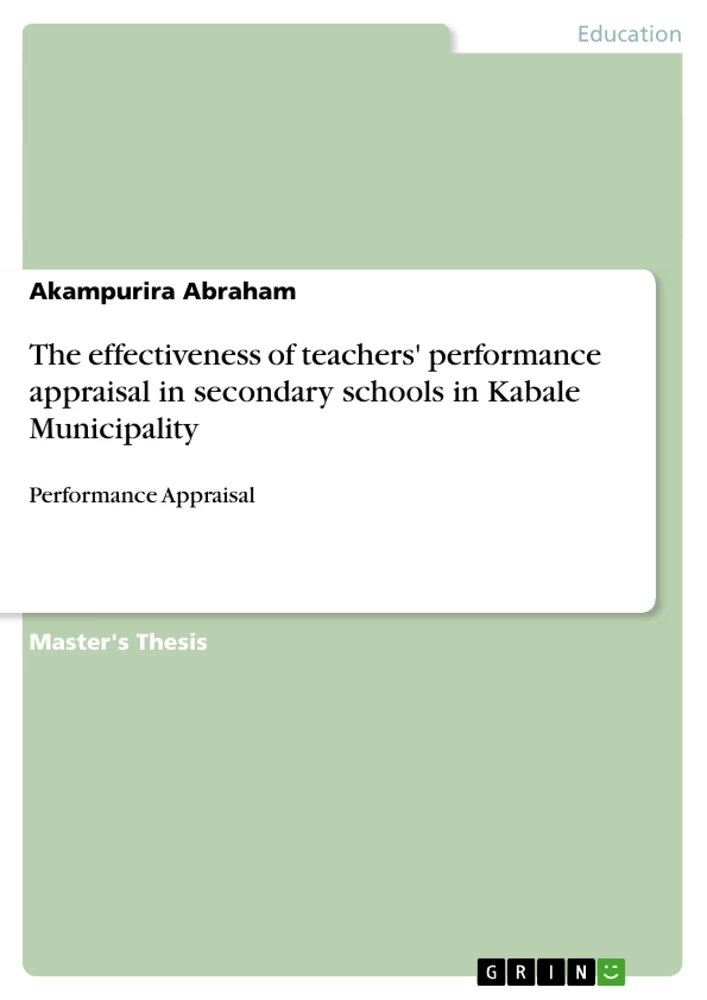
Table of Contents
Chapter One. INTRODUCTION.
1.1 Background.
1.2. Problem Statement.
1.3 Purpose of Study.
1.4 Objectives.
1.5 Research Questions.
1.6 Scope.
1.7 Significance.
1.8 Procedure.
CHAPTER TWO; LITERATURE REVIEW.
2.1. Introduction.
2.2 Literature review.
2.3 Conceptual frame work.
2.4 Related literature.
2.4.1. Feedback and implementation of appraisal scheme.
2.4.2 Employees’ attitude to performance appraisal
2.4.3 Problems with performance appraisal.
2.4.4 The role of performance appraisal design.
CHAPTER THREE; METHODOLOGY.
3.1. Introduction.
3.2. Research design
3.3. Area of Study.
3.4. The Study population
3.5. Sampling techniques and sample size.
3.6. Data collection instruments.
3.6.1 Self –administered Questionnaires.
3.6.2. Interview Schedule.
3.6.3. Documentary analysis.
3.7. Validity and Reliability.
3.7.1. Triangulation of Methods.
3.8. Data analysis.
CHAPTER FOUR; PRESENTATION, ANALYSIS, AND INTERPRETATION.
4.1. Introduction
4.2. Background Information.
CHAPTER FIVE; DISCUSSIONS, FINDINGS, CONCLUSIONS AND RECOMMENDATIONS.
Discussions of the research questions.
Conclusions.
Recommendations
Discusion of research Question One.
Discussion of research Quetion Two
Discussion of research Question Three.
Discussion of research Question Four.
Research Objectives and Focus
The primary objective of this study is to investigate the effectiveness of the teachers’ performance appraisal system currently implemented in secondary schools within Kabale Municipality. The research seeks to identify the challenges in the appraisal process, determine how teachers' attitudes impact the system's success, and analyze whether performance-related feedback contributes to professional development and improved organizational outcomes.
- Evaluating the effectiveness of feedback mechanisms in the appraisal process.
- Analyzing the impact of teacher attitudes on the implementation of appraisal schemes.
- Identifying the practical problems faced during performance evaluation in secondary schools.
- Assessing the role of appraisal design in encouraging staff for better performance.
- Investigating the correlation between appraisal results and administrative decision-making processes.
Excerpt from the Book
1.1 Background
Performance appraisal is the assessment of the performance of an individual in relation to the objectives, activities, outputs, and targets of a job over a given period of time. In organizational setting, performance appraisal is defined as a structured formal interaction between a subordinate and supervisor, that usually takes the form of a periodic interview (annual or semi-annual), in which the work performance of the subordinate is examined and discussed, with a view to identifying weaknesses and strengths as well as opportunities for improvement and skills development (McNamara, 1999).
Moorhead and Griffin (1992) describe it as the process of evaluating work behaviors by measurement and comparison to previously established standards, recording the results, and communicating them back to the employee. It is an activity between a manager and an employee. Performance appraisal is therefore the assessment of performance of an individual in relation to the objectives, activities, outputs, and targets of a job over a given period of time. Performance appraisal is a powerful tool for performance management. Okumbe (1998) asserts that performance helps in evaluating how a worker succeeds in his present job and this is important for estimating how well he or she will perform in the future. This therefore helps in determining the strengths or weaknesses of the individual workers to increase productivity.
In companies, performance appraisal systems (PAS) began as simple methods for deciding whether or not the salary of an employee was justified. Later on, empirical studies showed that pay rates were not the only element that had an impact on employee performance. It was found out that other issues, such as morale and self-esteem, could also have major influence. That resulted in progressive rejection of emphasis of performance appraisal on reward outcomes, and in 1950s, in the United States, its potential as a tool for motivation and development was recognized. The general model of performance appraisal, as it is known today, began from that time.
Summary of Chapters
Chapter One. INTRODUCTION: Outlines the background of performance appraisal, defines the research problem, and establishes the objectives and scope of the study.
CHAPTER TWO; LITERATURE REVIEW: Reviews existing theories and scholarly perspectives on performance appraisal, focusing on the conceptual framework, feedback systems, employee attitudes, and design challenges.
CHAPTER THREE; METHODOLOGY: Describes the case study research design, the selection of schools in Kabale Municipality, and the qualitative and quantitative instruments used for data collection.
CHAPTER FOUR; PRESENTATION, ANALYSIS, AND INTERPRETATION: Presents the gathered data, focusing on demographic profiles, respondent feedback on appraisal effectiveness, and analysis of current system challenges.
CHAPTER FIVE; DISCUSSIONS, FINDINGS, CONCLUSIONS AND RECOMMENDATIONS: Synthesizes the research findings, offers final conclusions regarding the system's effectiveness, and proposes recommendations for enhancing the appraisal process.
Keywords
Performance Appraisal, Teachers' Performance, Kabale Municipality, Performance Management, Feedback, Employee Attitude, Secondary Schools, Human Resource Management, Job Performance, Appraisal Design, Educational Management, Quantitative Approach, Qualitative Approach, Staff Development, Organizational Effectiveness.
Frequently Asked Questions
What is the primary focus of this dissertation?
The study investigates the effectiveness of the Teachers' Performance Appraisal system specifically within secondary schools in Kabale Municipality, Uganda.
What are the main thematic areas covered in the research?
Key areas include performance-related feedback, employee attitudes toward the appraisal system, existing problems in evaluation procedures, and the role of appraisal design in enhancing performance.
What is the core research question addressed by the author?
The author aims to establish how effective the current appraisal scheme is and to identify the factors—such as feedback management and staff involvement—that contribute to its success or failure.
What research methodology was employed?
The study utilizes a case study design, incorporating both qualitative and quantitative approaches, including self-administered questionnaires, interviews, and document analysis.
What does the main body of the work analyze?
The main body examines empirical data from teachers and administrators to assess how the appraisal system is perceived, whether feedback is provided, and if the system actually influences professional growth or remains a mere formality.
Which keywords are essential to understanding this work?
Key terms include Performance Appraisal, Feedback, Employee Attitude, Secondary Schools, and Human Resource Management.
How is feedback managed in the schools studied?
The findings suggest that feedback is often inconsistent or absent, and where provided, it is frequently not used to support professional development, leading to staff dissatisfaction.
What specific challenges do teachers face with the appraisal forms?
Teachers reported that the forms are often perceived as overly technical and lengthy, and there is a lack of sufficient training or sensitization on how to correctly interpret and use them.
Ende der Leseprobe aus 95 Seiten
- nach oben
- Arbeit zitieren
- Akampurira Abraham (Autor:in), 2010, The effectiveness of teachers' performance appraisal in secondary schools in Kabale Municipality, München, Page::Imprint:: GRINVerlagOHG, https://www.diplomarbeiten24.de/document/207381

neugierig - aktuell - relevant
Entdecken Sie hilfreiche Tipps und Tricks rund ums Studium!

Entdecken Sie hilfreiche Tipps und Tricks rund ums Studium!
Ihre Hausarbeit / Abschlussarbeit:

- - Publikation als E-Book und Buch
- - Hohes Honorar auf die Verkäufe
- - Für Sie komplett kostenlos - mit ISBN
- - Es dauert nur 5 Minuten
- - Jede Arbeit findet Leser

- © GRIN Publishing GmbH.
- Alle Inhalte urheberrechtlich geschützt. Kopieren und verbreiten untersagt.
- info@grin.com
- AGB
- Open Publishing
Der GRIN Verlag hat sich seit 1998 auf die Veröffentlichung akademischer eBooks und Bücher spezialisiert. Der GRIN Verlag steht damit als erstes Unternehmen für User Generated Quality Content. Die Verlagsseiten GRIN.com, Hausarbeiten.de und Diplomarbeiten24 bieten für Hochschullehrer, Absolventen und Studenten die ideale Plattform, wissenschaftliche Texte wie Hausarbeiten, Referate, Bachelorarbeiten, Masterarbeiten, Diplomarbeiten, Dissertationen und wissenschaftliche Aufsätze einem breiten Publikum zu präsentieren.
Kostenfreie Veröffentlichung: Hausarbeit, Bachelorarbeit, Diplomarbeit, Dissertation, Masterarbeit, Interpretation oder Referat jetzt veröffentlichen!
Folgen Sie GRIN auf


- GRIN Verlag GmbH
-
- Nymphenburger Str. 86
- 80636
- Munich, Deutschland
- +49 89-550559-0
- +49 89-550559-10
- info@grin.com
-
