
präsentiert von

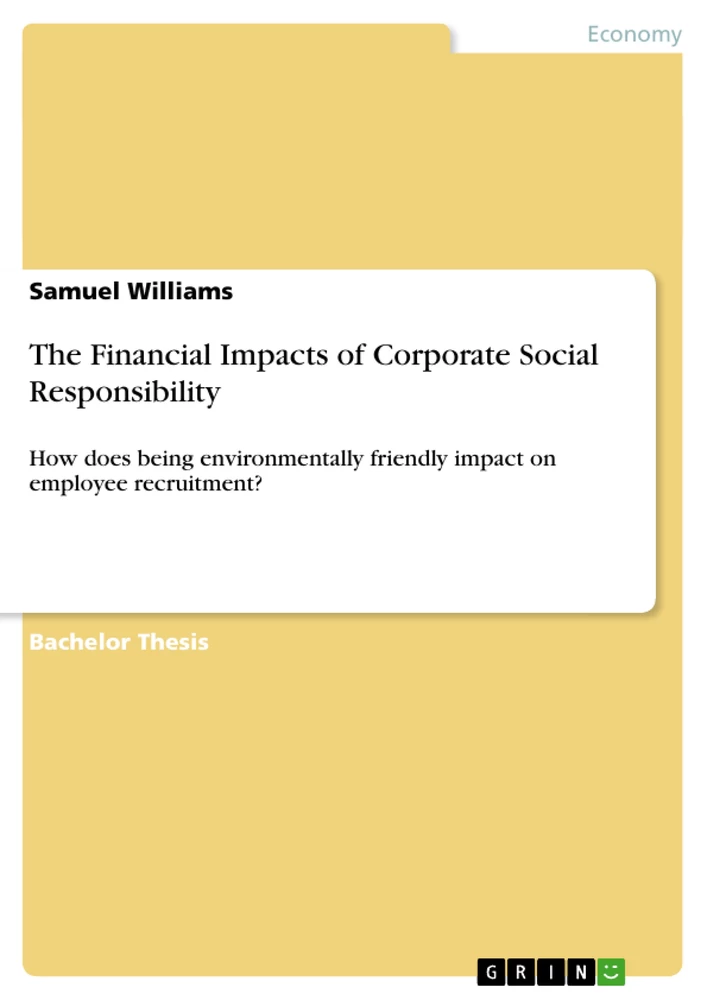
Table of Contents
Introduction
Problem Statement
Development of CSR Theories
CSR and Financial Impacts
Measuring CSR and Financial Impacts
End state outcome metrics
Intermediate outcome metrics
Mediating metrics
Impacts of CSR on Employees
Methodology
Primary Research Data Gathering
Results and Analysis
Evaluation
Conclusion
Reflections
Research Objectives and Themes
This study aims to investigate the financial implications of Corporate Social Responsibility (CSR), specifically focusing on whether a company's commitment to environmental friendliness acts as a significant determining factor in employee recruitment processes.
- Theoretical examination of CSR and its link to financial business performance.
- Evaluation of various metrics used to measure the impact of CSR initiatives.
- Primary research analysis of employee attitudes toward environmental sustainability in the workplace.
- Assessment of the importance of environmental reputation compared to utilitarian job attributes like salary and security.
- Exploration of the gap between stated preferences for CSR and actual job-seeking behavior.
Excerpt from the Book
Impacts of CSR on employees
The final mediating metrics are those which involve the individual stakeholder; employees. The first involves the relationship between the employees and individual staff members such as employers. This includes aspects such as motivation, retention and recruitment, all of which are extremely important in terms of business, as stated by Bhattacharya, Sen and Korschun (2008, p.37), “Increasingly, success comes from being able to attract, motivate and retain a talented pool of workers”. Furthermore, “increased employee motivation can increase productivity and eventually result in cost savings. The same is true for effects on employee recruitment or retention, which can lead to reduced personnel marketing costs” (Weber, 2008, p.250).
The second employee metric comprises the relationship among the employees as a whole. This includes the likes of job satisfaction, organisational culture and using CSR as a means to stimulate motivation. Business aspects such as these may help to stimulate manufacturing performance which in turn may influence employee aspects such as cost, speed, quality and flexibility (Peloza, 2009).
Summary of Chapters
Introduction: Provides a background on the shift toward CSR disclosures and establishes the research focus on environmental impacts on recruitment.
Development of CSR Theories: Reviews historical perspectives on CSR, ranging from Friedman’s criticism to Stakeholder and Resource-based theories.
CSR and Financial Impacts: Discusses the evolution of the debate linking corporate social performance to improved financial outcomes.
Measuring CSR and Financial Impacts: Explores the methodological challenges of quantifying CSR benefits through various outcome and mediating metrics.
End state outcome metrics: Analyzes the use of financial indicators like share price and accounting returns to evaluate CSR value.
Intermediate outcome metrics: Examines operational metrics, such as supply chain efficiency and cost reduction, in relation to CSR.
Mediating metrics: Focuses on internal factors like reputation and cost savings that precede final financial results.
Impacts of CSR on Employees: Investigates the relationship between CSR practices, motivation, and recruitment success.
Methodology: Details the design of the online questionnaire used to gather data on employee perceptions.
Primary Research Data Gathering: Describes the selection of the participating company and the distribution of the survey to UK employees.
Results and Analysis: Presents the demographic profile of respondents and the statistical findings from the survey data.
Evaluation: Critically assesses the results against current literature and highlights the discrepancy between opinions and actual job-seeking actions.
Conclusion: Synthesizes the findings, noting that while CSR is perceived as "nice to have," it rarely outweighs utilitarian factors in actual employment decisions.
Reflections: Offers a personal review of the research process, highlighting challenges in project focus and methodology.
Keywords
Corporate Social Responsibility, CSR, Employee Recruitment, Environmental Sustainability, Stakeholder Theory, Financial Impacts, Job Attributes, Employee Motivation, Sustainability Metrics, Corporate Reputation, Environmental Policy, Utilitarian Aspects, Employee Retention, Business Performance, Quantitative Research.
Frequently Asked Questions
What is the core focus of this research project?
The research examines the financial impacts of Corporate Social Responsibility, specifically investigating how a company’s environmental reputation influences its ability to recruit employees.
What are the primary themes discussed in the work?
The main themes include CSR theories, metrics for measuring financial and non-financial business impacts, the influence of CSR on workforce recruitment, and the comparison between different job attributes.
What is the main objective or research question?
The primary goal is to answer: "How does being environmentally friendly impact on employee recruitment?"
What scientific methods were employed?
The author conducted a comprehensive literature review followed by primary research using an online questionnaire distributed to 120 employees of an American multinational manufacturing company.
What is covered in the main body of the report?
The main body covers the theoretical evolution of CSR, the methodological approaches to measuring its financial impact, and a detailed analysis of how employees value environmental responsibility versus utilitarian benefits.
Which keywords characterize this study?
Key terms include Corporate Social Responsibility, Employee Recruitment, Environmental Sustainability, Financial Impacts, Stakeholder Theory, and Corporate Reputation.
Does the research find that environmental CSR is a primary driver for job seekers?
While employees express a preference for environmentally friendly companies in surveys, the research indicates that this is rarely a deciding factor, as utilitarian aspects like salary and job security hold significantly higher importance.
How does the author interpret the difference between survey opinions and real-world actions?
The author suggests that opinion-based surveys often overstate the significance of CSR, as employees may not actively seek environmental information when faced with the complex reality of selecting a new role.
Ende der Leseprobe aus 44 Seiten
- nach oben
- Arbeit zitieren
- Samuel Williams (Autor:in), 2012, The Financial Impacts of Corporate Social Responsibility, München, Page::Imprint:: GRINVerlagOHG, https://www.diplomarbeiten24.de/document/207639

neugierig - aktuell - relevant
Entdecken Sie hilfreiche Tipps und Tricks rund ums Studium!

Entdecken Sie hilfreiche Tipps und Tricks rund ums Studium!
Ihre Hausarbeit / Abschlussarbeit:

- - Publikation als E-Book und Buch
- - Hohes Honorar auf die Verkäufe
- - Für Sie komplett kostenlos - mit ISBN
- - Es dauert nur 5 Minuten
- - Jede Arbeit findet Leser

- © GRIN Publishing GmbH.
- Alle Inhalte urheberrechtlich geschützt. Kopieren und verbreiten untersagt.
- info@grin.com
- AGB
- Open Publishing
Der GRIN Verlag hat sich seit 1998 auf die Veröffentlichung akademischer eBooks und Bücher spezialisiert. Der GRIN Verlag steht damit als erstes Unternehmen für User Generated Quality Content. Die Verlagsseiten GRIN.com, Hausarbeiten.de und Diplomarbeiten24 bieten für Hochschullehrer, Absolventen und Studenten die ideale Plattform, wissenschaftliche Texte wie Hausarbeiten, Referate, Bachelorarbeiten, Masterarbeiten, Diplomarbeiten, Dissertationen und wissenschaftliche Aufsätze einem breiten Publikum zu präsentieren.
Kostenfreie Veröffentlichung: Hausarbeit, Bachelorarbeit, Diplomarbeit, Dissertation, Masterarbeit, Interpretation oder Referat jetzt veröffentlichen!
Folgen Sie GRIN auf


- GRIN Verlag GmbH
-
- Nymphenburger Str. 86
- 80636
- Munich, Deutschland
- +49 89-550559-0
- +49 89-550559-10
- info@grin.com
-
