
präsentiert von

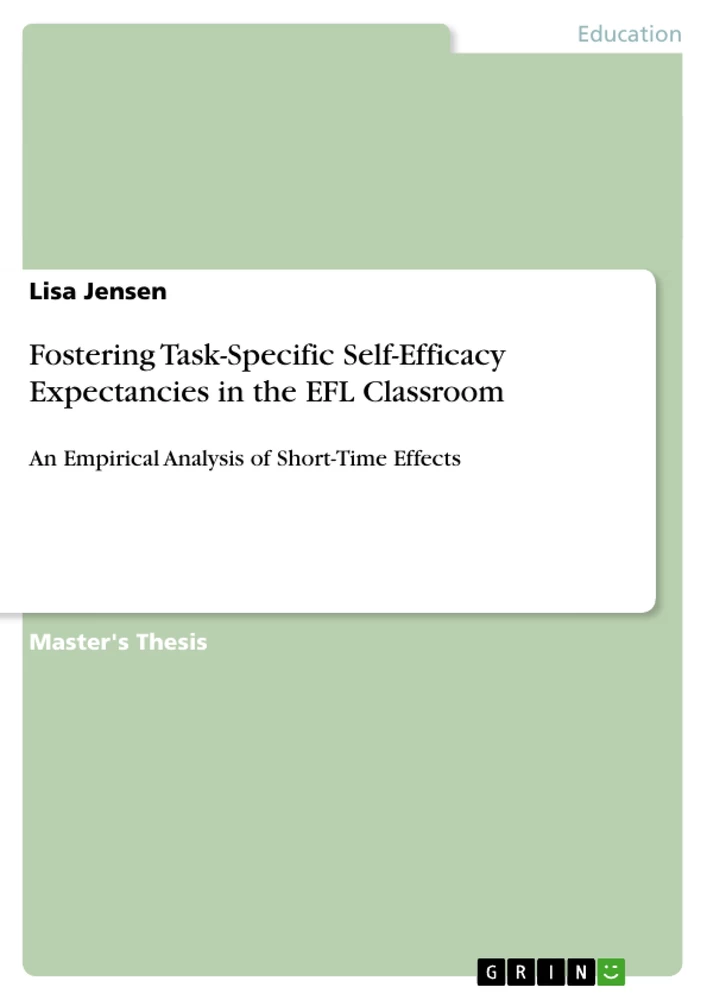
Table of Contents
1. Theories of Language Learning and Self-Beliefs
1.1. Introduction
1.2. Grammar Instruction in Second Language Acquisition
1.3. A Brief Motivation Theory Overview
1.4. Learners’ Self-Beliefs: A Cognitive-Motivational Perspective
1.4.1. Self-Concept
1.4.2. Self-Efficacy
1.4.3. Causal Attributions
1.4.4. Self-Beliefs and Self-Regulation
1.4.5. The Potential Effects of Teacher Feedback
1.5. Empirical Research on Learners’ Self-Beliefs and Grammar Teaching
1.5.1. Research on Grammar Teaching in the FL classroom
1.5.2. The Achievement Related Validity of Self-Efficacy
1.5.3. The Impact of Effort Attributional Feedback
1.6. Inferred Hypotheses
2. Self-Efficacy Training and Attribution Feedback - The Present Study
2.1. Method
2.1.1. Sample
2.1.2. Design and Procedure
2.1.3. Instrumentation
2.1.4. Statistical Analysis
2.2. Empirical Results
2.2.1. Preliminary Analyses
2.2.2. Treatment Effects by Group Comparison
2.2.3. Gender Effects
2.2.4. Grade Level Effects
2.2.5. Short-Term Effects of Self-Efficacy Training
2.3. Discussion of Empirical Findings
2.3.1. Results
2.3.2. Strengths and Limitations of the Present Study
2.3.3. Implications and Directions for Future Research
2.3.4. Educational Implications
2.4. Conclusion
Research Objectives and Core Themes
This master's thesis examines the short-term impact of a teacher-led self-efficacy and effort-attribution feedback intervention on English as a Foreign Language (EFL) learners in secondary schools, aiming to determine whether specific psychological feedback can influence students' self-beliefs and academic performance.
- Theoretical analysis of language learning, self-concept, and self-efficacy.
- Evaluation of effort-attributional feedback in classroom settings.
- Implementation of a quasi-experimental pretest-posttest control group design.
- Analysis of the relationship between self-beliefs, effort, and performance.
- Practical implications for grammar instruction and teacher feedback strategies.
Excerpt from the Book
1.4. Learners’ Self-Beliefs: A Cognitive-Motivational Perspective
Nowadays, it is commonly known that the beliefs learners hold about themselves are just as important as the skills they possess. If someone keeps telling himself ‘I can do it any-way’, he will not be able to do whatever he is supposed to do, regardless of whether his skills would actually permit the successful completion of the task. In school contexts, the self-beliefs especially focused on in the last few decades were self-concept, self-efficacy and causal attributions. Even though these beliefs are interrelated, they differ essentially enough to make it necessary to examine them separately. After having done that, the concept of self-regulation will be elaborated on and the role of teacher feedback examined.
Self-concept has generally been described as the views people hold about themselves, as Pajares and Schunk (2001) sum up. Self-concept emerges through positive and negative experiences and is relatively stable once established (Bong and Skaalvik, 2003). Bong and Skaalvik (2003) have identified five key sources of self-concept development:
Frames of reference. Skaalvik and Skaalvik (2002) identify several internal and external reference frames. They point out that social comparisons (external frames) often happen on school-average and/or classroom level of ability, depending on whether the school system allows for students to know a school average. For internal reference frames they identify four types: comparing achievements in different school subjects, comparing achievements in the same subject, comparing achievements in different subjects with goals for the same subject, comparing different subjects with the learner’s perceived applied effort in those subjects. Skaalvik and Skaalvik stress the complexity of these frames of reference by naming five sources: direct observation of achievement, teachers’ responses and comments in the classroom, responses from classmates, responses from people outside the classroom and grades. For optimal motivation, learners should be encouraged to use internal frames of reference, optimally comparing their achievements in the same subject, since this stresses effort attributions (as opposed to ability attributions which are enhanced by external frames of reference).
Summary of Chapters
1. Theories of Language Learning and Self-Beliefs: This chapter reviews foundational theories regarding language acquisition, motivation, and the cognitive-motivational aspects of self-beliefs, including self-concept, self-efficacy, and causal attributions.
2. Self-Efficacy Training and Attribution Feedback - The Present Study: This chapter details the empirical study, explaining the methodology, the intervention program, statistical analysis, the presentation of results, and a critical discussion of the findings and their educational implications.
Keywords
EFL Classroom, Self-Efficacy, Self-Concept, Causal Attributions, Effort Attributional Feedback, Grammar Teaching, Second Language Acquisition, Self-Regulation, Motivation, Student Performance, Educational Psychology, Intervention Study, Mastery Experiences, Teacher Feedback, Goal Setting.
Frequently Asked Questions
What is the primary focus of this thesis?
The thesis investigates how teacher-led interventions, specifically self-efficacy training and effort-attributional feedback, can foster positive self-beliefs and influence the academic performance of students in an EFL classroom.
What are the central themes discussed in the work?
The work focuses on the intersection of educational psychology and foreign language learning, specifically exploring how cognitive-motivational constructs like self-concept, self-efficacy, and causal attributions correlate with grammar learning.
What is the core research objective?
The primary research objective is to empirically determine if a structured intervention program implemented by regular teachers in a secondary school setting leads to significant short-term changes in students' self-beliefs and language performance.
Which methodology is employed in this research?
The study uses a quasi-experimental pretest-posttest control group design, involving 223 students from fifth and sixth grades. Data was collected via questionnaires across three time points and analyzed using ANOVA and descriptive statistics.
What topics are covered in the main section of the paper?
The main section covers the theoretical framework of self-beliefs and SLA, the specific design of the intervention study (including sample description and instrumentation), the presentation of empirical results, and a comprehensive discussion of the findings and limitations.
Which keywords best characterize this research?
Key terms include EFL Classroom, Self-Efficacy, Self-Concept, Effort Attributional Feedback, Causal Attributions, and Self-Regulation.
How does the author define the role of teacher feedback?
The author discusses teacher feedback not as a monolithic construct but as a multi-dimensional tool, emphasizing that effort-based feedback is more conducive to maintaining motivation and promoting an incremental view of ability than ability-based feedback.
What does the study conclude about the intervention's success?
The study concludes that significant changes were difficult to detect in a real-world school setting within the timeframe, highlighting challenges such as treatment implementation fidelity and the difficulty of isolating variables in a classroom environment.
Ende der Leseprobe aus 104 Seiten
- nach oben
- Arbeit zitieren
- Lisa Jensen (Autor:in), 2012, Fostering Task-Specific Self-Efficacy Expectancies in the EFL Classroom, München, Page::Imprint:: GRINVerlagOHG, https://www.diplomarbeiten24.de/document/209699

neugierig - aktuell - relevant
Entdecken Sie hilfreiche Tipps und Tricks rund ums Studium!

Entdecken Sie hilfreiche Tipps und Tricks rund ums Studium!
Ihre Hausarbeit / Abschlussarbeit:

- - Publikation als E-Book und Buch
- - Hohes Honorar auf die Verkäufe
- - Für Sie komplett kostenlos - mit ISBN
- - Es dauert nur 5 Minuten
- - Jede Arbeit findet Leser

- © GRIN Publishing GmbH.
- Alle Inhalte urheberrechtlich geschützt. Kopieren und verbreiten untersagt.
- info@grin.com
- AGB
- Open Publishing
Der GRIN Verlag hat sich seit 1998 auf die Veröffentlichung akademischer eBooks und Bücher spezialisiert. Der GRIN Verlag steht damit als erstes Unternehmen für User Generated Quality Content. Die Verlagsseiten GRIN.com, Hausarbeiten.de und Diplomarbeiten24 bieten für Hochschullehrer, Absolventen und Studenten die ideale Plattform, wissenschaftliche Texte wie Hausarbeiten, Referate, Bachelorarbeiten, Masterarbeiten, Diplomarbeiten, Dissertationen und wissenschaftliche Aufsätze einem breiten Publikum zu präsentieren.
Kostenfreie Veröffentlichung: Hausarbeit, Bachelorarbeit, Diplomarbeit, Dissertation, Masterarbeit, Interpretation oder Referat jetzt veröffentlichen!
Folgen Sie GRIN auf


- GRIN Verlag GmbH
-
- Nymphenburger Str. 86
- 80636
- Munich, Deutschland
- +49 89-550559-0
- +49 89-550559-10
- info@grin.com
-
