
präsentiert von


Table of Contents
1) Background & Importance of Customer Value-Based Model
2) Main Objectives
3) Problem Statement
4) Introduction
5) The Discounted Cash Flow Method
6) The Shareholder Value Concept
7) Customer Lifetime Value Concept
8) Customer Equity Concept
9) Customer Value-Based Model
Research Objectives and Focus Areas
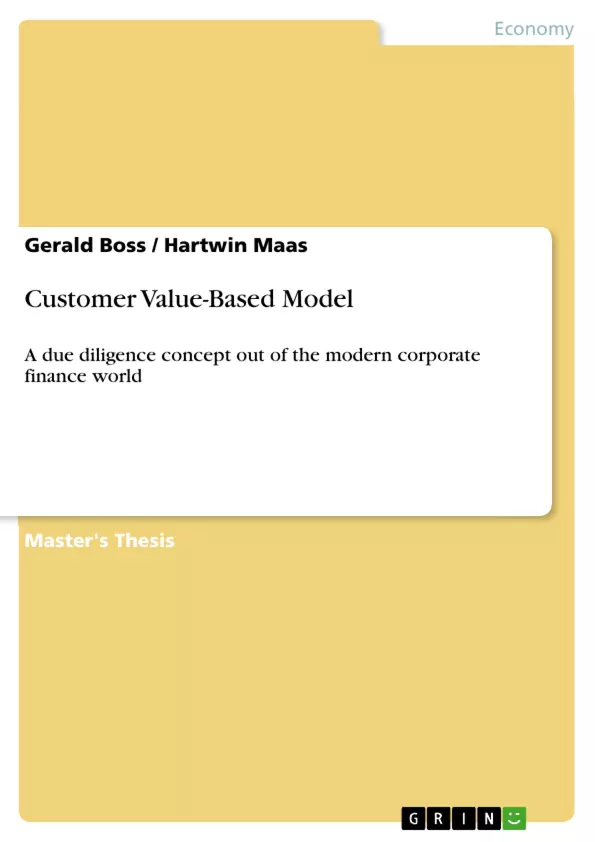
The primary objective of this thesis is to theoretically establish and implement a Customer Value-Based Model (CVM) that bridges marketing and finance. By synthesizing these disciplines, the research aims to improve corporate valuation and identify effective strategies for a Dutch car dealer group to enhance its overall corporate value over a three-year period.
- Integration of marketing metrics with corporate finance valuation methods.
- Assessment of customer lifetime value and its impact on firm performance.
- Development of a dynamic approach for corporate valuation under uncertainty.
- Strategic formulation based on customer-based segmentation and investment analysis.
Excerpt from the Book
1) Background & Importance of Customer Value-Based Model
Managers face a bunch of challenges due to the rapid nature of change and increasing complexity of today's competitive environment. According to Shay and Rothaermel (1999) many businesses get to reliant on particular strategic models. This comfort causes that managers act static and therefore miss to react on the never ending changes of the business world and its environment. Companies have to become aware of the fact that "products come and go, but customers remain" (Rust et al. 2001, p. 3). But since not all customers are equally profitable, marketing investment decisions into each customer have to differ. Gupta and Lehmann (2005) emphasised in “Managing Customers as Investments“ the importance of choosing the right customers. “All animals are equal but some are more equal than others”. The same is true for customers. All customers are important but some are more important than others, regarding to profitability. It makes sense to spent, say, €100 to acquire respectively hold a customer only if the value of a customer over its entire life with a company will be more than €100.
Mazur (1999) argues that companies have to know enough about customers to satisfy them, “and not waste money on costly activities that ultimately have little effect on the decision to buy” (Mazur 1999, p. 18). According to Reibstein (2006) only few firms take advantages of the tools to measure the long-term value of a customer. Furthermore, “there is not enough understanding and interaction between finance and marketing departments to develop this concept” (Reibstein 2006, p. 1). Reibstein (2006) by the same token as Bell et al. (2002), Gilmart (2002), Hogan, Lemon and Rust (2002) argue that a transformation respectively a perspective change is absolutely necessary for companies if they want to make the most out of their marketing investments. Moreover, to guide marketing strategy decisions, companies have to compute the long-term customer profitability. With this result companies can, according to Libai et al. (2002), try to optimize their marketing mix across their customer base. The idea of the assessment of a customer value and thus its profitability in a long-term is “that evaluations of both the anticipated return on investments (ROI) and the associated risks of those investments typically underlie the choice between investment opportunities” (Libai et al. 2002, p. 75).
Summary of Chapters
1) Background & Importance of Customer Value-Based Model: This chapter highlights the necessity for businesses to transition from traditional strategic models toward a customer-centric financial perspective, emphasizing long-term customer profitability.
2) Main Objectives: This chapter defines the core goals of the research, specifically focusing on the theoretical establishment of the CVM and its practical application to increase corporate value.
3) Problem Statement: This chapter outlines the main research question and sub-questions, centering on how to effectively merge marketing and financing approaches for valuation.
4) Introduction: This chapter provides an overview of the thesis structure and explains the rationale behind viewing customers as risky assets that generate future cash flows.
5) The Discounted Cash Flow Method: This chapter explains the traditional DCF methodology and discusses its limitations regarding flexibility and the incorporation of contingent business decisions.
6) The Shareholder Value Concept: This chapter explores the SHV approach, its seven key value drivers, and the critique that it lacks a direct link to the end-consumer.
7) Customer Lifetime Value Concept: This chapter introduces the CLV concept, detailing how it incorporates customer satisfaction and acquisition costs to better quantify value at an operative management level.
8) Customer Equity Concept: This chapter defines the Customer Equity (CE) model as an aggregation of the lifetime values of all current and future customers.
9) Customer Value-Based Model: This chapter synthesizes the previously discussed models into the comprehensive CVM, providing a holistic tool for strategic decision-making and precise corporate valuation.
Keywords
Customer Value-Based Model, CVM, Corporate Valuation, Customer Lifetime Value, CLV, Customer Equity, Shareholder Value, Marketing-Finance Interface, Discounted Cash Flow, Return on Investment, Strategic Planning, Customer Profitability, Value Drivers, Financial Analysis, Corporate Finance.
Frequently Asked Questions
What is the core focus of this thesis?
The thesis focuses on developing a new corporate valuation approach called the Customer Value-Based Model (CVM) to better integrate marketing investments with financial results.
What are the central themes of the research?
The research revolves around corporate finance, marketing management, customer profitability, valuation under uncertainty, and strategic resource allocation.
What is the primary research goal?
The primary goal is to establish a CVM that synchronizes marketing and financing to improve corporate value, specifically tested on a Dutch car dealer group.
Which scientific methods are employed?
The study utilizes Discounted Cash Flow (DCF) analysis, Shareholder Value (SHV) methodology, and Customer Lifetime Value (CLV) calculations as a foundation for the CVM.
What is addressed in the main body of the work?
The main body examines the limitations of traditional valuation methods, introduces customer-centric metrics, and demonstrates the synthesis of these metrics into a cohesive valuation model.
How can one define the most important keywords for this work?
The work is characterized by terms linking customer assets to financial performance, such as Customer Equity, Value Drivers, and Corporate Valuation.
How does the CVM differ from traditional DCF analysis?
Unlike traditional DCF, which may treat projects as fixed propositions, the CVM incorporates customer satisfaction and retention as active drivers, allowing for more flexible strategic adaptations.
Why is the link between finance and marketing considered critical?
The author argues that without a direct link to customer-based value, traditional financial models fail to account for the true drivers of long-term firm profitability and customer assets.
Ende der Leseprobe aus 37 Seiten
- nach oben
- Arbeit zitieren
- Mag. (FH), MIB Gerald Boss (Autor:in), Dipl.-Wirtsch.-Ing, MIB Hartwin Maas (Autor:in), 2005, Customer Value-Based Model, München, Page::Imprint:: GRINVerlagOHG, https://www.diplomarbeiten24.de/document/210178

neugierig - aktuell - relevant
Entdecken Sie hilfreiche Tipps und Tricks rund ums Studium!

Entdecken Sie hilfreiche Tipps und Tricks rund ums Studium!
Ihre Hausarbeit / Abschlussarbeit:

- - Publikation als E-Book und Buch
- - Hohes Honorar auf die Verkäufe
- - Für Sie komplett kostenlos - mit ISBN
- - Es dauert nur 5 Minuten
- - Jede Arbeit findet Leser

- © GRIN Publishing GmbH.
- Alle Inhalte urheberrechtlich geschützt. Kopieren und verbreiten untersagt.
- info@grin.com
- AGB
- Open Publishing
Der GRIN Verlag hat sich seit 1998 auf die Veröffentlichung akademischer eBooks und Bücher spezialisiert. Der GRIN Verlag steht damit als erstes Unternehmen für User Generated Quality Content. Die Verlagsseiten GRIN.com, Hausarbeiten.de und Diplomarbeiten24 bieten für Hochschullehrer, Absolventen und Studenten die ideale Plattform, wissenschaftliche Texte wie Hausarbeiten, Referate, Bachelorarbeiten, Masterarbeiten, Diplomarbeiten, Dissertationen und wissenschaftliche Aufsätze einem breiten Publikum zu präsentieren.
Kostenfreie Veröffentlichung: Hausarbeit, Bachelorarbeit, Diplomarbeit, Dissertation, Masterarbeit, Interpretation oder Referat jetzt veröffentlichen!
Folgen Sie GRIN auf


- GRIN Verlag GmbH
-
- Nymphenburger Str. 86
- 80636
- Munich, Deutschland
- +49 89-550559-0
- +49 89-550559-10
- info@grin.com
-
