
präsentiert von

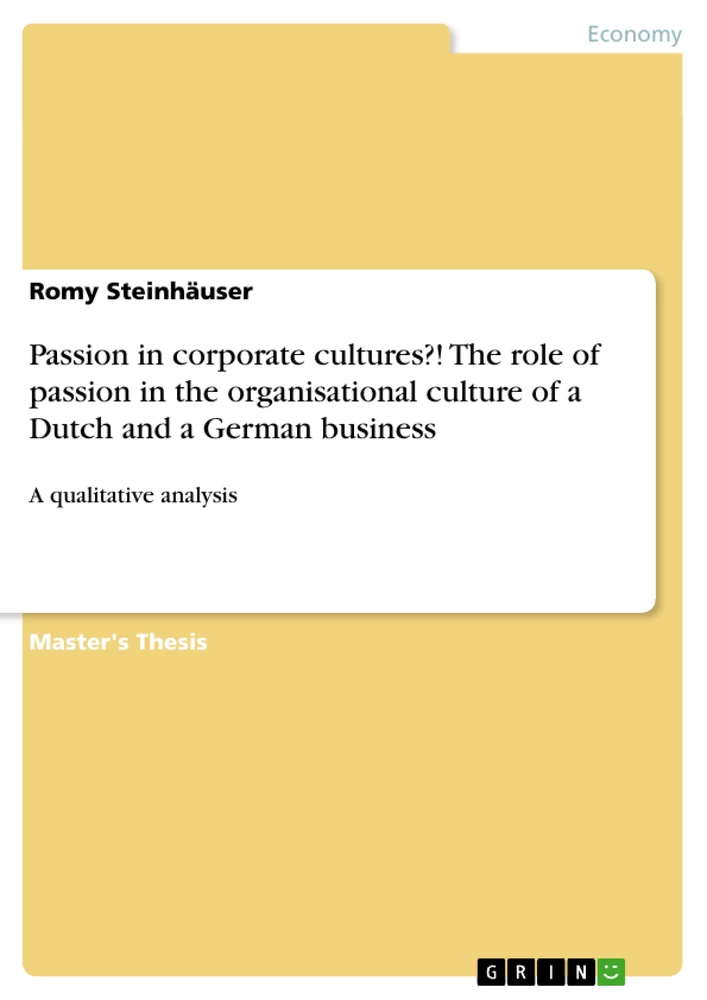
Table of Contents
1. Introduction
1.1 Background and relevance of the study
1.2 Central research themes
1.3 Central research questions
1.4 Central research aims
1.5 Contribution of the study
1.6 Further structure and content of the study
2. Passion in corporate cultures?! – Answers from literature
2.1 Investigating the concept of passion
2.1.1 In search for the elements of passion
2.1.2 Alternative ways to look at passion
2.1.3 The concept of passion – Implications of the findings for this research
2.2 Examining the concept of (passionate) corporate cultures
2.2.1 The four energy zones model (Bruch & Ghoshal, 2003)
2.2.2 The Gods of management classification (Handy, 1995)
2.2.3 Confucianism or the theory of the Ren and the Li – Part II (Weymes, 2005)
2.2.4 The concept of (passionate) corporate cultures – Implications of the findings for this study
2.3 A new way of combining the concepts of passion and corporate culture
2.3.1 The first dimension – Body
2.3.2 The second dimension – Mind
2.3.3 The third dimension – Soul
2.3.4 The fourth dimension – Spirit
2.3.5 A model of the four-dimensionality of passionate corporate cultures
2.3.6 The 4D model of passionate corporate cultures – Implications of the findings for this research
2.4 Summary of the literature review
3. Research Design
3.1 Phenomenology
3.2 The cases
3.2.1 Selection criteria
3.2.2 Description of the organisations
3.3 The methods
3.3.1 Preparatory booklets
3.3.2 Semi-structured interviews
3.3.3 Observations
3.4 The data collection
3.4.1 The data collection process at K&S
3.4.2 The data collection process at Hotel Bristol
3.5 The data analysis
3.5.1 Phase 1: Reducing the data and making them anonymous
3.5.2 Phase 2: Arranging and assembling the data
3.5.3 Phase 3: Establishing and identifying key themes and patterns
3.6 Limitations during the research process
3.7 Summary of the research design
4. Results
4.1 Interview and observation results
4.1.1 Main findings at Kessels & Smit
4.1.2 Interim summary of the main findings at Kessels & Smit
4.1.3 Main findings at Hotel Bristol
4.1.4 Interim summary of the results at Hotel Bristol
4.2 Further findings regarding the concept of passion and corporate cultures
4.2.1 The elements of the concept of passion
4.2.2 The elements of corporate cultures and the links to passion
4.3 Summary of the results chapter
5. Discussion & Conclusion
5.1 Discussion of the conclusions from the analysis process
5.1.1 Answers to the question: ‘What is the concept of passion?’
5.1.2 Recommendations regarding the concept of passion
5.1.3 Answers to the question: ‘To what does the concept of passion relate in corporate cultures?’
5.1.4 Recommendations regarding the concept of passion
5.1.5 Answers to the question: ‘What factors nurture/ inhibit passion in corporate cultures?’
5.1.6 Recommendations regarding support factors and inhibitors of passion
5.2 Critical review of the research process and learning experiences
5.3 Overall summary and conclusions
Research Objectives and Core Themes
This master thesis aims to develop a research-based understanding of the role and influence of passion within organisational cultures. By examining two distinct organisations—a Dutch HRD consultancy and a German superior hotel—the study investigates how passion acts as a multidimensional construct, how it is triggered or inhibited in the workplace, and how it translates into corporate culture to influence organisational dynamics and individual performance.
- Theoretical foundations of passion in personal and professional contexts
- Development of a four-dimensional model (body, mind, soul, spirit) to map passionate corporate cultures
- Exploratory case study analysis comparing a Dutch and a German organisation
- Identification of nurturing factors and inhibitors for passion within corporate settings
- Practical implications for Human Resource Development (HRD) professionals
Excerpt from the Book
The first dimension – Body
Human beings – The importance of the body respectively people's physical and mental health has gained significant importance in recent years. For, in today's fast and vastly changing world it becomes more and more difficult for people to avoid disturbances and instabilities in their bodies and their health as they face an increasing imbalance between effort and relaxation on a daily basis (Kallus in Klasman, 2005). However, as health most likely becomes the main driving force in economies in the near future (Nefiodow in Bergmann, 2002), people's 'bodies' will come into the focus of attention even more in coming years. First signs of this are already present in society. For instance, while it was difficult to find fat-reduced products in some shops and supermarkets a decade ago, today almost all food retailers offer them en masse.
Similarly, the awareness for healthy employees has risen in organisations. An example of this is the Californian company Pantagonia Inc. This organisation does not only encourage workers to pursue their passion but also values healthy employees. All workers are thus welcome to carry out their sport activities at any time during the day (e.g. during their lunch break). This has led Pantagonia not only to become very successful financially in recent years but was also crowned with the 2000 WORKEFORCE Optimas Award for the quality of work life they offer (Laabs, 2000).
How does the dimension 'body' relate to the concept of passion? – According to Leider (2000), following one's authentic vocation means "living from the inside out" (p.106). This suggests that simply expressing one's passion can significantly contribute to one's health. For, as Psychology has repeatedly shown, suppression of feelings or wishes can create tremendous stress and unrest (e.g. Gleitman, 1999; Gross, 2001; Pervin & John, 2001). On the other hand, Chaudhuri (2001) argues that being passionate means valuing and opting for enjoying all elements of life (e.g. good music, food, nature, etc). If Chaudhuri's assumption is correct, it can hence be said that passionate persons may particular attention to their health.
Summary of Chapters
1. Introduction: This chapter provides an overview of the research topic, its relevance to HRD professionals, and outlines the central research themes, questions, and the study's overall contribution.
2. Passion in corporate cultures?! – Answers from literature: This chapter explores theoretical frameworks to define passion and its role in corporate settings, culminating in the development of a unique four-dimensional framework.
3. Research Design: This section describes the phenomenological and case study-based methodology used to investigate the research questions through preparatory booklets, interviews, and observations.
4. Results: This chapter presents the data collected from both organisations, highlighting the specific passions of employees and the environmental factors that nurture or inhibit them.
5. Discussion & Conclusion: This chapter synthesizes the findings, answers the central research questions, and provides practical recommendations for HRD practitioners alongside a critical review of the research process.
Keywords
Passion, Corporate Culture, Human Resource Development, Organisation, Authenticity, Motivation, Engagement, Four-dimensionality, Qualitative Research, Case Study, Workplace, Employee Development, Leadership, Connectivity, Work Environment
Frequently Asked Questions
What is the core focus of this research?
The research explores the elusive concept of "passion" and its presence, function, and influence within corporate cultures, specifically looking at how it can be understood as an organisational asset.
Which theoretical fields are primarily addressed?
The study draws from anthropology, philosophy (specifically Confucianism), management theory (such as the four energy zones model and Gods of management), and HRD literature.
What is the central research question?
The primary aims are to define the concept of passion, examine its relation to corporate cultures, and identify the specific factors that nurture or inhibit passion within a workplace.
What research methodology was employed?
The author utilized a qualitative case study design, conducting 25 semi-structured interviews and 21 observation sessions across two organisations (Kessels & Smit and Hotel Bristol).
What does the main body of the work cover?
It details the literature review on passion, the construction of a new 4D framework (body, mind, soul, spirit), the systematic data collection process, and a comprehensive analysis of the results from the two case studies.
Which keywords best characterize this work?
Key terms include Passion, Corporate Culture, Human Resource Development, Authenticity, and Employee Engagement.
How does the author define passion in the corporate context?
The author views passion as a holistic, multifaceted construct that influences individual meaning-making and collective organisational energy, often manifesting through "lived" organisational experiences.
What are the specific findings regarding nurturing and inhibiting factors?
The findings identify factors like social support/colleagues, autonomy, and appreciation as key nurturing elements, while routine, lack of transparency, and rigid hierarchical structures are noted as primary inhibitors.
Ende der Leseprobe aus 148 Seiten
- nach oben
- Arbeit zitieren
- Romy Steinhäuser (Autor:in), 2006, Passion in corporate cultures?! The role of passion in the organisational culture of a Dutch and a German business, München, Page::Imprint:: GRINVerlagOHG, https://www.diplomarbeiten24.de/document/212589

neugierig - aktuell - relevant
Entdecken Sie hilfreiche Tipps und Tricks rund ums Studium!

Entdecken Sie hilfreiche Tipps und Tricks rund ums Studium!
Ihre Hausarbeit / Abschlussarbeit:

- - Publikation als E-Book und Buch
- - Hohes Honorar auf die Verkäufe
- - Für Sie komplett kostenlos - mit ISBN
- - Es dauert nur 5 Minuten
- - Jede Arbeit findet Leser

- © GRIN Publishing GmbH.
- Alle Inhalte urheberrechtlich geschützt. Kopieren und verbreiten untersagt.
- info@grin.com
- AGB
- Open Publishing
Der GRIN Verlag hat sich seit 1998 auf die Veröffentlichung akademischer eBooks und Bücher spezialisiert. Der GRIN Verlag steht damit als erstes Unternehmen für User Generated Quality Content. Die Verlagsseiten GRIN.com, Hausarbeiten.de und Diplomarbeiten24 bieten für Hochschullehrer, Absolventen und Studenten die ideale Plattform, wissenschaftliche Texte wie Hausarbeiten, Referate, Bachelorarbeiten, Masterarbeiten, Diplomarbeiten, Dissertationen und wissenschaftliche Aufsätze einem breiten Publikum zu präsentieren.
Kostenfreie Veröffentlichung: Hausarbeit, Bachelorarbeit, Diplomarbeit, Dissertation, Masterarbeit, Interpretation oder Referat jetzt veröffentlichen!
Folgen Sie GRIN auf


- GRIN Verlag GmbH
-
- Nymphenburger Str. 86
- 80636
- Munich, Deutschland
- +49 89-550559-0
- +49 89-550559-10
- info@grin.com
-
