
präsentiert von

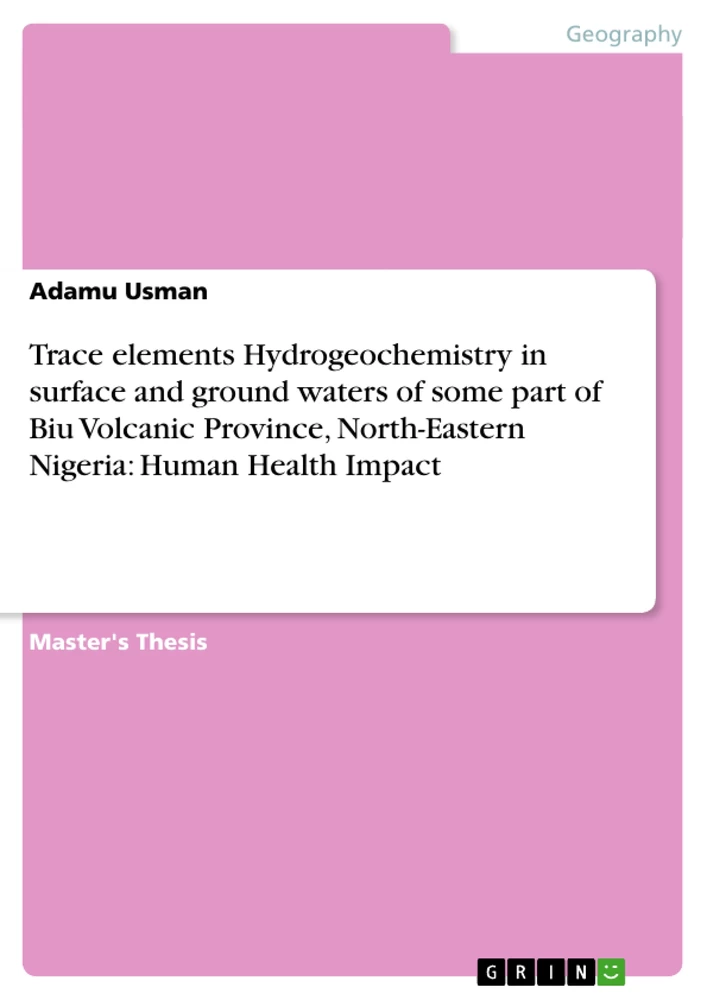
Table of Contents
CHAPTER ONE: General Introduction
Introduction
Location, Extent and Accessibility
Relief and Drainage
Climate and Vegetation
Settlement and Land Use
Aims and Objectives
Scope of the Studies
CHAPTER TWO: Literature review
Introduction
Effects of Trace Elements in Volcanic Areas
CHAPTER THREE: Detailed Geology and Hydrogeology of the study area
3.1.0 Introduction
3.1.1 Porphyritic and Amygdaloidal Variet.
3.1.2 Large Phenocryst of Zoned labradorite
3.1.3 Agglomerates, Tuffs and Brownish Red Basaltic Scoria
3.2.0 Hydrogeology of the Study Area
3.2.1 Introduction
3.2.2 Surface Water
3.2.3 LakeTila
3.2.4 Perennial Stream Water
3.2.5 Groundwater in the Basalts
3.2.6 Data Collection
3.2.7 Data Processing
3.2.8 Interpretation of Groundwater Map
3.2.9 Structures
3.2.10 Joints
CHAPTER FOUR: Hydrogeochemistry
4.0 Introduction
4.1.1 Sample Collection and Preservation
4.1.2 Water Sample Preparations
4.1.3 Soil Sample Preparations
4.2 Analytical Technique
CHAPTER FIVE:Result/Discussion
5.1.0 Presentation of Results
5.1.1 Water Sample
5.1.2 MajorElements
5.1.3 TraceElements
5.2.0 Soil Sample Analysis Results
5.2.1 Major Elements
5.2.2 Trace Elements
5.3.0 Discussion
5.3.1 Major Elements in Soil and Water Samples
5.3.2 Trace Elements in Soil and Water Samples
5.4.0 Trace Element Exposure And Human Health Impact
5.4.1 Introduction
5.4.2 Trace Element Exposure
5.5 Trace Elements and Human Health Impact
CHAPTER SIX: Summary, Conclusion/Recommendations
6.1.1 Summary
6.1.2 Conclusion
6.1.3 Recommendations
Research Objectives and Topics
This study aims to provide foundational data on the distribution of trace elements within the surface and groundwater of the Biu Volcanic Province, focusing specifically on assessing potential health impacts resulting from the consumption of these waters due to trace element toxicity or deficiency.
- Trace element concentration levels in soil and natural water sources.
- The influence of soil composition on local water chemistry.
- Comparison of analytical data against World Health Organization (WHO) standards.
- Database creation for environmental, hydrogeological, and medical geology applications.
Excerpt from the Book
3.2.1 INTRODUCTION
Water is the most important natural resource provided for survival of man by nature. Globally, water is mostly used for domestic, industrial and agricultural purposes.
The water resources of the study area can be divided into surface and groundwater resources.
The surface water of this area occurs in the form of streams and lakes. They serve as water supply sources for both drinking and domestic uses. Most of the streams are seasonal. The streams and lakes are recharged by direct precipitation during the rainy season.
Summary of Chapters
CHAPTER ONE: General Introduction: Provides an overview of the research, describing the study area, its geography, climate, and the general importance of understanding trace element distribution for human health.
CHAPTER TWO: Literature review: Discusses existing research on trace elements in volcanic environments and their global impacts on human and animal health.
CHAPTER THREE: Detailed Geology and Hydrogeology of the study area: Outlines the geological framework of the Biu Plateau, its rock types, and the hydrogeological characteristics of the region's aquifers.
CHAPTER FOUR: Hydrogeochemistry: Details the methodologies used for sample collection, preparation, and the analytical techniques employed for geochemical assessment.
CHAPTER FIVE:Result/Discussion: Presents and analyzes the chemical data, comparing findings with WHO standards to assess environmental and potential human health impacts.
CHAPTER SIX: Summary, Conclusion/Recommendations: Synthesizes the research findings, offers conclusions on water contamination, and proposes recommendations for future investigation and management.
Keywords
Biu Volcanic Province, Hydrogeochemistry, Trace Elements, Groundwater, Surface Water, Volcanic Soils, Human Health Impact, Toxicity, Deficiency, WHO Standards, Geogenic Contamination, Arsenic, Selenium, Antimony, Lead.
Frequently Asked Questions
What is the primary focus of this research?
The research investigates the trace element hydrogeochemistry in the surface and groundwater of the Biu Volcanic Province to assess potential human health impacts.
What are the central themes of this study?
The study centers on environmental geochemistry, volcanic geology, water quality assessment, and medical geology.
What is the main objective of the work?
The primary goal is to determine trace element concentrations in water and soil, compare these with international health standards, and evaluate the risk of toxicity or deficiency for the local population.
Which scientific methods are utilized?
The researcher uses field sampling of water and soil, followed by laboratory analysis using Inductively Coupled Plasma Optical Emission Spectrometry (ICP-OES) and data processing with software like Surfer and Microsoft Excel.
What does the main body of the paper cover?
The body covers geological and hydrogeological descriptions, detailed chemical analytical results of water and soil samples, and discussions on the relationship between these findings and human health.
Which keywords characterize this work?
Key terms include Biu Volcanic Province, trace elements, hydrogeochemistry, groundwater, water toxicity, and health impact.
How does the basaltic geology influence water chemistry in the region?
Weathering of volcanic rocks releases elements into the environment; the study finds that while some major elements are leached from soil into water, specific Potentially Harmful Elements (PHEs) also show high concentrations due to extreme solubility.
What are the identified health risks for the inhabitants of the Biu Volcanic Province?
Long-term exposure to harmful elements like Arsenic, Selenium, Antimony, and Lead is linked to health manifestations such as nail deformities, skin rashes, hyper-pigmentation, and other dermatological issues.
Ende der Leseprobe aus 133 Seiten
- nach oben
- Arbeit zitieren
- Adamu Usman (Autor:in), 2012, Trace elements Hydrogeochemistry in surface and ground waters of some part of Biu Volcanic Province, North-Eastern Nigeria: Human Health Impact, München, Page::Imprint:: GRINVerlagOHG, https://www.diplomarbeiten24.de/document/214684

neugierig - aktuell - relevant
Entdecken Sie hilfreiche Tipps und Tricks rund ums Studium!

Entdecken Sie hilfreiche Tipps und Tricks rund ums Studium!
Ihre Hausarbeit / Abschlussarbeit:

- - Publikation als E-Book und Buch
- - Hohes Honorar auf die Verkäufe
- - Für Sie komplett kostenlos - mit ISBN
- - Es dauert nur 5 Minuten
- - Jede Arbeit findet Leser

- © GRIN Publishing GmbH.
- Alle Inhalte urheberrechtlich geschützt. Kopieren und verbreiten untersagt.
- info@grin.com
- AGB
- Open Publishing
Der GRIN Verlag hat sich seit 1998 auf die Veröffentlichung akademischer eBooks und Bücher spezialisiert. Der GRIN Verlag steht damit als erstes Unternehmen für User Generated Quality Content. Die Verlagsseiten GRIN.com, Hausarbeiten.de und Diplomarbeiten24 bieten für Hochschullehrer, Absolventen und Studenten die ideale Plattform, wissenschaftliche Texte wie Hausarbeiten, Referate, Bachelorarbeiten, Masterarbeiten, Diplomarbeiten, Dissertationen und wissenschaftliche Aufsätze einem breiten Publikum zu präsentieren.
Kostenfreie Veröffentlichung: Hausarbeit, Bachelorarbeit, Diplomarbeit, Dissertation, Masterarbeit, Interpretation oder Referat jetzt veröffentlichen!
Folgen Sie GRIN auf


- GRIN Verlag GmbH
-
- Nymphenburger Str. 86
- 80636
- Munich, Deutschland
- +49 89-550559-0
- +49 89-550559-10
- info@grin.com
-
