
präsentiert von

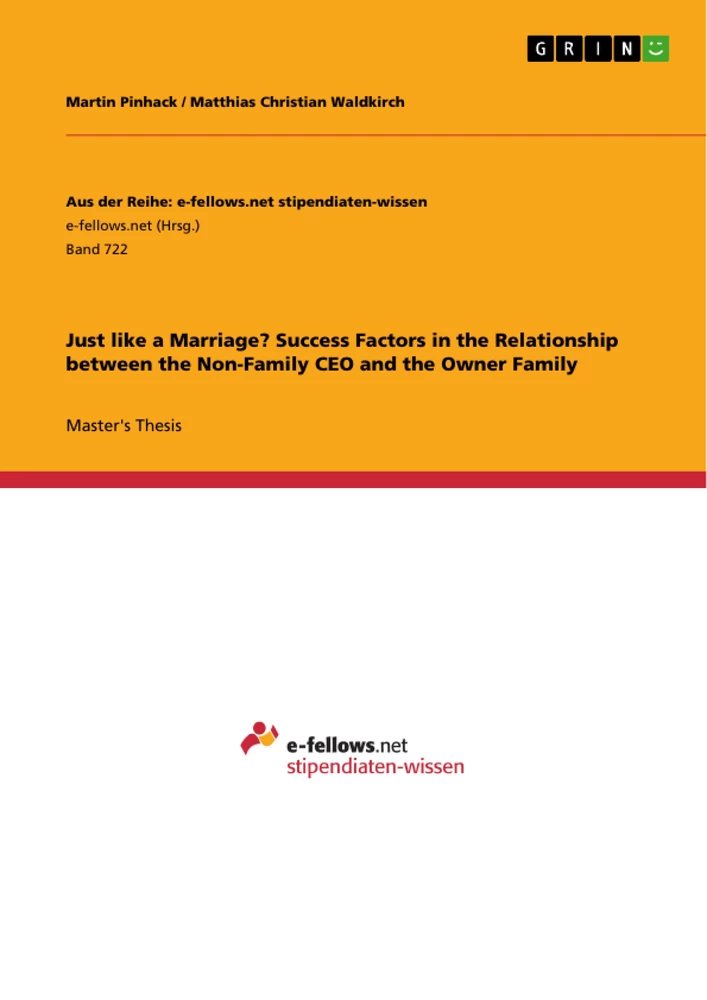
Table of Contents
1 Introduction
1.1 Problem
1.2 Background
1.3 Purpose
1.4 Structure of the Thesis
2 Frame of References
2.1 NFCs in Family Businesses in Sweden
2.2 The Chief Executive Officer
2.2.1 Role of the CEO
2.2.2 CEO Appointment
2.3 The CEO in Family Businesses
2.3.1 The Model of Three Circles in Family Businesses
2.3.2 Working in a Family Business
2.3.3 Managing the Family Business
2.3.4 Continuity and Succession in Family Businesses
2.3.5 Non-Family CEOs in Family Businesses
3 Methodology
3.1 Research Philosophy
3.2 Research Purpose
3.3 Research Approach
3.4 Research Strategy
3.5 Data Collection
3.5.1 Sampling Method
3.5.2 Different Types of Interviews
3.5.3 Conducting the Interviews
3.5.4 Research Ethics
3.5.5 Analysing the Empirical Data
3.6 Research Time Horizon
3.7 Research Credibility
3.8 Data Presentation
4 Analysis
4.1 Learning to Step Out of the Business
4.2 Finding a New Role for the Old Generation
4.3 Succession and the Role of the New Generation
4.4 Learning to Become a Good Owner
4.5 Characteristics of a NFC
4.5.1 Background of a NFC
4.5.2 Personality of a NFC
4.5.3 Being a NFC – a Long-Term Commitment
4.6 Finding the Right Way for Recruiting a NFC
4.6.1 External Recruitment
4.6.2 Internal Recruitment
4.7 The Importance of a Strong Board
5 Conclusion, Contribution and Further Research
5.1 Conclusion
5.1.1 Mutual Agreement on Communication
5.1.2 Dedication or the Call for Stewards
5.1.3 Double-Sided Leadership
5.1.4 Achieving a Balance of Involvement
5.1.5 The Integration of the Next Generation
5.2 Contribution
5.3 Recommendations
5.4 Future Research
Research Objectives & Key Topics
The primary objective of this thesis is to identify and elaborate on the critical success factors governing the relationship between non-family CEOs (NFCs) and owner families within family-owned enterprises. The study addresses the complexity of navigating professional management in an environment deeply rooted in familial and emotional dynamics.
- The influence of the "old generation" owners versus the "new generation" owners in their interaction with the NFC.
- Methods for finding a balance of involvement between family members and the appointed external management.
- The significance of cultural competence and family business background for successful non-family leadership.
- Strategies for professionalizing communication and board structures to facilitate healthy transitions.
- The role of succession planning and the emotional attachment of founders to their "corporate baby."
Excerpt from the Book
4.1 Learning to Step Out of the Business
In most cases we have witnessed, the NFC has taken over the command straight from the last family CEO. The former family CEO is mostly also the main owner, so there was a lot of contact between the NFC and the old generation main owner. A good connection between the OGO and the NFC can be a great asset for the business; nevertheless, there are many possible traps and pitfalls in this relationship.
One aspect we encountered very often is the problem of the old generation to set clear boundaries on their involvement in the daily business. They have been in the company for many years, often involved as the CEO, so their company in a way is “like a family member” (NGO) to them. One famous quotation about founder owners described their relationship to the business as follows: “At first it is your mistress, but it winds up being your child” (Berenbeim, 1990, p. 84). It is therefore clear that giving “your baby” (NFC) into the hands of an NFC is a difficult step to take. Some OGOs we met have managed to deal with this issue very well, whereas other owners struggle to find their place in the business. The following part will elaborate on these findings.
Chapter Summaries
1 Introduction: Provides the context regarding the rising significance of non-family CEOs in family businesses and defines the research problem regarding their complex relationship with owner families.
2 Frame of References: Reviews academic literature on the role of CEOs in family businesses, succession dynamics, and the specific challenges associated with the three-circle model of family, ownership, and business.
3 Methodology: Details the inductive research strategy and qualitative approach, emphasizing the use of semi-structured interviews with Swedish family businesses to build new theory.
4 Analysis: Examines key success factors through empirical data, focusing on the roles of the old and new generations, characteristics of the NFC, and the professionalization of boards.
5 Conclusion, Contribution and Further Research: Synthesizes the findings into five core success factors and offers practical, hands-on recommendations for stakeholders while suggesting avenues for future research.
Keywords
Family Business, Succession, Non-Family CEO, Ownership, Relationships in Family Business, New Generation, CEO Recruitment, Stewardship, Cultural Competence, Professional Management, Board of Directors, Emotional Capital, Business Continuity, Leadership Succession, Organizational Dynamics.
Frequently Asked Questions
What is the core focus of this thesis?
The thesis focuses on identifying and analyzing the success factors that determine the quality and productivity of the relationship between non-family CEOs and owner families in family-owned companies.
What are the primary themes discussed in the work?
The work explores themes such as generational transitions, the emotional challenges of "letting go" for founders, the professionalization of boards, the need for mutual trust, and the integration of the next generation of owners.
What is the overarching research goal?
The goal is to provide a deeper understanding of how these distinct parties can collaborate effectively to ensure business continuity and long-term organizational success despite different roles and emotional stakes.
Which scientific methodology was applied?
The authors utilized an inductive, exploratory research approach based on Grounded Theory, conducting 16 semi-structured, face-to-face interviews within seven Swedish family businesses.
What topics are covered in the main body of the research?
The main body covers the transition of the "old generation," the role of the "new generation" in ownership, the essential characteristics and background required for an effective NFC, and the strategic importance of a professionalized board.
What primary keywords best describe this study?
Key terms include Family Business, Non-Family CEO (NFC), Succession, Stewardship, Cultural Competence, and Board Professionalization.
How does the "Old Generation" impact the success of the NFC?
The "Old Generation" (OGO) often struggles with excessive involvement. Success depends on their ability to set boundaries, communicate clearly, and transition from an operational role to a supportive, long-term strategic role as a board member.
Why is the "New Generation" mentioned as a specific factor in the study?
The "New Generation" (NGO) represents the future owners of the business. Their lack of involvement or clarity regarding their future role can create significant tension; therefore, their early integration and training are crucial for long-term continuity.
Ende der Leseprobe aus 80 Seiten
- nach oben
- Arbeit zitieren
- Martin Pinhack (Autor:in), Matthias Christian Waldkirch (Autor:in), 2013, Just like a Marriage? Success Factors in the Relationship between the Non-Family CEO and the Owner Family, München, Page::Imprint:: GRINVerlagOHG, https://www.diplomarbeiten24.de/document/214925

neugierig - aktuell - relevant
Entdecken Sie hilfreiche Tipps und Tricks rund ums Studium!

Entdecken Sie hilfreiche Tipps und Tricks rund ums Studium!
Ihre Hausarbeit / Abschlussarbeit:

- - Publikation als E-Book und Buch
- - Hohes Honorar auf die Verkäufe
- - Für Sie komplett kostenlos - mit ISBN
- - Es dauert nur 5 Minuten
- - Jede Arbeit findet Leser

- © GRIN Publishing GmbH.
- Alle Inhalte urheberrechtlich geschützt. Kopieren und verbreiten untersagt.
- info@grin.com
- AGB
- Open Publishing
Der GRIN Verlag hat sich seit 1998 auf die Veröffentlichung akademischer eBooks und Bücher spezialisiert. Der GRIN Verlag steht damit als erstes Unternehmen für User Generated Quality Content. Die Verlagsseiten GRIN.com, Hausarbeiten.de und Diplomarbeiten24 bieten für Hochschullehrer, Absolventen und Studenten die ideale Plattform, wissenschaftliche Texte wie Hausarbeiten, Referate, Bachelorarbeiten, Masterarbeiten, Diplomarbeiten, Dissertationen und wissenschaftliche Aufsätze einem breiten Publikum zu präsentieren.
Kostenfreie Veröffentlichung: Hausarbeit, Bachelorarbeit, Diplomarbeit, Dissertation, Masterarbeit, Interpretation oder Referat jetzt veröffentlichen!
Folgen Sie GRIN auf


- GRIN Verlag GmbH
-
- Nymphenburger Str. 86
- 80636
- Munich, Deutschland
- +49 89-550559-0
- +49 89-550559-10
- info@grin.com
-
