
präsentiert von

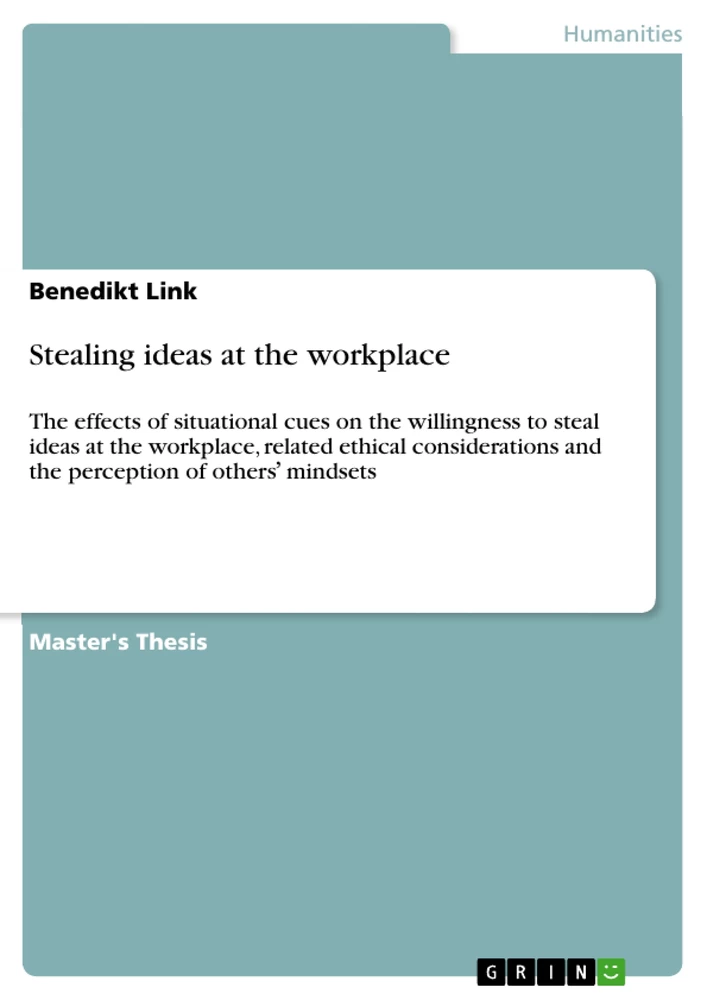
Table of Contents
1. INTRODUCTION
2. THEORY AND HYPOTHESES
2.1 The role of subliminal priming
2.2 Willingness to take credit without and with escalating severity of consequences
2.3 Perceived ethical costs
2.4 Perception of others’ mindset
3. METHODOLOGY
4. RESULTS
4.1 Quantitative results
4.2 Qualitative results
5. DISCUSSION
6. LIMITATIONS
7. CONCLUSION AND IMPLICATIONS
Research Objectives & Topics
The study investigates the impact of situational cues, specifically subliminal priming, on an individual's decision-making regarding the theft of intellectual ideas in a workplace setting under high-pressure conditions. It aims to determine if environmental factors like competition or cooperation can trigger specific mindsets that influence an individual's willingness to take credit for a colleague's work, their perception of ethical costs, and their projections of others' decision-making processes.
- Effects of subliminal priming on workplace behavior
- Willingness to take credit for others' ideas
- Perceived ethical costs and norm violations
- Perception of others’ competitive or cooperative mindsets
- Individual decision-making processes under high workload strain
Excerpt from the Book
1. Introduction
In his book “The rise of the knowledge worker” James Cortada (1998) describes the change in industrialized and increasingly computerized countries: More and more workers are required not to manufacture new goods anymore, but to provide knowledge and information to those who still do. In fact, with the manufacturing industries declining and the shift to service and knowledge sectors in developed countries, the importance of generating new ideas and innovation has risen over the last decades (Schettkat/Yocarini 2003).
With increasing importance of ideas, they more and more pose a competitive advantage for workers who have ideas over those who donʼt. Following this thought, Wang and Noe (2010: 124) found in the literature about knowledge sharing that ideas can act as positive factors in oneʼs performance evaluation and thus in promotions, bonuses and other forms of personal gains. They also mention that employees in possession of valuable ideas will tend to guard them and thus keep their status as an expert in a particular area. As with any other resource, individuals who are in need of a valuable idea, but are not able to obtain it for whatever reason, might be tempted to illegally take credit for an idea of another person. A popular example for this poses the former German Minister of Defence, Karl-Theodor zu Guttenberg, who was recently stripped of doctorate due to plagiarism. He justified the substantial copying with his heavy workload as member of the German parliament while raising his two daughters (Pidd 2011).
Summary of Chapters
1. INTRODUCTION: This chapter highlights the rising importance of knowledge work and ideas, introducing the core problem of employees tempted to steal credit for others' ideas due to job pressure and workload.
2. THEORY AND HYPOTHESES: It explores the psychological concepts of subliminal priming, ethical decision-making, and the perceived mindset of others, resulting in four formal hypotheses regarding how competitive or cooperative environments influence behavior.
3. METHODOLOGY: This section details the laboratory experiment involving 64 participants, outlining the priming procedure, the fictional scenario used for assessment, and the statistical methods employed for quantitative and qualitative data analysis.
4. RESULTS: The chapter presents the findings, noting that the priming manipulations did not significantly support the initial hypotheses, but revealing significant inter-scale correlations and providing a thematic analysis of the qualitative data.
5. DISCUSSION: This part interprets the unexpected results, discusses the role of control variables like personality and stress, and reflects on why the experimental design may have failed to trigger the anticipated priming effects.
6. LIMITATIONS: The chapter outlines critical constraints of the study, including the sample size, the diverse native languages of participants, and the artificiality of the hypothetical moral scenario.
7. CONCLUSION AND IMPLICATIONS: It summarizes the findings, suggesting that while the initial goals were not met, the study offers valuable insights for future research on the intersection of ethical reasoning and utilitarian considerations in the workplace.
Keywords
Subliminal Priming, Idea Theft, Workplace Ethics, Competitive Environment, Cooperative Environment, Decision-Making, Knowledge Worker, Impression Management, Social Cognition, Ethical Costs, Job Demands, Behavioral Intention, General Strain Theory, Quantitative Analysis, Qualitative Analysis
Frequently Asked Questions
What is the primary focus of this research?
The research explores whether subtle situational cues (semantic primes) can influence an employee's decision to take credit for a colleague's idea when they are under significant job pressure.
What are the central themes of the work?
The central themes include workplace ethics, the impact of work environment (competitive vs. cooperative), the role of psychological mindsets, and individual decision-making under high workload.
What is the main objective of the study?
The primary goal was to test four hypotheses suggesting that competitive environments increase, and cooperative environments decrease, the willingness of individuals to steal ideas from their colleagues.
Which scientific method did the author employ?
The author conducted a laboratory experiment using between-groups design, utilizing subliminal priming techniques, quantitative scales based on Likert formats, and qualitative inductive analysis of open-ended responses.
What topics are covered in the main body of the work?
The main body covers the theoretical background of subliminal priming and ethical costs, the methodology of the experiment, a comprehensive results section (quantitative and qualitative), and a critical discussion of the findings and limitations.
What keywords characterize the study?
Key terms include Subliminal Priming, Idea Theft, Workplace Ethics, Competitive Environment, Cooperative Environment, Decision-Making, and Impression Management.
Why did the author conclude that the priming procedure might have been flawed?
The author suggests that the priming might have been too weak for the length of the questionnaire, or that the scenario provided was not ambiguous enough, potentially allowing external factors or personal dispositions to overshadow the subtle priming effects.
What unique insights did the qualitative analysis reveal?
The qualitative data revealed that many participants evaluate the act of stealing ideas not just through an ethical lens, but through utilitarian cost-benefit considerations, such as the threat to one's career or personal relationships.
Ende der Leseprobe aus 53 Seiten
- nach oben
- Arbeit zitieren
- Benedikt Link (Autor:in), 2011, Stealing ideas at the workplace, München, Page::Imprint:: GRINVerlagOHG, https://www.diplomarbeiten24.de/document/215541

neugierig - aktuell - relevant
Entdecken Sie hilfreiche Tipps und Tricks rund ums Studium!

Entdecken Sie hilfreiche Tipps und Tricks rund ums Studium!
Ihre Hausarbeit / Abschlussarbeit:

- - Publikation als E-Book und Buch
- - Hohes Honorar auf die Verkäufe
- - Für Sie komplett kostenlos - mit ISBN
- - Es dauert nur 5 Minuten
- - Jede Arbeit findet Leser

- © GRIN Publishing GmbH.
- Alle Inhalte urheberrechtlich geschützt. Kopieren und verbreiten untersagt.
- info@grin.com
- AGB
- Open Publishing
Der GRIN Verlag hat sich seit 1998 auf die Veröffentlichung akademischer eBooks und Bücher spezialisiert. Der GRIN Verlag steht damit als erstes Unternehmen für User Generated Quality Content. Die Verlagsseiten GRIN.com, Hausarbeiten.de und Diplomarbeiten24 bieten für Hochschullehrer, Absolventen und Studenten die ideale Plattform, wissenschaftliche Texte wie Hausarbeiten, Referate, Bachelorarbeiten, Masterarbeiten, Diplomarbeiten, Dissertationen und wissenschaftliche Aufsätze einem breiten Publikum zu präsentieren.
Kostenfreie Veröffentlichung: Hausarbeit, Bachelorarbeit, Diplomarbeit, Dissertation, Masterarbeit, Interpretation oder Referat jetzt veröffentlichen!
Folgen Sie GRIN auf


- GRIN Verlag GmbH
-
- Nymphenburger Str. 86
- 80636
- Munich, Deutschland
- +49 89-550559-0
- +49 89-550559-10
- info@grin.com
-
