
präsentiert von

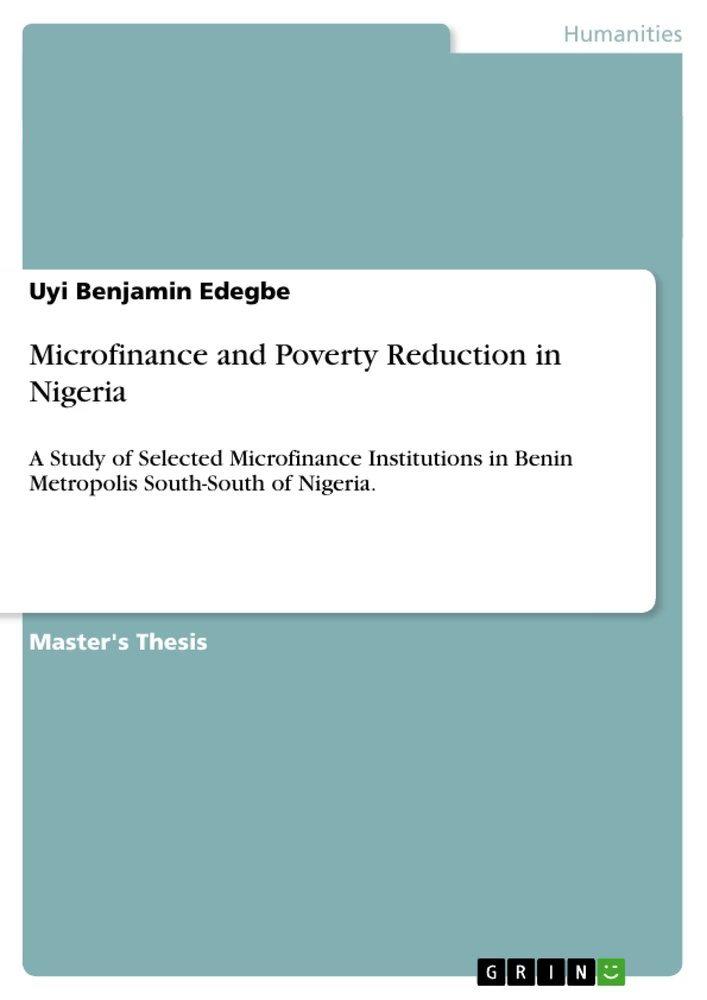
Table of Contents
Chapter one: Introduction
1.1: Background to the Study
1.2: Statement of the Problem
1.3: Objectives of the Study
1.4: Research Question
1.5: Significance of the Study
1.6: Definition of Key Concepts
Chapter 2: Literature Review
2.1: Definition and Meaning of Poverty
2.2: Measurement of Poverty
2.3: Incidence of Poverty in Nigeria
2.4: Poverty Reduction Strategies in Nigeria
2.5: Microfinance/Credit Schemes
2.6: General Overview of Microfinance/Microcredit Scheme
2.7: Meaning and Definition of Microfinance
2.8: Growth of Microfinance in Nigeria
2.9: Justification for the Establishment of Microfinance Banks in Nigeria
2.10: Empirical Literatures on Microfinance
2.11: Theoretical Framework
Chapter 3: Research Methodology
3.1: Research Design
3.2: The Area of Study
3.3: Population of Study
3.4: Sample
3.5: Sample Size
3.6: Methods of Data Collection
3.7: Data Analysis
Chapter 4: Data Analysis and Interpretation
4.1: Question one: Socio-Economic and Demographic Characteristics of Microfinance Scheme Beneficiaries
4.2: Question two: The Impact of Microfinance on the Living Standard and Wellbeing of Beneficiaries
4.3: Question three: The Policies, Regulatory and Supervisory Frameworks That Guide Microfinance Banks in Nigeria
4.4: Question Four: Problems/Challenges Hampering the Successful Implementation of the Microfinance Scheme
4.5: Discussion of Results
Chapter 5: Recommendation and Conclusion
5.1: Recommendations
5.2: Conclusion
Objectives and Research Themes
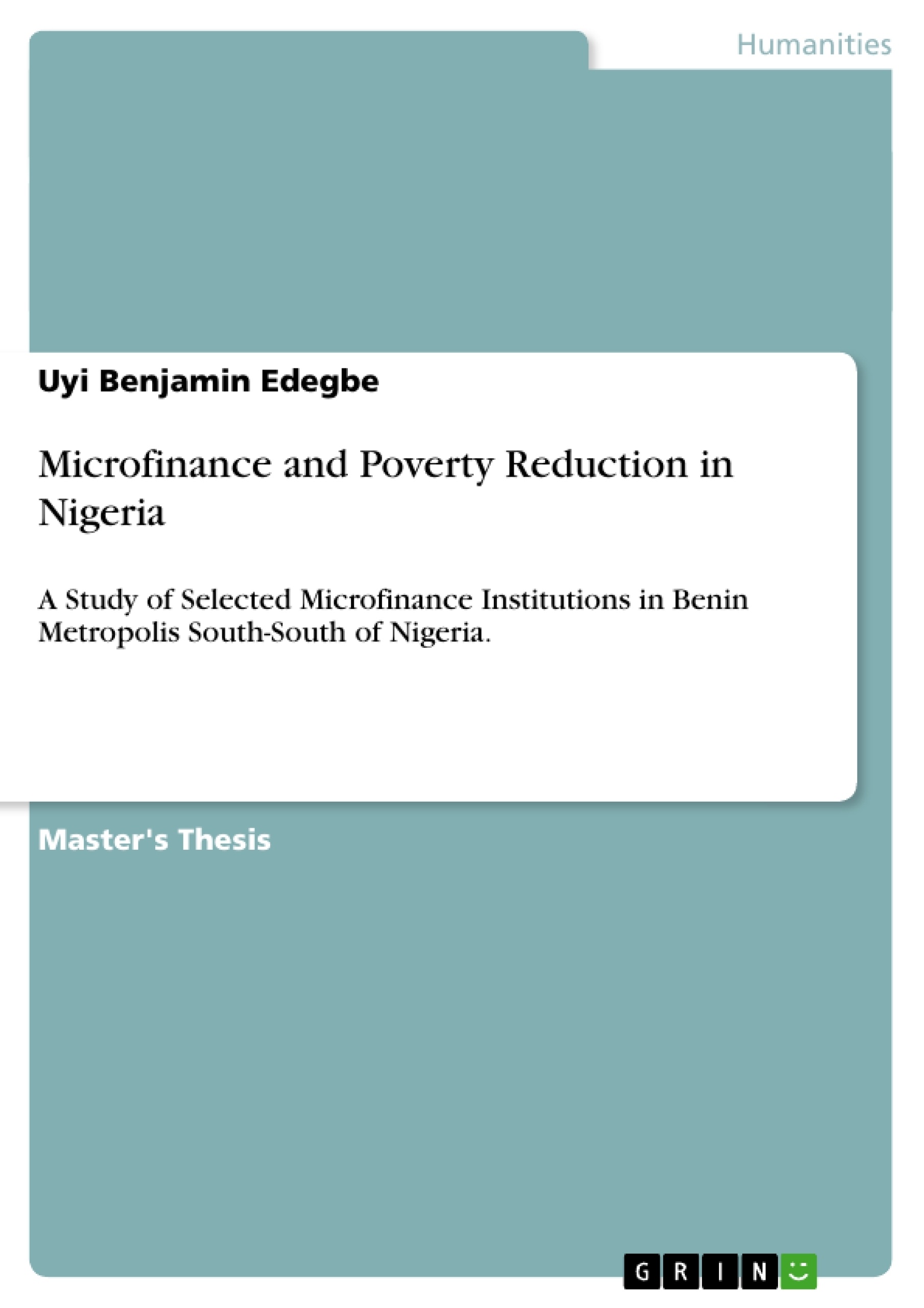
This thesis examines the role and effectiveness of microfinance institutions in poverty reduction within Nigeria, specifically focusing on the Benin Metropolis. The study aims to evaluate how micro-credit access impacts the socio-economic status, living standards, and overall wellbeing of beneficiaries, while identifying the regulatory challenges and operational obstacles facing these financial institutions in their mission to empower low-income populations.
- Socio-economic impact of microfinance on living standards and wellbeing.
- Evaluation of regulatory and supervisory frameworks for Nigerian microfinance banks.
- Identification of barriers hampering the successful implementation of microfinance schemes.
- Analysis of poverty reduction strategies within the Nigerian context.
- Utilization of the Capability Approach as a theoretical lens for poverty assessment.
Excerpt from the Book
1.1 BACKGROUND TO THE STUDY
We will spare no effort to free our fellow men, women, and children from the abject and dehumanizing conditions of extreme poverty to which more than a billion of them are currently subjected. -United Nations Millennium Declaration, September 2000
No society can surely be flourishing and happy of which by far the greater part of the numbers are poor and miserable - Adam Smith, 1776.
The poverty question is a global phenomenon. It is perhaps one of the greatest challenges facing Mankind today, especially in most parts of the developing world. This Perhaps explains why the eradication of poverty was listed as the first of the eight issues of the millennium development goals. The problem of poverty is more disturbing giving the fact that there is abundant and enormous wealth in the world to adequately meet the needs of every one. Poverty may be defined as a condition of lack and inability to meet adequately the basic needs of life such as Shelter, food, education and health care. Similarly, according to a United Nations statement:
Poverty is a denial of choices and opportunities, a violation of human dignity. It means lack of basic capacity to participate effectively in society. It means not having enough to feed and clothe a family, not having a school or clinic to go to; not having the land on which to grow one’s food or a job to earn one’s living, not having access to credit. It means insecurity, powerlessness and exclusion of individuals, households and communities. It means susceptibility to violence, and it often implies living on marginal or fragile environments, without access to clean water or sanitation.(UN,2008 quoted in Ucha,2010).
Summary of Chapters
Chapter one: Introduction: This chapter introduces the global and local context of poverty, defines key research objectives, and establishes the rationale for investigating microfinance as a tool for poverty reduction.
Chapter 2: Literature Review: Provides a comprehensive theoretical overview of poverty definitions, measurement approaches, and the history and development of microfinance schemes in Nigeria.
Chapter 3: Research Methodology: Details the research design, area of study, sampling techniques, and data collection methods utilized to gather information from MFB beneficiaries in Benin Metropolis.
Chapter 4: Data Analysis and Interpretation: Presents the findings from questionnaires, interviews, and focus group discussions, specifically analyzing the impact of loans on beneficiary welfare and the challenges faced by MFBs.
Chapter 5: Recommendation and Conclusion: Offers policy recommendations based on study findings and concludes by summarizing the effectiveness and limitations of microfinance in addressing poverty in Nigeria.
Keywords
Poverty, Microfinance, Microfinance Institution, Benin Metropolis, Nigeria, Poverty Reduction, Economic Empowerment, Capability Approach, Socio-economic Impact, Microcredit, Financial Inclusion, Living Standard, Regulatory Framework, Small Business, Development Economics.
Frequently Asked Questions
What is the core focus of this research?
The research focuses on evaluating how microfinance institutions contribute to poverty reduction in Nigeria, with a specific case study of Benin Metropolis.
What are the primary themes discussed in the study?
The study covers the conceptualization of poverty, the development of microfinance in Nigeria, the impact of micro-credit on beneficiary socio-economic status, and the challenges faced by both financial institutions and their clients.
What is the primary research objective?
The main objective is to examine the impact of micro-finance schemes on poverty reduction and the improvement of the living standards and wellbeing of selected beneficiaries in Benin Metropolis.
Which scientific methodology is applied?
The study employs a survey research design, incorporating both qualitative and quantitative data collection methods such as questionnaires, structured interviews, focus group discussions, and participant observation.
What topics are covered in the main body of the work?
The main body includes a literature review of poverty theories, a review of Nigerian poverty reduction strategies, empirical analysis of microfinance outcomes, and an assessment of the current regulatory and supervisory environment for microfinance banks.
How would you characterize this work through keywords?
The work is best characterized by terms such as poverty reduction, microfinance, Benin Metropolis, financial inclusion, and economic empowerment.
How does the Capability Approach inform this research?
The Capability Approach, pioneered by Amartya Sen, is used to define poverty not just as a lack of income, but as a deprivation of basic capabilities and freedoms necessary for a meaningful life, framing microfinance as a tool to restore these capabilities.
What specific challenges for microfinance in Nigeria are highlighted?
Key challenges identified include high interest rates, difficult loan requirements, the over-concentration of MFBs in urban areas, and a lack of infrastructural support from the government.
Does microfinance effectively reach the extreme poor in Nigeria?
The findings suggest that while microfinance has positively impacted many beneficiaries, it has not yet reached the vast majority of those living in extreme poverty, indicating a gap in current outreach strategies.
Ende der Leseprobe aus 87 Seiten
- nach oben
- Arbeit zitieren
- Uyi Benjamin Edegbe (Autor:in), 2013, Microfinance and Poverty Reduction in Nigeria, München, Page::Imprint:: GRINVerlagOHG, https://www.diplomarbeiten24.de/document/215819

neugierig - aktuell - relevant
Entdecken Sie hilfreiche Tipps und Tricks rund ums Studium!

Entdecken Sie hilfreiche Tipps und Tricks rund ums Studium!
Ihre Hausarbeit / Abschlussarbeit:

- - Publikation als E-Book und Buch
- - Hohes Honorar auf die Verkäufe
- - Für Sie komplett kostenlos - mit ISBN
- - Es dauert nur 5 Minuten
- - Jede Arbeit findet Leser

- © GRIN Publishing GmbH.
- Alle Inhalte urheberrechtlich geschützt. Kopieren und verbreiten untersagt.
- info@grin.com
- AGB
- Open Publishing
Der GRIN Verlag hat sich seit 1998 auf die Veröffentlichung akademischer eBooks und Bücher spezialisiert. Der GRIN Verlag steht damit als erstes Unternehmen für User Generated Quality Content. Die Verlagsseiten GRIN.com, Hausarbeiten.de und Diplomarbeiten24 bieten für Hochschullehrer, Absolventen und Studenten die ideale Plattform, wissenschaftliche Texte wie Hausarbeiten, Referate, Bachelorarbeiten, Masterarbeiten, Diplomarbeiten, Dissertationen und wissenschaftliche Aufsätze einem breiten Publikum zu präsentieren.
Kostenfreie Veröffentlichung: Hausarbeit, Bachelorarbeit, Diplomarbeit, Dissertation, Masterarbeit, Interpretation oder Referat jetzt veröffentlichen!
Folgen Sie GRIN auf


- GRIN Verlag GmbH
-
- Nymphenburger Str. 86
- 80636
- Munich, Deutschland
- +49 89-550559-0
- +49 89-550559-10
- info@grin.com
-
