
präsentiert von

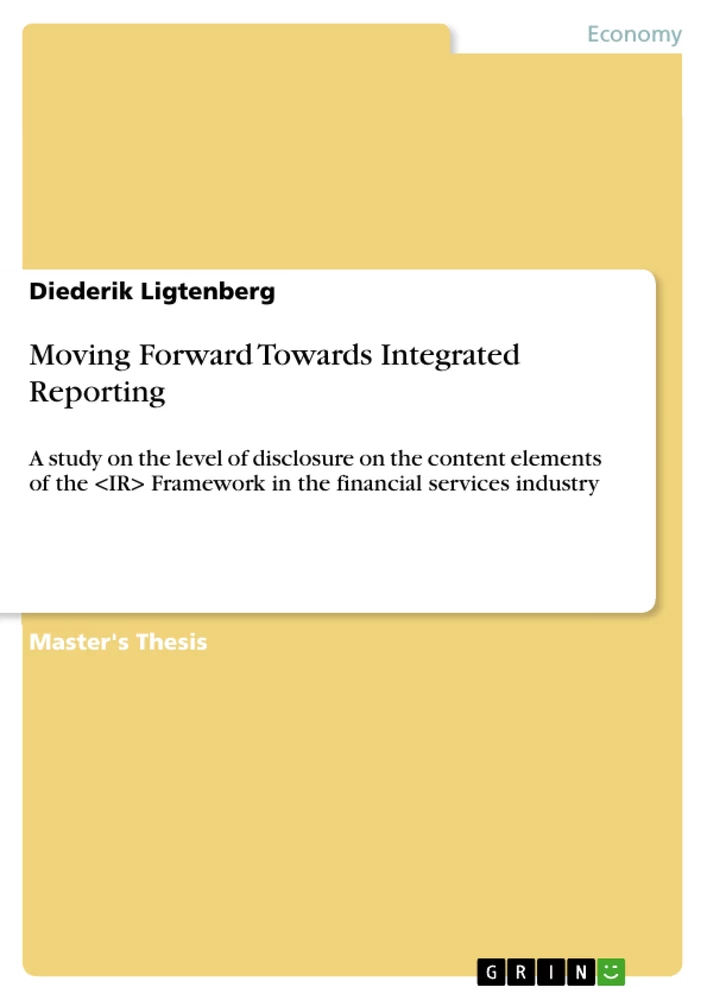
Table of Contents
1. INTRODUCTION
2. LITERATURE REVIEW
2.1 DISCLOSURE AND THE INFORMATION ENVIRONMENT
2.2 DEVELOPMENTS IN NON-FINANCIAL INFORMATION DISCLOSURE
2.3 THE CONCEPT OF INTEGRATED REPORTING
2.3.1 THE KING CODE
2.3.2 THE INTERNATIONAL INTEGRATED REPORTING COUNCIL AND THE INTEGRATED REPORTING FRAMEWORK
2.4 RESEARCH QUESTIONS
2.4.1 MATURITY OF DISCLOSURE ON THE CONTENT OF REPORTING
2.4.2 FORWARD-LOOKING NATURE OF REPORTING
2.4.3 AREAS FOR IMPROVEMENT
3. DATA AND METHODS
3.1 SAMPLE SELECTION AND MATCHING PROCEDURE
3.2 VARIABLES
3.2.1 MEASURING THE MATURITY ON CONTENT ELEMENTS
3.2.2 MEASURING THE FORWARD-LOOKING NATURE OF THE REPORT
4. RESULTS
4.1 DESCRIPTIVE STATISTICS
4.2 RESULTS ON THE IR CONTENT ELEMENT VARIABLES
4.2.1 ORGANIZATIONAL OVERVIEW AND EXTERNAL ENVIRONMENT
4.2.2 GOVERNANCE
4.2.3 OPPORTUNITIES AND RISKS
4.2.4 STRATEGY AND RESOURCE ALLOCATION
4.2.5 BUSINESS MODEL
4.2.6 PERFORMANCE
4.2.7 FUTURE OUTLOOK
4.3 RESULTS ON THE FLR. VARIABLE
5. CONCLUSION
5.1 CONCLUSION RESEARCH QUESTION 1
5.2 CONCLUSION RESEARCH QUESTION 2
5.3 CONCLUSION RESEARCH QUESTION 3
5.4 LIMITATIONS AND FUTURE RESEARCH
6. RECOMMENDATIONS
6.1 DEFINE THE STRATEGY
6.2 DEFINE THE BUSINESS MODEL
6.3 DETERMINE VALUE DRIVERS & DESIGN VALUE DRIVER TREE
6.4 DESIGN & IMPLEMENT PERFORMANCE METRICS
6.5 DEFINE NORMS & TARGETS
6.6 COMMUNICATE THROUGH INTEGRATED REPORTING
Objectives & Core Topics
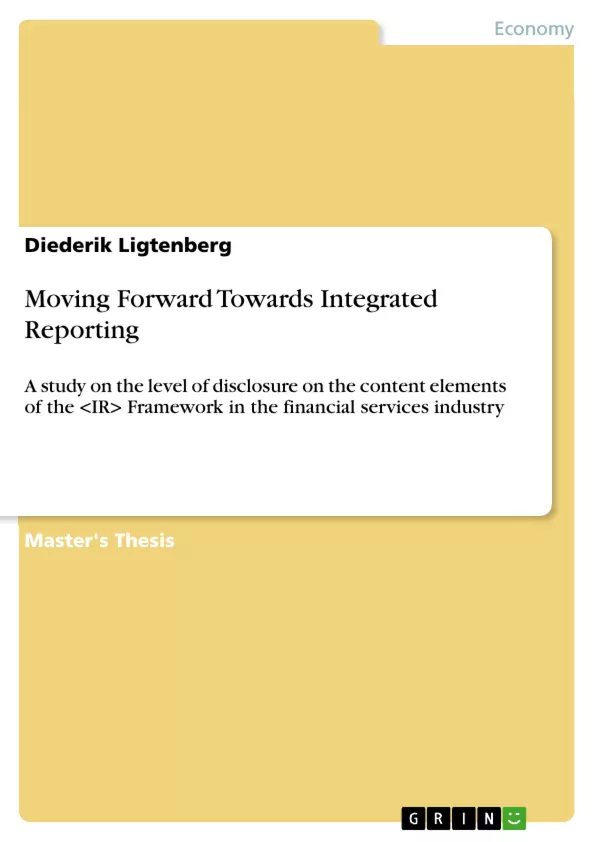
The primary objective of this thesis is to assess whether Integrated Reporting (IR) leads to a higher level of disclosure on non-financial information, utilizing the criteria set forth in the Consultation Draft of the Integrated Reporting Framework. Furthermore, it aims to provide a structured approach for financial decision-makers to navigate the implementation process of Integrated Reporting within the financial services industry.
- The impact of Integrated Reporting on corporate disclosure quality
- Maturity assessment of non-financial reporting disclosure
- The forward-looking nature of corporate reports
- Implementation challenges and best practices for Integrated Reporting
- The role of the CFO as a strategic business partner in reporting
Excerpt from the Book
2.1 Disclosure and the information environment
To understand the importance of corporate disclosures, one should comprehend the context of the information environment in relation to capital markets. It has been widely debated in the literature that the functioning of efficient capital markets is inextricably related to transparency and corporate disclosure (Lang & Lundholm, 1996; Healy & Palepu, 2001). In efficient capital markets, stock prices reflect all information on the value of a firm, and hence, the quality of the information available, is crucial for the functioning of these markets. As a result of this fact, different official bodies and institutions, varying from accounting boards to market authorities, regulate and monitor markets to support the reporting and disclosure mechanisms. Two of the key issues related to this information environment, namely ‘the agency problem’ and ‘information asymmetry’ are subjects of corporate governance research (Roe, 2004).
The agency problem (based on the agency theory) describes the (mis)alignment of the interests of both agents (managers) and principals (stakeholders). As the ownership and control of a firm are separated, and hence, the interests of both parties differ, costs can arise due to these conflicting interests (Healy & Palepu, 2001; Roe, 2004). This problem, and the related agency costs, are the essence of corporate governance issues as reduction of these costs is relevant for all involved.
Information asymmetry pertains to the different levels of information available to the stakeholders, explained by Ligtenberg (2010, p. 12) as ‘...the extent to which managers have more insights about the firm and its value, than other external stakeholders...’. This problem, and disclosure related solutions, has been widely studied in the literature (Healy & Palepu, 2001; Harris & Raviv, 2008).
Chapter Summaries
1. INTRODUCTION: Outlines the corporate failures motivating the need for more transparent reporting and introduces Integrated Reporting as a holistic response to stakeholder needs.
2. LITERATURE REVIEW: Examines the theoretical underpinnings of corporate disclosure, information asymmetry, and the emergence of Integrated Reporting as a new global standard.
3. DATA AND METHODS: Describes the methodology, including sample selection of financial firms and the binary coding criteria used to measure disclosure levels.
4. RESULTS: Presents the findings regarding disclosure levels across different maturity panels and provides a descriptive analysis of the forward-looking nature of these reports.
5. CONCLUSION: Summarizes the study's contribution and discusses how organizational maturity correlates with higher disclosure levels on Integrated Reporting elements.
6. RECOMMENDATIONS: Offers a structured approach for practitioners, focusing on strategy definition, business model visualization, and the design of value driver trees.
Keywords
Integrated Reporting, Financial Services Industry, Non-financial disclosure, Information asymmetry, Corporate governance, Business model, Performance management, Value driver tree, Stakeholder responsiveness, Sustainability reporting, IIRC, Forward-looking statements, Transparency, Strategic alignment, Capital markets.
Frequently Asked Questions
What is the core focus of this research?
This research examines how Integrated Reporting (IR) affects the disclosure of non-financial information within the financial services industry, assessing the maturity of companies on their path toward integrated reporting.
What are the central thematic fields?
The study centers on corporate reporting transparency, the alignment of financial and non-financial data, performance management systems, and the strategic role of the CFO in driving value.
What is the primary research objective?
The primary objective is to determine if companies that are more mature in their journey toward Integrated Reporting demonstrate a higher level of disclosure on the content elements defined by the IIRC's Consultation Draft.
Which scientific method is employed?
The study utilizes a qualitative content analysis approach, specifically a keyword-in-context methodology combined with a binary (yes/no) assessment of disclosure criteria across 12 specific corporate reports.
What does the main body address?
The main body covers the literature on information environments, detailed data collection and matching procedures for financial firms, results analysis based on IR content elements, and recommendations for performance management.
How would you characterize this work with keywords?
The work is characterized by terms such as Integrated Reporting, Non-financial disclosure, Value Driver Tree, Corporate Governance, and Strategic Value Creation.
How does company maturity impact reporting?
The findings indicate that as companies progress along the path toward Integrated Reporting—specifically those influenced by mandates like South Africa's King III—they exhibit significantly higher levels of disclosure and more forward-looking content.
Why are strategy and business models highlighted for improvement?
The study identifies strategy, resource allocation, and business models as the most challenging areas for disclosure, suggesting that clarifying these links is essential for meaningful performance measurement.
Ende der Leseprobe aus 81 Seiten
- nach oben
- Arbeit zitieren
- Diederik Ligtenberg (Autor:in), 2013, Moving Forward Towards Integrated Reporting, München, Page::Imprint:: GRINVerlagOHG, https://www.diplomarbeiten24.de/document/230203

neugierig - aktuell - relevant
Entdecken Sie hilfreiche Tipps und Tricks rund ums Studium!

Entdecken Sie hilfreiche Tipps und Tricks rund ums Studium!
Ihre Hausarbeit / Abschlussarbeit:

- - Publikation als E-Book und Buch
- - Hohes Honorar auf die Verkäufe
- - Für Sie komplett kostenlos - mit ISBN
- - Es dauert nur 5 Minuten
- - Jede Arbeit findet Leser

- © GRIN Publishing GmbH.
- Alle Inhalte urheberrechtlich geschützt. Kopieren und verbreiten untersagt.
- info@grin.com
- AGB
- Open Publishing
Der GRIN Verlag hat sich seit 1998 auf die Veröffentlichung akademischer eBooks und Bücher spezialisiert. Der GRIN Verlag steht damit als erstes Unternehmen für User Generated Quality Content. Die Verlagsseiten GRIN.com, Hausarbeiten.de und Diplomarbeiten24 bieten für Hochschullehrer, Absolventen und Studenten die ideale Plattform, wissenschaftliche Texte wie Hausarbeiten, Referate, Bachelorarbeiten, Masterarbeiten, Diplomarbeiten, Dissertationen und wissenschaftliche Aufsätze einem breiten Publikum zu präsentieren.
Kostenfreie Veröffentlichung: Hausarbeit, Bachelorarbeit, Diplomarbeit, Dissertation, Masterarbeit, Interpretation oder Referat jetzt veröffentlichen!
Folgen Sie GRIN auf


- GRIN Verlag GmbH
-
- Nymphenburger Str. 86
- 80636
- Munich, Deutschland
- +49 89-550559-0
- +49 89-550559-10
- info@grin.com
-
