
präsentiert von

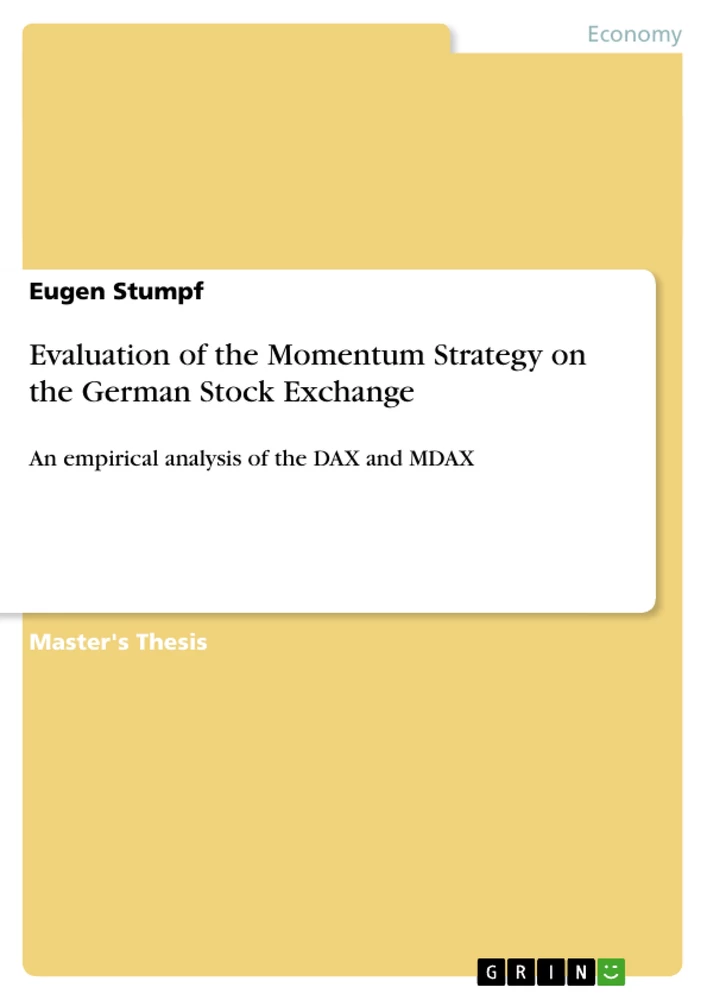
Table of Contents
1 Introduction
2 Traditional Financial Market Theory vs. Newly Developed Financial Behavior Theory
2.1 Market efficiency and “noisy inverter”
2.2 Behavioral Finance
2.2.1 Overconfidence
2.2.2 Representativeness
2.2.3 Other behavioral biases and models
3 Momentum Effect and Momentum Strategy as Part of Market Anomalies
3.1 CAPM and “abnormal return”
3.2 Contrarian strategy
3.3 Momentum strategy: initial evidence from the United States
3.4 Empirical evidence of momentum strategy from other countries
4 Data and Methodology
4.1 Data
4.2 Methodology
5 Results
5.1 DAX
5.2 MDAX
5.3 Summary
6 Outlook
7 Conclusion
Research Objectives and Key Topics
This thesis investigates the momentum effect within the German stock market, specifically analyzing data from the DAX and MDAX indices over the last decade. The primary research goal is to verify two hypotheses: whether the momentum effect persists in an era of high internet availability and if this effect is stronger in the MDAX due to lower market efficiency compared to larger firm-size indices.
- Analysis of behavioral financial theories and their impact on market anomalies.
- Evaluation of momentum and contrarian trading strategies.
- Development of custom software using VBA to process financial data and simulate trading portfolios.
- Comparative empirical analysis of DAX and MDAX stock performance.
- Investigation into the influence of "noise investors" and human psychological biases on market efficiency.
Excerpt from the Book
Overconfidence
Humans are naturally overconfident. As an example, “94% of college professors [in the United States] think they do above average work.” From a statistic point of view, this is nonsense (ANDERSON et al. 2012). People overvalue their own experience and knowledge and underestimate their possible failures and troubles. Overconfidence is defined as “an overestimation of probabilities for a set of events” (MAHAJAN 1992: p. 330). Overconfidence is present in all of us; as a single factor it will not lead to success in any decision process, but “it is usually celebrated and encouraged” (DITTRICH 2001). The availability of overconfidence also has a positive effect. One hypothesis suggests that it can improve our health (PLOUS 1993).
Another example of human overconfidence is the daily behavior of Swedish drivers. SVENSON (1981) analyzed drivers for their feeling of their own competence versus the average driver. The result is a strong tendency toward overconfidence, being more skillful and less risky than the rest of the group (SVENSON 1981: 146). Similar investigations about U.S. students’ driving capability shows that 82% of students think their driving capability is within the top third of all drivers (DE BONDT and THALER 1995: 389). Most tests prove this overconfidence bias provided by PALLIER et al. (2002) and by ALPERT et al. (1982). The financial market players are not immune to this overconfidence bias. The experiment of DITTRICH et al. (2001) shows that in an investor group at least two thirds of the participants exhibit overconfidence behavior.
Summary of Chapters
1 Introduction: This chapter introduces the research context, the focus on momentum and contrarian strategies, and outlines the objectives of investigating these phenomena on the German stock exchange.
2 Traditional Financial Market Theory vs. Newly Developed Financial Behavior Theory: This chapter contrasts classical efficient market theories with emerging behavioral models, exploring how psychological biases influence market dynamics.
3 Momentum Effect and Momentum Strategy as Part of Market Anomalies: This section provides a theoretical foundation for the momentum and contrarian strategies, discussing relevant empirical evidence from international markets.
4 Data and Methodology: This chapter details the data collection process from Bloomberg terminals and describes the development of a custom VBA-based tool for calculating portfolio returns.
5 Results: This chapter presents the empirical findings of the study, comparing the performance of portfolios based on DAX and MDAX securities against the average market.
6 Outlook: This chapter offers suggestions for future research, including testing additional indices and refining the software's trading algorithms.
7 Conclusion: This chapter summarizes the study's findings, confirming that the momentum effect is observable and significant, particularly in the MDAX segment.
Keywords
Momentum Strategy, Contrarian Strategy, German Stock Exchange, DAX, MDAX, Behavioral Finance, Overconfidence, Market Efficiency, Abnormal Returns, Portfolio Management, Financial Anomalies, VBA, Noise Investor, Investment Psychology.
Frequently Asked Questions
What is the core focus of this master thesis?
The thesis focuses on evaluating the effectiveness of the momentum trading strategy on the German Stock Exchange, specifically analyzing the DAX and MDAX indices over the last ten years.
What are the primary research themes covered?
The work covers behavioral finance, market anomalies, the application of contrarian and momentum strategies, and the empirical testing of these strategies using historical stock market data.
What is the main goal or research question of this study?
The study aims to verify if the momentum effect still produces abnormal returns in the contemporary era and if this effect is more pronounced in the MDAX due to differences in market efficiency compared to the DAX.
Which scientific methods are applied in this work?
The research uses quantitative empirical analysis. The author developed custom software in Visual Basic for Applications (VBA) to simulate dynamic portfolio construction and measure t-statistics for performance evaluation.
What does the main part of the thesis address?
The main body examines existing financial theories, introduces behavioral biases like overconfidence and representativeness, explains the methodology of portfolio formation, and presents the calculated results for both DAX and MDAX.
Which keywords best characterize this research?
Key terms include Momentum Strategy, Behavioral Finance, DAX, MDAX, Market Efficiency, Abnormal Returns, and Portfolio Management.
Why did the author choose the year 2001 as the starting point for data analysis?
The starting point was chosen to ensure consistency in the composition of the indices, as many companies that existed before 2001 are no longer listed, which would have introduced bias into the statistical evaluation.
How does this study contribute to the existing literature on the momentum effect?
It provides a fresh empirical investigation into the German market using a dynamic portfolio approach, contrasting the performance of mid-cap (MDAX) and blue-chip (DAX) stocks to validate claims of market efficiency.
Ende der Leseprobe aus 92 Seiten
- nach oben
- Arbeit zitieren
- Eugen Stumpf (Autor:in), 2013, Evaluation of the Momentum Strategy on the German Stock Exchange, München, Page::Imprint:: GRINVerlagOHG, https://www.diplomarbeiten24.de/document/230538

neugierig - aktuell - relevant
Entdecken Sie hilfreiche Tipps und Tricks rund ums Studium!

Entdecken Sie hilfreiche Tipps und Tricks rund ums Studium!
Ihre Hausarbeit / Abschlussarbeit:

- - Publikation als E-Book und Buch
- - Hohes Honorar auf die Verkäufe
- - Für Sie komplett kostenlos - mit ISBN
- - Es dauert nur 5 Minuten
- - Jede Arbeit findet Leser

- © GRIN Publishing GmbH.
- Alle Inhalte urheberrechtlich geschützt. Kopieren und verbreiten untersagt.
- info@grin.com
- AGB
- Open Publishing
Der GRIN Verlag hat sich seit 1998 auf die Veröffentlichung akademischer eBooks und Bücher spezialisiert. Der GRIN Verlag steht damit als erstes Unternehmen für User Generated Quality Content. Die Verlagsseiten GRIN.com, Hausarbeiten.de und Diplomarbeiten24 bieten für Hochschullehrer, Absolventen und Studenten die ideale Plattform, wissenschaftliche Texte wie Hausarbeiten, Referate, Bachelorarbeiten, Masterarbeiten, Diplomarbeiten, Dissertationen und wissenschaftliche Aufsätze einem breiten Publikum zu präsentieren.
Kostenfreie Veröffentlichung: Hausarbeit, Bachelorarbeit, Diplomarbeit, Dissertation, Masterarbeit, Interpretation oder Referat jetzt veröffentlichen!
Folgen Sie GRIN auf


- GRIN Verlag GmbH
-
- Nymphenburger Str. 86
- 80636
- Munich, Deutschland
- +49 89-550559-0
- +49 89-550559-10
- info@grin.com
-
