
präsentiert von

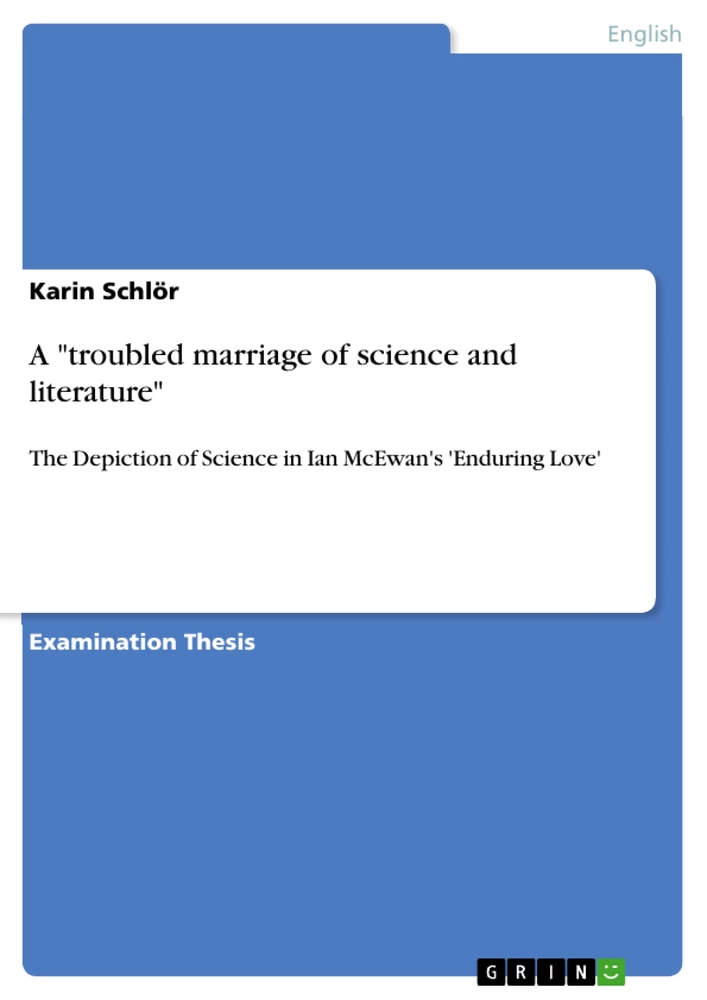
Table of Contents
1. Introduction
2. Scientific Method and Rationalism in Enduring Love
2.1. Narrative Implementation
2.1.1. Language
2.1.2. Point of View
2.1.3. Reliability of the Narrator
2.2. Testing of Scientific Rationalism – ‘a little cage of reason’ or ‘a route to wonder’?
2.2.1. Rational Thought as ‘a wonderful aspect of our natures’
2.2.2. ‘Rationalism gone berserk’
2.3. Science, Literature and the Narrative
2.3.1. Science’s Need for Narration
2.3.2. Science as an Enrichment for Literature
2.3.3. Science Writing
3. Synthesis: ‘Rapprochement of the disciplines’
4. Conclusion
5. Works Cited
Objectives and Core Themes
This work examines the complex relationship between science, literature, and the narrative within Ian McEwan's novel Enduring Love. It investigates whether the novel advocates for a purely scientific, rationalist interpretation of the world or if it suggests that a complementary, interdisciplinary approach is necessary for a fuller understanding of human existence.
- The role and reliability of the narrator, Joe Rose, as a representative of scientific rationalism.
- The tension between scientific discourse and emotional, subjective experiences.
- The critique of scientific reductionism in explaining complex human behaviors like love and faith.
- The concept of "consilience" as a bridge between the natural sciences and the humanities.
- The meta-narrative function of science writing and its reliance on storytelling.
Excerpt from the Book
2.1.3. Reliability of the Narrator
Another point that causes the reader to question Joe’s personal interpretation of the events is the fact that “Joe’s narration in Enduring Love is not in competition with another – he does not need to cooperate or consult in telling his story” (Matthews 91). As mentioned before, Clarissa’s and Jed’s world views are present in the novel, but only moderated through Joe’s point of view. The critical reader has to question how reliable Joe, the narrator, is (cf. Matthews 91). Matthews holds that “[o]ur privilege as readers is a critical perspective not only on the narrator’s character but also on the limits of that narrator’s way of seeing and explaining the world” (Matthews 104). It is this narrative characteristic, the reliability of the narrator, that is discussed most in research about Enduring Love.
According to Nünning, the narrator’s limited knowledge implies an unreliable narrator (cf. Nünning 124). Since Joe is a first-person narrator, this is clearly the case. A first-person narrator can never be omniscient. Moreover, Nünning cites emotional involvement in the events as another sign for an unreliable narrator (cf. Nünning 124). And in fact, Joe is gravely emotionally involved in the story. To name only two out of many examples, he fears for his own and for Clarissa’s safety and he is plagued by self-doubt about his guilt in the balloon accident.
Summary of Chapters
1. Introduction: Introduces the novel's thematic focus on the difficult relationship between science and literature, referencing Keats and setting up the research hypothesis regarding Joe Rose’s scientific worldview.
2. Scientific Method and Rationalism in Enduring Love: Discusses the epistemological conflict in the novel, defining the character roles of Joe, Clarissa, and Jed in the quest to interpret reality.
2.1. Narrative Implementation: Analyzes the structural techniques, specifically the first-person perspective, that grant the narrator, Joe, control over the portrayal of events.
2.1.1. Language: Examines how Joe’s reliance on technical, scientific vocabulary influences his account of the world and distinguishes his perspective from the religious and literary accounts of others.
2.1.2. Point of View: Explores the impact of the unidirectional first-person narration on the reader's ability to objectively interpret the events and the motives of the characters.
2.1.3. Reliability of the Narrator: Investigates the inherent limitations of Joe’s perspective and whether he can be considered a reliable narrator despite his scientific rigor.
2.2. Testing of Scientific Rationalism – ‘a little cage of reason’ or ‘a route to wonder’?: Investigates the struggle between opposing views on evolutionary biology and the legitimacy of applying scientific methods to explain human nature.
2.2.1. Rational Thought as ‘a wonderful aspect of our natures’: Explores McEwan’s own perspective, which advocates for a celebratory, wonder-filled view of science that does not necessarily crush the imagination.
2.2.2. ‘Rationalism gone berserk’: Discusses the criticism directed at Joe’s rationalist approach, particularly from Clarissa, who views his reduction of emotional phenomena to biological programs as misguided.
2.3. Science, Literature and the Narrative: Analyzes the interplay between the disciplines and whether they should be viewed as separate "Two Cultures" or as complementary forces.
2.3.1. Science’s Need for Narration: Discusses the inherent dependence of scientific knowledge on narrative structures for transmission and coherence, challenging the notion of science as an autonomous, objective field.
2.3.2. Science as an Enrichment for Literature: Explores how engagement with scientific progress can provide new imagery and thematic depth for writers, transcending the binary opposition of art versus science.
2.3.3. Science Writing: Analyzes the paradox of Joe’s career as a science journalist, caught between his desire for pure research and the storytelling demands of the publishing market.
3. Synthesis: ‘Rapprochement of the disciplines’: Synthesizes the findings, arguing that the novel ultimately points toward a "consilience"—a mutual respect and cooperation between the sciences and the humanities.
4. Conclusion: Summarizes that while the novel affirms the power of the rational, it advocates for a rationalism mediated by emotional wisdom and interdisciplinary awareness.
5. Works Cited: Lists all primary and secondary literature referenced throughout the analysis.
Keywords
Enduring Love, Ian McEwan, Scientific Rationalism, Evolutionary Biology, Literature and Science, Narrative Theory, Unreliable Narrator, Consilience, Joe Rose, Epistemology, Reductionism, Human Nature, Interdisciplinarity, Two Cultures.
Frequently Asked Questions
What is the core subject of this analysis?
The paper explores how Ian McEwan’s novel Enduring Love portrays the tension between the natural sciences and the humanities, specifically focusing on the character Joe Rose and his scientific worldview.
What are the primary themes discussed in the work?
The themes include the clash of epistemologies (science vs. religion vs. literature), the reliability of first-person narration, the debate over evolutionary biology in explaining human behavior, and the need for interdisciplinary cooperation.
What is the main research question of this study?
The study examines to what extent evolutionary biology and its methods are presented in Enduring Love as justifiable to explain human nature, and how science is depicted in relation to literature and the narrative.
Which scientific method is central to the novel’s analysis?
The work focuses heavily on evolutionary biology and psychology, as Joe Rose uses these fields as a lens to interpret his world and the crisis he faces with the stalker, Jed Parry.
What does the main body of the paper cover?
The body analyzes the narrator's language and point of view, the specific testing of scientific rationalism against human experiences like love, and the meta-narrative relationship between science writing and storytelling.
Which keywords best characterize this publication?
Key terms include Enduring Love, scientific rationalism, evolutionary biology, interdisciplinary, narrator reliability, and consilience.
How is Joe Rose described as a narrator?
Joe is characterized as an "explicit" and "unreliable" narrator who is deeply invested in the scientific discourse, yet whose authority is constantly challenged by his own emotional instability and the conflicting perspectives of his wife, Clarissa.
Does the novel conclude that science is the "right" way to view the world?
The paper concludes that while the novel "celebrates the rational," it does not advocate for an exclusive or reductionist science. Instead, it suggests that science is most effective when mediated by emotional wisdom and when it enters into a "rapprochement" with the humanities.
Ende der Leseprobe aus 54 Seiten
- nach oben
- Arbeit zitieren
- Karin Schlör (Autor:in), 2013, A "troubled marriage of science and literature" , München, Page::Imprint:: GRINVerlagOHG, https://www.diplomarbeiten24.de/document/231540

neugierig - aktuell - relevant
Entdecken Sie hilfreiche Tipps und Tricks rund ums Studium!

Entdecken Sie hilfreiche Tipps und Tricks rund ums Studium!
Ihre Hausarbeit / Abschlussarbeit:

- - Publikation als E-Book und Buch
- - Hohes Honorar auf die Verkäufe
- - Für Sie komplett kostenlos - mit ISBN
- - Es dauert nur 5 Minuten
- - Jede Arbeit findet Leser

- © GRIN Publishing GmbH.
- Alle Inhalte urheberrechtlich geschützt. Kopieren und verbreiten untersagt.
- info@grin.com
- AGB
- Open Publishing
Der GRIN Verlag hat sich seit 1998 auf die Veröffentlichung akademischer eBooks und Bücher spezialisiert. Der GRIN Verlag steht damit als erstes Unternehmen für User Generated Quality Content. Die Verlagsseiten GRIN.com, Hausarbeiten.de und Diplomarbeiten24 bieten für Hochschullehrer, Absolventen und Studenten die ideale Plattform, wissenschaftliche Texte wie Hausarbeiten, Referate, Bachelorarbeiten, Masterarbeiten, Diplomarbeiten, Dissertationen und wissenschaftliche Aufsätze einem breiten Publikum zu präsentieren.
Kostenfreie Veröffentlichung: Hausarbeit, Bachelorarbeit, Diplomarbeit, Dissertation, Masterarbeit, Interpretation oder Referat jetzt veröffentlichen!
Folgen Sie GRIN auf


- GRIN Verlag GmbH
-
- Nymphenburger Str. 86
- 80636
- Munich, Deutschland
- +49 89-550559-0
- +49 89-550559-10
- info@grin.com
-
