
präsentiert von

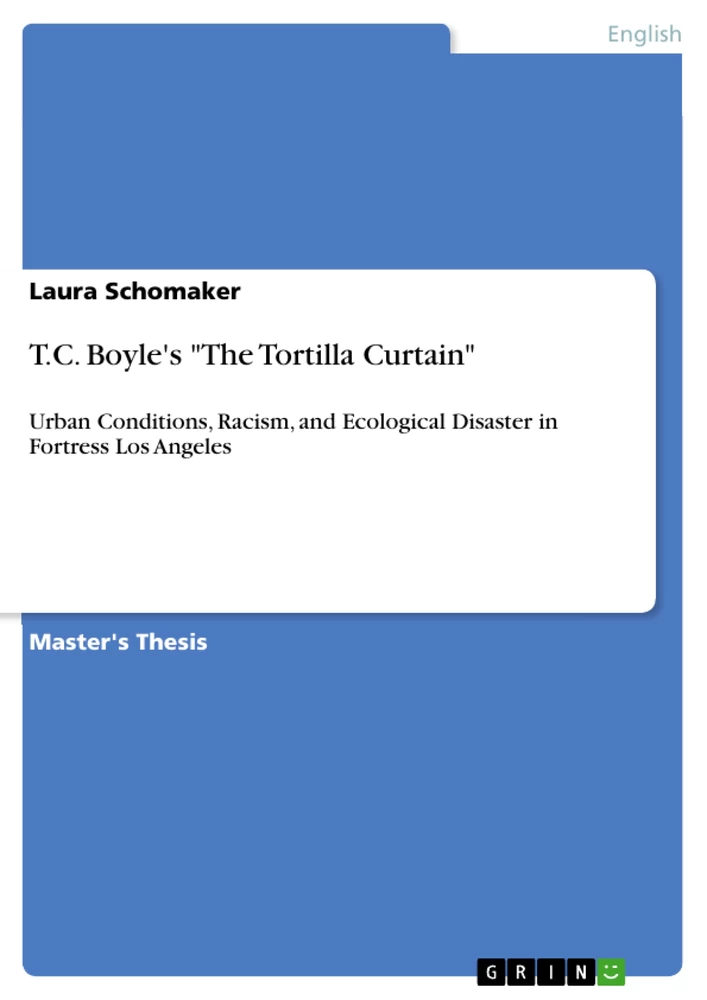
Table of Contents
1. Introduction
2. Los Angeles: Basic Facts and Figures
3. Los Angeles in Urban Studies
3.1. The L.A. School
3.2. Gates and Walls: The Fortress City
3.3. (The Crossing of) Borders and Boundaries
3.4. L.A.’s Urban Ecology: From Natural Disaster to Environmental Racism
4. T.C. Boyle’s The Tortilla Curtain
4.1. Arroyo Blanco: The Fortress Community
4.2. (The Crossing of) the Tortilla Curtain
4.3. The Juxtaposition of Man and Animal
4.4. The Apocalyptic Denouement through Ecological Disaster
5. Conclusion
Objectives and Topics
This work explores the intersection of urban theory and literary representation, using T.C. Boyle’s novel "The Tortilla Curtain" to analyze the socio-political realities of Los Angeles. It investigates how urban conditions, systemic racism, and environmental challenges intersect within the metropolis, ultimately arguing that fiction serves as a crucial lens for understanding modern urban problems.
- The significance of the L.A. School in contemporary urban studies.
- The concept of the "fortress city" and the impact of privatization on public space.
- The manifestation of environmental racism and suburban ecological impact.
- Social and spatial segregation, exacerbated by border militarization.
- The role of "The Tortilla Curtain" in depicting immigration, white flight, and class conflict.
Excerpt from the Book
3.2. Gates and Walls: The Fortress City
But while social separation is obviously produced by fear and racism, it is moreover supported and cemented by the economy, politics and planners: [R]esidential segregation created by prejudice and socioeconomic disparities is reinforced by planning practices and policing, implemented by zoning laws and regulations, and subsidized by businesses and banks (Low, “Edge and Center” 47).
Apart from this spatial distance, material barriers begin to appear in growing numbers throughout the city, “producing a literal landscape of fear” (Low, “Urban Fear” 53) that reminds residents constantly of the dangerous world outside (cf. Blakely and Snyder, “Fortress America” 150). Often, these two aspects come together in gated communities that are located in the (outer) suburbs already: Even richer neighborhoods in the canyons and hillsides isolate themselves behind walls guarded by gun-toting private police and state-of-the-art electronic surveillance (Davis, “Fortress LA”, 267).
Hence, “[g]ates are firmly within the suburban tradition: they enhance and harden the suburbanness of the suburbs, and they attempt to suburbanize the city” (Blakely and Snyder, “Fortress America” 10 f.). So while it is primarily still a suburban phenomenon, gating more and more also appears in the center (cf. ibid. 2): “[S]uch closures occur in the inner city and in the suburbs, in neighborhoods of great wealth and in areas of great poverty” (Blakely and Snyder, “Gates”). Although walled and gated communities are definitely not new, their current forms are exclusively residential as well as private rather than public (cf. Low, “Urban Fear” 53). Moreover, they often go even further in their means of exclusion (cf. Blakely and Snyder, “Fortress America” 8), for example by privatizing “civic responsibilities like police protection and communal services such as street maintenance, recreation, and entertainment” (ibid.). Thus, most gated enclaves are run by their own “private government[s] called ‘homeowner associations’” (Low, “Edge and Center” 47). These powerful coalitions primarily preserve the isolated spaces of their neighborhoods by lobbying for zoning regulations (cf. Caldeira 99). In this way, “local democracy may be used as an instrument of segregation” (ibid. 104).
Chapter Summaries
1. Introduction: Outlines the dual nature of Los Angeles as a hub of media fantasy and a subject of critical urban studies, framing the research objective of linking urban theory to fictional representation.
2. Los Angeles: Basic Facts and Figures: Provides demographic and historical context, detailing the city's transformation into a diverse, multicentric megalopolis shaped by waves of migration.
3. Los Angeles in Urban Studies: Examines the paradigm shift from the Chicago School to the L.A. School, the emergence of the "fortress city," the politics of borders, and the intersection of environmental issues with social stratification.
4. T.C. Boyle’s The Tortilla Curtain: Analyzes the novel as a case study for themes of white flight, gated communities, immigrant experience, and the metaphorical and literal boundaries that structure society.
5. Conclusion: Synthesizes the main findings, reiterating that urban sprawl and fortress mentalities create deep-seated social inequities, and suggesting that political and planning solutions are essential for future coexistence.
Keywords
Los Angeles, L.A. School, Urban Studies, The Tortilla Curtain, T.C. Boyle, Fortress City, Suburbanization, Environmental Racism, Immigration, Spatial Segregation, Gated Communities, White Flight, Urban Sprawl, Postmodernism, Border Politics.
Frequently Asked Questions
What is the primary focus of this work?
This work examines the connection between urban theory and the fictional depiction of Los Angeles in T.C. Boyle’s novel "The Tortilla Curtain," focusing on themes of social and spatial segregation.
What are the central thematic areas?
The key themes include the "fortress mentality" of the white elite, the impact of suburbanization on both nature and society, and the experiences of Latin American immigrants.
What is the core objective of the research?
The goal is to analyze how urban conditions, racism, and natural catastrophes intersect in Los Angeles and how literature reflects these complex societal dynamics.
Which scientific methodologies are utilized?
The work employs a multidisciplinary approach, synthesizing urban studies theories (such as the L.A. School's postmodernism) with literary analysis of narrative structures and character development.
What topics are covered in the main body?
The main body covers the theoretical framework of urban growth, the history and geography of Los Angeles, the architectural and social manifestations of fear, and a detailed literary analysis of the novel.
Which keywords characterize the work?
Key terms include urban sprawl, environmental racism, gated communities, the fortress city, the L.A. School, social segregation, and border politics.
How does the novel relate to the concept of the "Fortress City"?
The novel mirrors reality through the community of "Arroyo Blanco," where residents seek to exclude outsiders through walls, gates, and homeowner association regulations to maintain homogeneity.
What role does nature play in the book's narrative?
Nature is depicted as both a commodity and a threat, with suburban sprawl damaging the environment while residents simultaneously blame marginalized groups for ecological disasters like fires.
How does the author interpret the final scene of the novel?
The final scene, where the protagonists are confronted by a mudslide, acts as a "deus ex machina" that forces a moment of common humanity, highlighting the failure of social boundaries in the face of nature.
Ende der Leseprobe aus 55 Seiten
- nach oben
- Arbeit zitieren
- Laura Schomaker (Autor:in), 2013, T.C. Boyle's "The Tortilla Curtain", München, Page::Imprint:: GRINVerlagOHG, https://www.diplomarbeiten24.de/document/231712

neugierig - aktuell - relevant
Entdecken Sie hilfreiche Tipps und Tricks rund ums Studium!

Entdecken Sie hilfreiche Tipps und Tricks rund ums Studium!
Ihre Hausarbeit / Abschlussarbeit:

- - Publikation als E-Book und Buch
- - Hohes Honorar auf die Verkäufe
- - Für Sie komplett kostenlos - mit ISBN
- - Es dauert nur 5 Minuten
- - Jede Arbeit findet Leser

- © GRIN Publishing GmbH.
- Alle Inhalte urheberrechtlich geschützt. Kopieren und verbreiten untersagt.
- info@grin.com
- AGB
- Open Publishing
Der GRIN Verlag hat sich seit 1998 auf die Veröffentlichung akademischer eBooks und Bücher spezialisiert. Der GRIN Verlag steht damit als erstes Unternehmen für User Generated Quality Content. Die Verlagsseiten GRIN.com, Hausarbeiten.de und Diplomarbeiten24 bieten für Hochschullehrer, Absolventen und Studenten die ideale Plattform, wissenschaftliche Texte wie Hausarbeiten, Referate, Bachelorarbeiten, Masterarbeiten, Diplomarbeiten, Dissertationen und wissenschaftliche Aufsätze einem breiten Publikum zu präsentieren.
Kostenfreie Veröffentlichung: Hausarbeit, Bachelorarbeit, Diplomarbeit, Dissertation, Masterarbeit, Interpretation oder Referat jetzt veröffentlichen!
Folgen Sie GRIN auf


- GRIN Verlag GmbH
-
- Nymphenburger Str. 86
- 80636
- Munich, Deutschland
- +49 89-550559-0
- +49 89-550559-10
- info@grin.com
-
