
präsentiert von

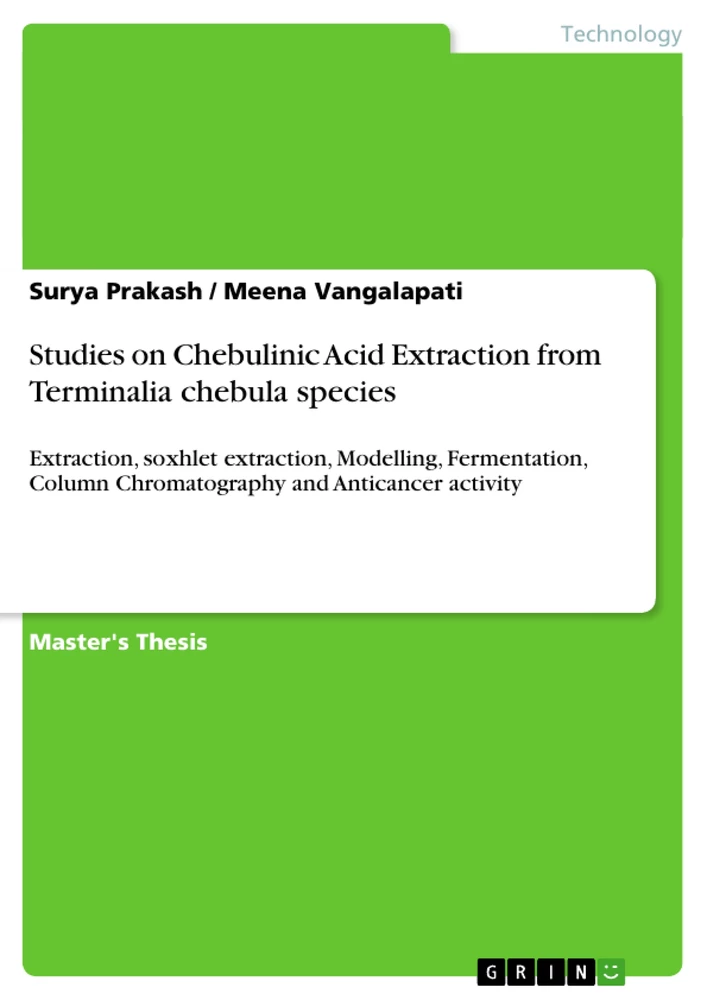
Table of Contents
Abstract
Introduction
Literature Review
Materials and Methods
I. Extraction and Processing
II. Quantative Determination of Phytoconstituents
III. Optimization of Physico-Chemical parameters
IV. Soxhlet extractor- An experimental & modelling studies
V. Fermentation
VI. Pratition coefficient
VII. Column chromatography
VIII. Anticancer activity
Results and Discussions
I. Extraction and Processing
II. Quantative Determination of Phytoconstituents
III. Optimization of Physico-Chemical parameters
IV. Soxhlet extractor- An experimental &modelling studies
V. Fermentation
VI. Pratition coefficient
VII. Column chromatography
VIII. Anticancer activity
Conclusion
References
Research Objectives and Key Topics
The primary research objective of this project is to optimize the extraction process of chebulinic acid from the fruits of the Terminalia chebula species. This involves evaluating various experimental methods, including batch, Soxhlet, and fermentation-based extraction techniques, to determine the most effective parameters for high yield and purity. Furthermore, the study investigates the antioxidant and anticancer potential of the extracted compounds.
- Optimization of extraction parameters such as solvent type, particle size, soaking time, and pH.
- Comparative analysis of different extraction processes: batch, Soxhlet, and fermentation.
- Purification of chebulinic acid using column chromatography techniques.
- Evaluation of pharmacological bioactivities, specifically focusing on anticancer properties using cell lines.
Excerpt from the Book
Microscopic characteristics
Transverse section of the fruit shows epicarp composed of a layer of epidermal cells, the outer tangential wall and upper portion of the thick radial walls. Mesocarp, 2 or 3 layers of collenchymas[16] followed by a broad zone of parenchyma with fibres and sclereids in groups and vascular bundles, scattered; fibres, simple pitted walls; porous parenchyma; sclereids, various shapes and sizes, mostly elongated; tannins and aggregate crystals of calcium oxalate in parenchyma; starch grains simple rounded or oval in shape, measuring 2-7 μm in diameter. Endocarp consists of thick walled sclereids of various shapes and sizes, mostly elongated. Fibres, sclereids and vessels lignified. Testa, one layer of large cubical cells, followed by a zone of reticulates parenchyma and vessel; tegmen consists of collapsed parenchyma. Cotyledon folded and containing aleurone grains, oil globules and some rosette aggregate crystals.
Summary of Chapters
Extraction and Processing: This chapter outlines the methodology for collecting, cleaning, drying, and powdering Terminalia chebula fruits to prepare them for subsequent chemical extraction.
Quantative Determination of Phytoconstituents: This section details the analytical procedures used to measure the concentrations of total phenols, flavonoids, and chebulinic acid within the plant extracts.
Optimization of Physico-Chemical parameters: This chapter describes the study of various environmental and processing factors, such as solvent type, particle size, and pH, to maximize the yield of target bioactive compounds.
Soxhlet extractor- An experimental & modelling studies: This chapter covers the use of the Soxhlet extraction method and the development of a mathematical model to describe the extraction kinetics of chebulinic acid.
Fermentation: This chapter focuses on utilizing Saccharomyces cerevisiae (Baker's yeast) in a fermentation process to enhance the yield of chebulinic acid.
Pratition coefficient: This section calculates the partition coefficients for different extraction processes to understand the distribution of chebulinic acid between immiscible solvent phases.
Column chromatography: This chapter explains the purification process of chebulinic acid from the crude extract using silica gel-based column chromatography.
Anticancer activity: This final chapter presents the in-vitro analysis of the purified chebulinic acid on HT-29 colon adenocarcinoma cancer cell lines using the MTT assay.
Keywords
Terminalia chebula, Chebulinic acid, Phytoconstituents, Soxhlet extraction, Fermentation, Column chromatography, Anticancer activity, HT-29 cell lines, Total Phenolic Content, Quercetin, Bioactive compounds, Medicinal plants, Solvent extraction, Pharmacological activities.
Frequently Asked Questions
What is the primary focus of this research project?
The research focuses on the extraction, optimization, and purification of chebulinic acid from Terminalia chebula, as well as evaluating its pharmacological applications.
Which species is investigated in this study?
The study exclusively investigates the Terminalia chebula species.
What is the main goal of the research?
The primary goal is to find the most efficient conditions for extracting chebulinic acid and to examine its potential therapeutic benefits.
What methods are used for extraction?
The research employs batch extraction, Soxhlet extraction, and microbial fermentation to obtain the active compounds.
What does the main part of the report cover?
The main body covers the preparation of raw materials, optimization of physico-chemical parameters, kinetic modeling, purification techniques, and pharmacological assays.
Which keywords best describe this study?
Key terms include Terminalia chebula, chebulinic acid extraction, fermentation, and anticancer activity.
What is the significance of the mathematical model mentioned?
The mathematical model helps to describe the extraction phenomena quantitatively and provides a way to predict the yield based on time.
How was the anticancer activity measured?
The anticancer activity was evaluated using the MTT cell growth inhibition assay on HT-29 colon adenocarcinoma cancer cell lines.
Ende der Leseprobe aus 124 Seiten
- nach oben
- Arbeit zitieren
- Surya Prakash (Autor:in), Dr. Meena Vangalapati (Autor:in), 2012, Studies on Chebulinic Acid Extraction from Terminalia chebula species, München, Page::Imprint:: GRINVerlagOHG, https://www.diplomarbeiten24.de/document/231724

neugierig - aktuell - relevant
Entdecken Sie hilfreiche Tipps und Tricks rund ums Studium!

Entdecken Sie hilfreiche Tipps und Tricks rund ums Studium!
Ihre Hausarbeit / Abschlussarbeit:

- - Publikation als E-Book und Buch
- - Hohes Honorar auf die Verkäufe
- - Für Sie komplett kostenlos - mit ISBN
- - Es dauert nur 5 Minuten
- - Jede Arbeit findet Leser

- © GRIN Publishing GmbH.
- Alle Inhalte urheberrechtlich geschützt. Kopieren und verbreiten untersagt.
- info@grin.com
- AGB
- Open Publishing
Der GRIN Verlag hat sich seit 1998 auf die Veröffentlichung akademischer eBooks und Bücher spezialisiert. Der GRIN Verlag steht damit als erstes Unternehmen für User Generated Quality Content. Die Verlagsseiten GRIN.com, Hausarbeiten.de und Diplomarbeiten24 bieten für Hochschullehrer, Absolventen und Studenten die ideale Plattform, wissenschaftliche Texte wie Hausarbeiten, Referate, Bachelorarbeiten, Masterarbeiten, Diplomarbeiten, Dissertationen und wissenschaftliche Aufsätze einem breiten Publikum zu präsentieren.
Kostenfreie Veröffentlichung: Hausarbeit, Bachelorarbeit, Diplomarbeit, Dissertation, Masterarbeit, Interpretation oder Referat jetzt veröffentlichen!
Folgen Sie GRIN auf


- GRIN Verlag GmbH
-
- Nymphenburger Str. 86
- 80636
- Munich, Deutschland
- +49 89-550559-0
- +49 89-550559-10
- info@grin.com
-
