
präsentiert von

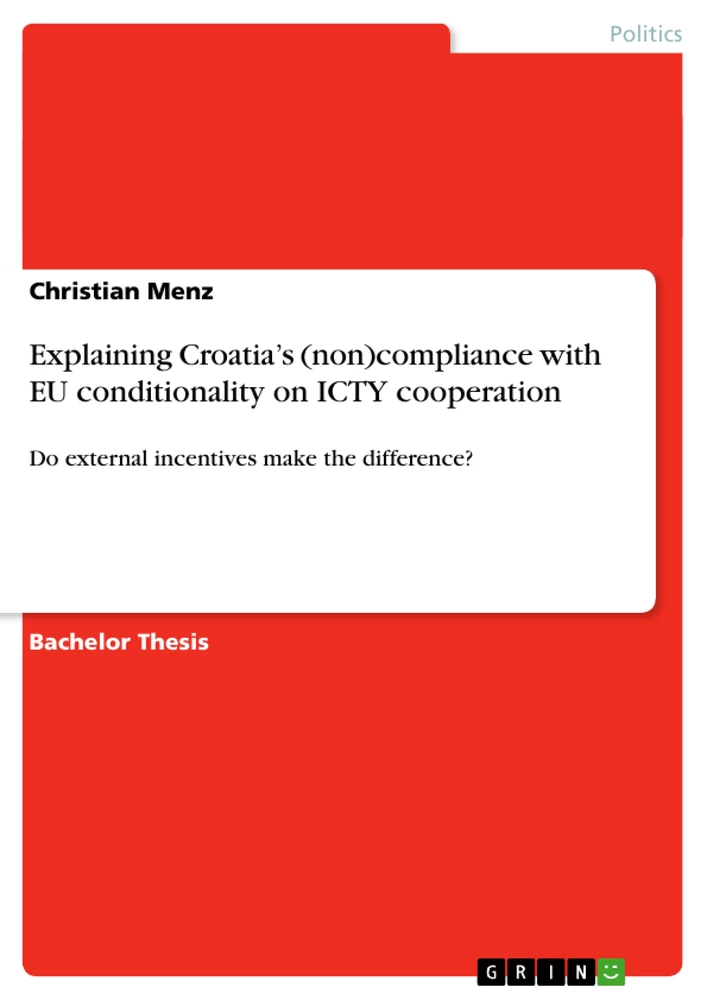
Table of Contents
1. Introduction
2. Theoretical foundations and current state of research
2.1 Theory and development of hypotheses
2.1.1 The role of external factors in democratization research
2.1.2 The external governance approach
2.1.3 Basic concepts of rationalism and constructivism
2.1.4 The external incentives model (EIM)
2.2 Empirical findings on (non)compliance with EU conditionality
2.2.1 Compliance with democratic conditionality
2.2.2 Compliance with acquis conditionality
3. Methodology and research design
4. Empirical analysis
4. 1 The role of ICTY conditionality within the EU enlargement framework
4.2 The case of Croatia
4.2.1 Introduction: the political context in Croatia
4.2.2 Phase I: the Račan government (2000-2003)
4.2.3 Phase II: The Sanader government (2003-2009)
Research Objectives and Key Topics
This thesis examines the factors explaining the variation in Croatia’s compliance with EU conditionality regarding cooperation with the International Criminal Tribunal for the former Yugoslavia (ICTY) during the period from 2000 to 2005. It specifically analyzes how external incentives and domestic political constraints influenced the Croatian government’s decisions in relation to the ICTY and European integration.
- Application of the rationalist 'External Incentives Model' (EIM) to the case of Croatia.
- Analysis of the interplay between internal domestic politics and external EU pressure.
- Examination of the transition from the Račan government to the Sanader government regarding ICTY cooperation.
- Investigation of the role of nationalist credibility and political adoption costs in policy compliance.
Excerpt from the Book
4.2.1 Introduction: the political context in Croatia
Croatia from 1995 until 2000 might be labeled a “hybrid regime” or as “corrupt populist pluralism” (Ramet 2008: 157) due to its bad record on civil and freedom rights, strong control of the media, an extensive patronage-based network and disrespect for parliamentary institutions (cf. Bartlett 2003: 49-55; BTI 2003: 2; Richter 2009b: 231).52 Moreover, at the end of the 1990s, Croatia was largely isolated because of the regime’s disregard for international norms (NYT 1999, 2000c).53 What is more, Tuđman’s restrictive policies led to sanctions by the International Monetary Fund (IMF), the exclusion from EU assistance under the PHARE program and from NATO’s Partnership for Peace program (PfP) (cf. BTI 2003: 1-3) which exacerbated the economic and social situation and thus was one important factor for the defeat of Tuđman’s HDZ (Croatian Democratic Union) in the 2000 elections which until then had dominated the political system (cf. Richer 2009b: 215; Zakošek 2008: 601).54
Moreover, Tuđman only very reluctantly and sporadically cooperated with the ICTY, especially with regard to the military operations ‘Flash’ and ‘Storm’ (cf. AFP 2001; BBC 1999; Del Ponte 2008: 315-321; Mundis 2001).55 In order to prevent democratic reforms and to legitimize his policies, the Tuđman regime built on historical nationalist ideas.56 After 1992, new parties emerged next to the dominant HDZ and, after 2000, the fragmentation of existing parties and the foundation of several new ones resulted in the transformation into a multiparty system (cf. Richter 2009b: 220; Zakošek 2008: 600).
Summary of Chapters
1. Introduction: Presents the central puzzle of Croatia’s erratic compliance with ICTY conditionality and establishes the research framework using the external incentives model.
2. Theoretical foundations and current state of research: Outlines the theoretical concepts of external governance and compares rationalist and constructivist approaches to compliance and socialization.
3. Methodology and research design: Details the structured, focused case study approach and the use of process-tracing to investigate the Croatian case.
4. Empirical analysis: Examines the evolution of EU conditionality and provides a detailed analysis of Croatia's political context and its ICTY cooperation during the Račan and Sanader administrations.
Keywords
Croatia, EU conditionality, ICTY, European enlargement, External Incentives Model, political compliance, democratization, nationalism, war crimes, transition, Western Balkans, policy transfer, Račan, Sanader, European integration.
Frequently Asked Questions
What is the core subject of this thesis?
The thesis investigates the factors that explain Croatia's inconsistent compliance with EU conditionality regarding cooperation with the International Criminal Tribunal for the former Yugoslavia (ICTY) between 2000 and 2005.
What are the central themes?
The central themes include the mechanics of EU conditionality, the impact of domestic political constraints and adoption costs, and the influence of national identity on foreign policy compliance.
What is the primary research question?
The study asks: What factors explain the variation in Croatia’s compliance with ICTY-related EU conditionality?
Which scientific method is employed?
The author uses a focused and structured single case study design, employing process-tracing to identify causal mechanisms and intermediate steps in the decision-making process.
What does the main part cover?
The main part analyzes the EU enlargement framework, the specific political context in Croatia under Tuđman, and provides a detailed examination of ICTY cooperation during the Račan (2000-2003) and Sanader (2003-2009) governments.
Which keywords characterize this work?
Key terms include Croatia, EU conditionality, ICTY, External Incentives Model, democratization, and political transition.
How did the Račan government approach ICTY cooperation?
The Račan government adopted a cautious approach, often attempting to balance international demands for cooperation with the need to maintain domestic support and prevent political backlash from nationalist groups.
What role did the "External Incentives Model" play?
The model serves as the primary analytical framework, helping to evaluate how material benefits and potential costs (adoption costs) influenced the government's willingness to comply with EU demands.
How did the change to the Sanader government impact cooperation?
The Sanader government used its conservative and nationalist credibility to facilitate cooperation while minimizing domestic political costs, eventually shifting the HDZ toward a more moderate position to satisfy EU requirements.
What conclusion does the author draw?
The author concludes that while the rationalist approach explains much of the compliance, the inconsistent application of conditionality by the EU and the role of national identity suggest that purely rationalist explanations are incomplete.
Ende der Leseprobe aus 64 Seiten
- nach oben
- Arbeit zitieren
- Christian Menz (Autor:in), 2010, Explaining Croatia’s (non)compliance with EU conditionality on ICTY cooperation, München, Page::Imprint:: GRINVerlagOHG, https://www.diplomarbeiten24.de/document/232064

neugierig - aktuell - relevant
Entdecken Sie hilfreiche Tipps und Tricks rund ums Studium!

Entdecken Sie hilfreiche Tipps und Tricks rund ums Studium!
Ihre Hausarbeit / Abschlussarbeit:

- - Publikation als E-Book und Buch
- - Hohes Honorar auf die Verkäufe
- - Für Sie komplett kostenlos - mit ISBN
- - Es dauert nur 5 Minuten
- - Jede Arbeit findet Leser

- © GRIN Publishing GmbH.
- Alle Inhalte urheberrechtlich geschützt. Kopieren und verbreiten untersagt.
- info@grin.com
- AGB
- Open Publishing
Der GRIN Verlag hat sich seit 1998 auf die Veröffentlichung akademischer eBooks und Bücher spezialisiert. Der GRIN Verlag steht damit als erstes Unternehmen für User Generated Quality Content. Die Verlagsseiten GRIN.com, Hausarbeiten.de und Diplomarbeiten24 bieten für Hochschullehrer, Absolventen und Studenten die ideale Plattform, wissenschaftliche Texte wie Hausarbeiten, Referate, Bachelorarbeiten, Masterarbeiten, Diplomarbeiten, Dissertationen und wissenschaftliche Aufsätze einem breiten Publikum zu präsentieren.
Kostenfreie Veröffentlichung: Hausarbeit, Bachelorarbeit, Diplomarbeit, Dissertation, Masterarbeit, Interpretation oder Referat jetzt veröffentlichen!
Folgen Sie GRIN auf


- GRIN Verlag GmbH
-
- Nymphenburger Str. 86
- 80636
- Munich, Deutschland
- +49 89-550559-0
- +49 89-550559-10
- info@grin.com
-
