
präsentiert von

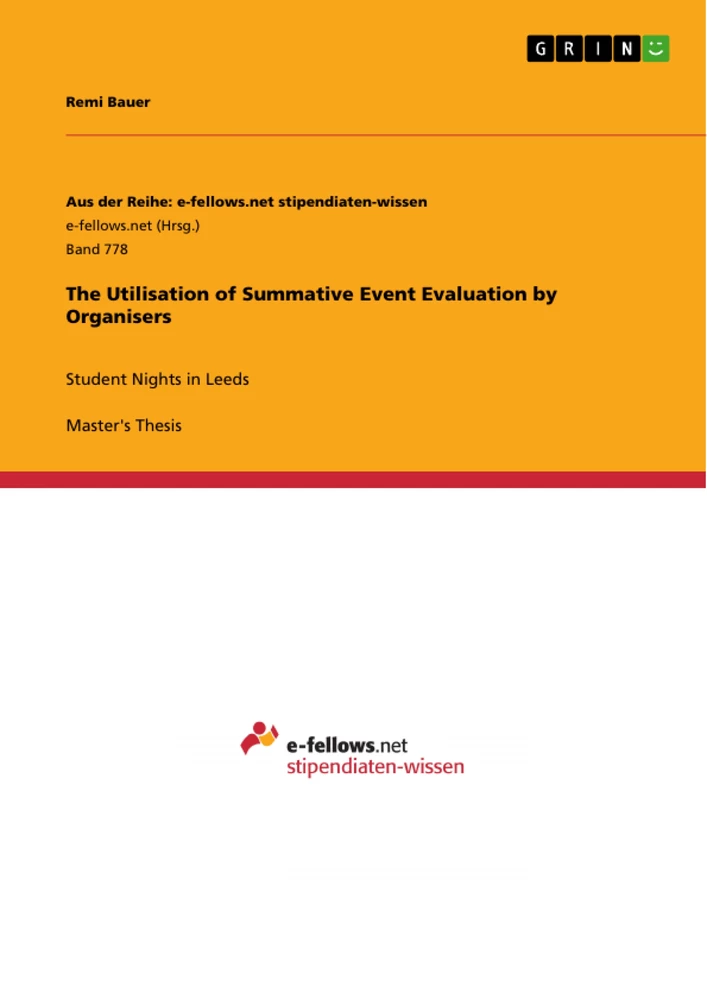
Table of Contents
1. Introduction
1.1 Background
1.2 Aims
1.3 Objectives
1.4 Significance and Value
1.5 Structure of the Dissertation
2. Literature Review
2.1 Introduction
2.2 Night-time economy
2.2.1 The concept of night-time economy
2.2.2 Economic value of the night-time economy
2.2.3 Market segmentation
2.2.4 Student nights
2.2.5 Leeds’ student nights market
2.3 Evaluation
2.3.1 Evaluation: Background
2.3.1 Types of Evaluation
2.3.2 Models of Evaluation
2.3.3 Post-event evaluation
2.3.3.1 Importance of Post-Event Evaluation
2.3.3.2 Conducting Post-Event Evaluation
2.4 Summary
3. Methodological process and methods
3.1 Introduction
3.2 Research Process
3.3 Understand Research Philosophy and Approach
3.3.1 Research Philosophy
3.3.2 Research Questions
3.3.3 Research Approach
3.3.4 Role of the Researcher
3.4 Formulate Research Design
3.5 Negotiate Access and Address Ethical Issues
3.5.1 Access
3.5.2 Ethics
3.6 Plan and Execute Data Collection
3.6.1 Sampling Methods
3.6.2 Participants
3.6.3. Data Collection
3.6.3.1 Internet Content Analysis
3.6.3.2 Questionnaire
3.6.3.3 Interviews
3.6.3.4 Justification
3.7 Limitations
3.8 Summary
4. Analysis and Discussion
4.1 Introduction
4.2 Internet Content Analysis
4.2.1 Results
4.2.2 Discussion
4.3 Questionnaire
4.3.1 Structure
4.3.2 Results
4.3.3 Discussion
4.4 Answers to the Research Questions
4.4.1 RQ1: Student Nights’ Market
4.4.2 RQ2: Measuring Success
4.4.3 RQ3: Goal-attainment Method
4.5 Summary
5. Conclusion and Recommendation
5.1 Introduction
5.2 Recommendation
5.2.1 Event Organisers
5.2.2 Improvements and Future Research
5.3 Conclusion
Research Objectives and Key Themes
This dissertation investigates the application of post-event evaluation theories, specifically goal-attainment models, within the night-time economy, focusing on student night organisers in Leeds to determine if and how they assess event success and performance.
- Evaluation practices within the night-time economy
- Analysis of the student nights’ market segment in Leeds
- The use of goal-attainment methods and success indicators
- Organisational perspectives on event performance and evaluation
Excerpt from the Dissertation
2.3.3.1 Importance of Post-Event Evaluation
Event evaluation is a vital part of the overall event management process. By conducting event evaluation, insights are gained, valuable lessons are learnt and, thus, events are improved (Allen et al. 2005). Summative evaluation provides a clear record of performance. If it is not conducted, success and failure of an event are matter of perception and not measured and clearly defined (Tum, Norton and Wright 2006). As completing a retrospective assessment aids an organisation in determining an event’s strengths and weaknesses (Meyers 2012), if properly interpreted, used and implemented, it is a driver of continuous improvement (Allen et al. 2005). Research proposes that summative evaluation is essential for an event and should be completed regularly. In order to do this, it is of utmost importance to create gauges for the event evaluation. Such criterions can be founded on tangible and quantitative hard criteria and on intangible and qualitative soft criteria (Watt 1998; Crowther 2010). This goes hand in hand with the theory of the goal-attainment model of result-based evaluation as it assesses success according to predetermined goals (Hansen 2005). However, event evaluation is often neglected by organisers themselves after an event has been completed (Van der Wagen 2005). This is commonly due to cost and time constraints. An absence of awareness of significance as well as usefulness of evaluation also plays a role in the negligence (Robinson, Wale and Dickson 2010). Wood (2009) agrees that limited resources such as time and money are restraining factors and the main reason why companies neglect evaluation. Further, the author points out that objectives and evaluation are related to a vicious cycle. Events without clear objectives are hard to assess and the objectives for future events have to be based on evaluations conducted in the past.
Summary of Chapters
Chapter One: Introduction: Provides the research background, identifies the research gap regarding evaluation in the night-time economy, and outlines the study's aims and objectives.
Chapter Two: Literature Review: Examines the concept of the night-time economy, defines student nights, and reviews academic literature on evaluation models, specifically focusing on summative and post-event evaluation.
Chapter Three: Methodological process and methods: Details the interpretivist research philosophy, justifies the choice of internet content analysis and online questionnaires, and discusses research limitations and ethics.
Chapter Four: Analysis and Discussion: Presents and discusses the empirical findings from the content analysis and questionnaires regarding how student night organisers in Leeds measure success.
Chapter Five: Conclusion and Recommendation: Summarises the findings, offers practical recommendations for event organisers, and suggests areas for future research.
Keywords
Summative Evaluation, Post-Event Evaluation, Night-time Economy, Student Nights, Leeds, Goal-attainment Model, Event Management, Market Segmentation, Performance Measurement, Event Organisers, Success Indicators, Research Methodology, Interpretivism, Online Questionnaire, Internet Content Analysis
Frequently Asked Questions
What is the core focus of this dissertation?
The research explores how event organisers within the night-time economy, specifically those hosting student nights in Leeds, utilise summative event evaluation to measure success and accomplish objectives.
What are the primary themes addressed in the study?
Key themes include the economic importance of the night-time economy, the definition and market segmentation of student nights, and the practical application of formal evaluation models.
What is the central research question?
The study aims to determine the evaluation approaches of student night organisers, specifically testing if and how goal-attainment methods are applied in a real-world, commercial context.
Which scientific methodology was employed?
The researcher adopted an interpretivist philosophy using a qualitative approach. Data was collected via an internet content analysis and an online questionnaire distributed to identified student night organisers.
What topics are covered in the main body of the work?
The dissertation covers the background of the night-time economy, theoretical frameworks for evaluation, the specifics of the Leeds student market, and a detailed analysis of survey results regarding organiser practices.
Which keywords best characterise this research?
Key terms include Summative Evaluation, Night-time Economy, Student Nights, Performance Measurement, and Goal-attainment.
How is the student market in Leeds described?
The study identifies the Leeds student market as a highly competitive, lucrative segment within the night-time economy, driven by promotional tactics like cheap drink prices and viral marketing.
Does the research conclude that organisers use evaluation effectively?
The dissertation concludes that while organisers often set economic objectives, there are significant inconsistencies in evaluation frequency and process, meaning the full potential of evaluation is currently underutilised.
What are the primary indicators organisers use to measure success?
The research reveals a strong reliance on hard, quantitative data, primarily profit, cost, and attendee numbers, while soft criteria are largely neglected during the planning stage.
Ende der Leseprobe aus 104 Seiten
- nach oben
- Arbeit zitieren
- Remi Bauer (Autor:in), 2012, The Utilisation of Summative Event Evaluation by Organisers, München, Page::Imprint:: GRINVerlagOHG, https://www.diplomarbeiten24.de/document/232080

neugierig - aktuell - relevant
Entdecken Sie hilfreiche Tipps und Tricks rund ums Studium!

Entdecken Sie hilfreiche Tipps und Tricks rund ums Studium!
Ihre Hausarbeit / Abschlussarbeit:

- - Publikation als E-Book und Buch
- - Hohes Honorar auf die Verkäufe
- - Für Sie komplett kostenlos - mit ISBN
- - Es dauert nur 5 Minuten
- - Jede Arbeit findet Leser

- © GRIN Publishing GmbH.
- Alle Inhalte urheberrechtlich geschützt. Kopieren und verbreiten untersagt.
- info@grin.com
- AGB
- Open Publishing
Der GRIN Verlag hat sich seit 1998 auf die Veröffentlichung akademischer eBooks und Bücher spezialisiert. Der GRIN Verlag steht damit als erstes Unternehmen für User Generated Quality Content. Die Verlagsseiten GRIN.com, Hausarbeiten.de und Diplomarbeiten24 bieten für Hochschullehrer, Absolventen und Studenten die ideale Plattform, wissenschaftliche Texte wie Hausarbeiten, Referate, Bachelorarbeiten, Masterarbeiten, Diplomarbeiten, Dissertationen und wissenschaftliche Aufsätze einem breiten Publikum zu präsentieren.
Kostenfreie Veröffentlichung: Hausarbeit, Bachelorarbeit, Diplomarbeit, Dissertation, Masterarbeit, Interpretation oder Referat jetzt veröffentlichen!
Folgen Sie GRIN auf


- GRIN Verlag GmbH
-
- Nymphenburger Str. 86
- 80636
- Munich, Deutschland
- +49 89-550559-0
- +49 89-550559-10
- info@grin.com
-
