
präsentiert von

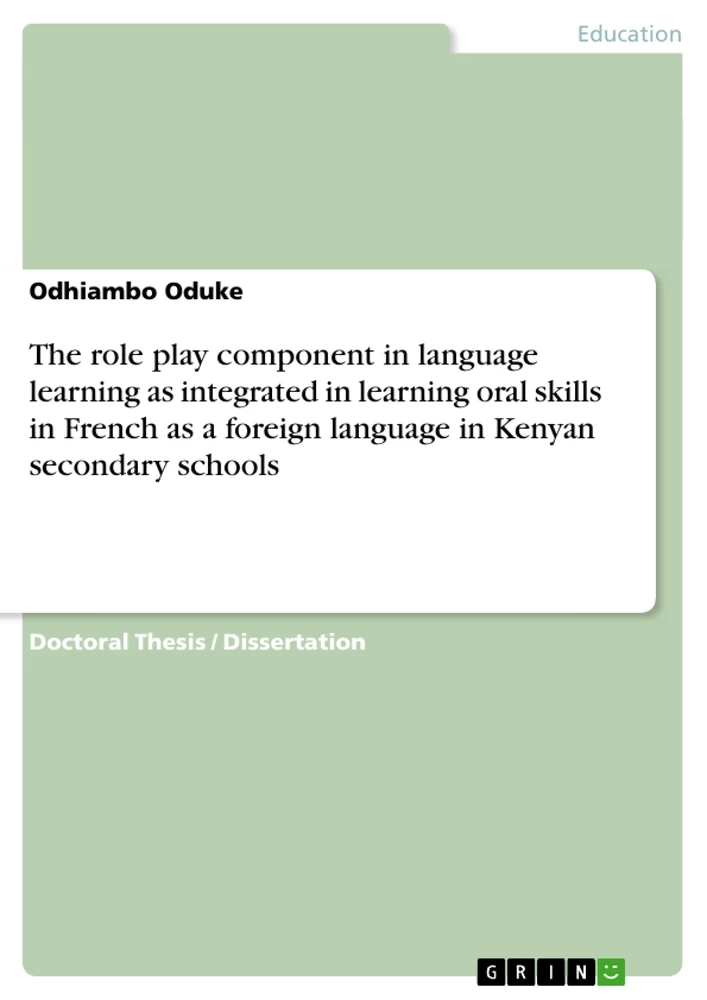
Table of Contents
Chapter 1
1.0 General Introduction
1.1. The main objective of the research
1.2 The Research Questions
1.3 The study sample
Chapter 2
2.0 Background
2.1 Assessment and Evaluation
2.2 Kenya Association of Teachers of French (KATF)
2.3 Regional French Language Centers
2.4 French Language presence in Kenya
2.5 Alliance Française
2.6 Schools Drama festival
2.7 French for specific purposes
Chapter 3
3.0 General analysis
3.1 The conceptual Framework
3.2 Kraschen’s Monitor Model
3.4 The Grounded Theory
Chapter 4
4.0 The results of the study
4.1 The course books- General overview
4.2 The role play content in Pierre et Seydou series
4.3 The role play content in the Parlons Français series
4.4 The role play content in the Entre Copains series
4.5 The National examination assessment
4.6 Schools Drama Festival –Plays interpreted in French
4.7 The results from the questionnaires
4.8 The aspect of language learning which learners enjoy most
4.9 How best should French as a foreign language be taught
4.10 How does one gain fluency and confidence in expressing oneself in a language
4.11 Interview and remarks from the teachers
Conclusion
5.0 Conclusion
5.1 recommendations
Objectives and Research Themes
This thesis examines the integration of role play as a teaching technique to enhance oral proficiency in French among secondary school students in Kenya. The research investigates how this method bridges the gap between latent language knowledge and active communicative competence, while addressing the specific challenges of a foreign language environment.
- Role play as a pedagogical tool for oral language development.
- Krashen’s Monitor Model and Grounded Theory in the context of foreign language acquisition.
- The effectiveness of role play in Kenyan secondary school course books and national assessments.
- Learner motivations, attitudes, and the role of confidence in acquiring oral fluency.
Excerpt from the Thesis
3.2 KRASCHEN’S MONITOR MODEL
According to Kraschen language is always acquired. It is rarely learnt. It is authentic and at some point pseudo-authentic situations (where role play actually plays a major role) which facilitates the acquisition of language. The traditional classroom where grammar lessons and compiling vocabulary and other fixed linguistic expressions though being the norm has always failed to facilitate the actual acquisition of language and its proficient use. That is why varied contexts for example in the street, at the supermarket, at the garage or any other defined space facilitates the language to be expressed because various defined spaces ‘dictate’ the type of register that is to be used.
For instance at a restaurant the client and the waiter will engage in communication with some defined specific objective. The client would wish to be served some food whereas the waiter would wish to take the order. The ‘hospitality’ register takes place and this will facilitate communication. In role play the aforementioned scenario is at times enacted in the classroom to imitate the ‘restaurant’ scene. Herein some aspects of acquisition start taking some shape. This is what Kraschen qualifies to be the acquisition learning hypothesis.
The Monitor Hypothesis where editing of the language is done by the speaker has always been controversial among linguists and language researchers in general. Speakers of the language being learnt at times make some conscious effort to speak in correct and appropriate grammar. This Kraschen observes that the speaker is able to prepare snippets of the communication to conform to some order of correctness.
Summary of Chapters
Chapter 1: Provides the introduction to the research, outlining the objectives regarding the integration of role play into the Kenyan French language syllabus and identifying the research questions.
Chapter 2: Outlines the background of French language education in Kenya, including the influence of colonial history and the role of institutions like the Alliance Française and local Drama Festivals.
Chapter 3: Details the conceptual framework of the study, synthesising Krashen’s Monitor Model with Grounded Theory to explore language acquisition through role play.
Chapter 4: Presents the primary results of the research, analyzing the presence of role play in standard French course books and detailing the outcomes of questionnaires and teacher interviews.
Conclusion: Summarizes the findings, confirming that role play is a vital catalyst for oral acquisition and provides evidence-based recommendations for language instructors.
Keywords
Role play, oral skills, French as a foreign language, language acquisition, Kraschen’s Monitor Model, Grounded Theory, Kenyan secondary schools, language pedagogy, communication fluency, simulation, linguistic competence, learner motivation, oral output, classroom interaction, educational curriculum.
Frequently Asked Questions
What is the core focus of this research?
The research examines the implementation and effectiveness of role play as a teaching technique to foster oral proficiency in French among secondary school students in Kenya.
What are the primary themes of this study?
The central themes include the integration of simulation, the impact of communicative activities on student confidence, the evolution of French assessment methods in Kenya, and the application of theoretical language acquisition models in a practical classroom environment.
What is the primary objective of this work?
The goal is to provide an authoritative analysis of how role play can be used to motivate students to move beyond latent linguistic knowledge and achieve active communicative competence in a foreign language.
Which scientific methodologies are employed?
The study utilizes a qualitative-cum-textual approach, drawing on Grounded Theory and Krashen’s Monitor Model to interpret data collected through questionnaires, interviews, and content analysis of textbooks.
What is covered in the main section of the paper?
The main section covers an extensive overview of the history of French teaching in Kenya, an analysis of the role-play content within approved course books, and a detailed examination of teacher and student feedback regarding oral language development.
What defines the core keyword set for this thesis?
The keywords are centered on "Role play," "Oral skills," "Language acquisition," and "Kenyan secondary schools," reflecting the intersection of pedagogy, specific instructional techniques, and the local socio-educational context.
How does the author define the "silent phase" in language learning?
The author, referencing Krashen, describes the silent phase as an innate period during the early stages of acquisition where input is being collated and collected by the learner before they feel ready to initiate verbal expression.
What impact do the findings suggest for policy makers?
The findings advocate for the inclusion of formal oral assessment techniques, similar to those tested between 1995 and 2005, to ensure that oral skills are prioritized equally alongside reading, writing, and listening.
How does the "Schools Drama Festival" facilitate language learning?
The festival serves as a practical, high-stakes application of role play where students utilize scaffolded linguistic expressions and rehearsals to create and perform French plays, thereby enhancing their confidence and language mastery.
Ende der Leseprobe aus 83 Seiten
- nach oben
- Arbeit zitieren
- Odhiambo Oduke (Autor:in), 2013, The role play component in language learning as integrated in learning oral skills in French as a foreign language in Kenyan secondary schools, München, Page::Imprint:: GRINVerlagOHG, https://www.diplomarbeiten24.de/document/232757

neugierig - aktuell - relevant
Entdecken Sie hilfreiche Tipps und Tricks rund ums Studium!

Entdecken Sie hilfreiche Tipps und Tricks rund ums Studium!
Ihre Hausarbeit / Abschlussarbeit:

- - Publikation als E-Book und Buch
- - Hohes Honorar auf die Verkäufe
- - Für Sie komplett kostenlos - mit ISBN
- - Es dauert nur 5 Minuten
- - Jede Arbeit findet Leser

- © GRIN Publishing GmbH.
- Alle Inhalte urheberrechtlich geschützt. Kopieren und verbreiten untersagt.
- info@grin.com
- AGB
- Open Publishing
Der GRIN Verlag hat sich seit 1998 auf die Veröffentlichung akademischer eBooks und Bücher spezialisiert. Der GRIN Verlag steht damit als erstes Unternehmen für User Generated Quality Content. Die Verlagsseiten GRIN.com, Hausarbeiten.de und Diplomarbeiten24 bieten für Hochschullehrer, Absolventen und Studenten die ideale Plattform, wissenschaftliche Texte wie Hausarbeiten, Referate, Bachelorarbeiten, Masterarbeiten, Diplomarbeiten, Dissertationen und wissenschaftliche Aufsätze einem breiten Publikum zu präsentieren.
Kostenfreie Veröffentlichung: Hausarbeit, Bachelorarbeit, Diplomarbeit, Dissertation, Masterarbeit, Interpretation oder Referat jetzt veröffentlichen!
Folgen Sie GRIN auf


- GRIN Verlag GmbH
-
- Nymphenburger Str. 86
- 80636
- Munich, Deutschland
- +49 89-550559-0
- +49 89-550559-10
- info@grin.com
-
