
präsentiert von

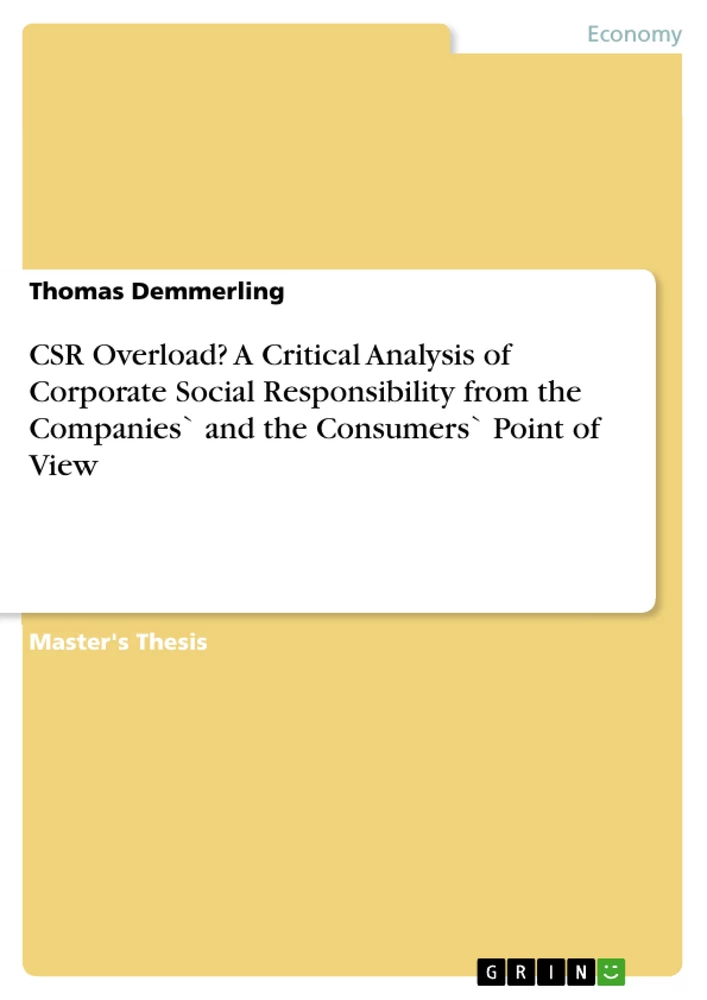
Table of Contents
1. Introduction
1.1 Problem Definition and Relevance of the Topic
1.2 Objectives of Work
1.3 Structure of Work
2. Theoretical Foundation of Corporate Social Responsibility
2.1 Definition
2.2 Distinction from Related Terms
2.3 Elements of CSR
2.3.1 Corporate Citizenship
2.3.2 Sustainability
2.3.3 Corporate Governance
2.4 Historical Development of CSR
2.5 Systemization of CSR
2.5.1 Pyramid of CSR by Carroll
2.5.2 Two-Dimensional Model of Corporate Social Responsibility by Quazi and O’Brien
2.5.3 Three-Dimensional Model of CSR by Schwartz/Carroll
3. CSR from the Companies’ Point of View
3.1 Causes for CSR
3.1.1 Moral Imperative and Sustainability
3.1.2 Prevention Against Barriers and Restrictions
3.1.3 Pressure from Society and Reputation
3.2 Ethical Values vs. the Market
3.2.1 Financial and Time Expenditure for CSR
3.2.2 Managing CSR
3.2.3 Missing Support of Stakeholders
3.3 CSR as Competitive Advantage
3.3.1 Unique Selling Proposition
3.3.2 Strategic CSR by Porter and Kramer
3.3.3 CSR and Communication
3.4 Greenwashing
3.4.1 Definition and Relation to CSR
3.4.2 Possible Effects of Greenwashing
3.5 Interim Conclusion – CSR from a Companies’ Point of View
4. CSR from the Consumers’ Point of View
4.1 Awareness of Corporate Social Responsibility
4.2 Influence of CSR on Consumer Behavior
4.2.1 Current Scientific Statistics
4.2.2 Reactance to CSR and Influence on Consumer Behavior
4.3 Empirical Questioning to Test Current Reactance to CSR Campaigns
4.3.1 Structure of Questioning
4.3.2 Evaluation of Results
4.4 Interim Conclusion – CSR from a Consumers’ Point of View
5. Recommendations for Companies to Implement CSR
5.1 Recommendations for the Decision Making for CSR
5.2 Recommendations for a Credible CSR Communication
6. Conclusion and Outlook
Research Objectives and Topics
This Master-Thesis examines the phenomenon of "CSR Overload" by critically analyzing the perception of Corporate Social Responsibility from both the companies' and the consumers' points of view. The central research question explores whether CSR initiatives can still function as a competitive advantage or if an overabundance of such initiatives leads to consumer reactance, mistrust, or skepticism.
- The theoretical foundations and historical development of CSR.
- Companies' motives for adopting CSR and the management challenges involved.
- The strategic integration of CSR into the value chain as a competitive advantage (USP).
- Consumer awareness, behavior, and potential reactance towards CSR campaigns.
- The role of "greenwashing" and its negative effects on reputation and trust.
- Practical recommendations for effective and credible CSR communication.
Excerpt from the Book
3.1.2 Prevention Against Barriers and Restrictions
CSR can take the role as a proactive and preventive instrument which enhances the company’s image within society and therefore reduces the criticism and possible legal restrictions. With the implementation and communication of CSR activities a company can reduce potential barriers and legitimate its actions towards the government and other authorities. Especially in totally regulated industries there is often a danger, due to the offer of low quality products and services which do not meet international standards and norms, to be accused. In this context, also the influence of activist persons and NGOs need to be mentioned, as they, for example, could call for a boycott of products and services. Governmental institutions and municipalities, NGOs, employee representative committees, and employee representatives (labor unions) should therefore have an involvement in CSR activities.
Porter and Kramer also talk about the “license-to-operate”, it derives from the fact that every company needs tacit or explicit permission from governments, communities, and numerous other stakeholders to do business. In this way a company can identify issues and problems that matter to its stakeholders and make decisions about them. These findings show that it is not just about meeting all legal requirements, but especially about anticipating the expectations of the society that a company could face in the future. In this context, companies are also made responsible to find solutions for social and economic problems. Demands and requirements by society, government, NGO etc. are often not articulated in advance but mostly ex post in reaction to any kind of action. So, it is also a company’s task to anticipate not articulated demands and requirements of stakeholders to identify specific intersections between interests of the firm and those of society, for example projects and activities that can help the company due to competitive advantage while generating positive social outcomes.
Summary of Chapters
1. Introduction: Defines the relevance of CSR in modern capitalism, identifies the research gap regarding consumer reactance, and outlines the objectives and structure of the work.
2. Theoretical Foundation of Corporate Social Responsibility: Provides definitions of CSR, distinguishes it from related terms like Corporate Citizenship and Sustainability, and presents foundational models like the Carroll pyramid.
3. CSR from the Companies’ Point of View: Examines motives for CSR, the dilemma between ethical values and market pressure, the concept of CSR as a competitive advantage, and the risks of greenwashing.
4. CSR from the Consumers’ Point of View: Analyzes consumer awareness and behavior, introduces the theory of reactance, and evaluates empirical findings from an online survey regarding CSR campaigns.
5. Recommendations for Companies to Implement CSR: Offers actionable advice for decision-making and suggests strategies for ensuring credible and transparent CSR communication.
6. Conclusion and Outlook: Synthesizes the main findings, confirms that while a positive attitude towards CSR exists, skepticism and mistrust are prevalent, and suggests future research directions.
Keywords
Corporate Social Responsibility, CSR, Sustainability, Corporate Citizenship, Corporate Governance, Competitive Advantage, Unique Selling Proposition, Greenwashing, Consumer Behavior, Reactance Theory, Stakeholder Management, CSR Communication, Reputation, Moral Imperative, Strategic CSR.
Frequently Asked Questions
What is the core focus of this Master-Thesis?
The work examines whether Corporate Social Responsibility (CSR) still serves as a credible competitive advantage or if the current "flood" of CSR initiatives leads to consumer overload and reactance.
What are the primary thematic fields covered?
The thesis covers the theoretical foundations of CSR, corporate motivations and management strategies, consumer perception and behavioral response, and the implications of greenwashing.
What is the primary objective of this research?
The goal is to determine if consumers are becoming resistant to CSR due to over-communication and to provide companies with strategies for credible, value-based CSR implementation.
Which scientific methods are employed?
The research combines an extensive review of existing literature and management theories with an empirical, quantitative online survey conducted among consumers to test specific hypotheses regarding CSR reactance.
What is addressed in the main part of the thesis?
The main body contrasts the company perspective—justifications, strategic integration, and management barriers—with the consumer perspective—awareness, trust, and response to CSR activities.
Which keywords best characterize this work?
The key concepts include CSR, Greenwashing, Consumer Reactance, Competitive Advantage, Reputation Management, and Strategic CSR communication.
How does the author define the "license-to-operate" in the context of CSR?
The author uses Porter and Kramer’s concept to describe the tacit or explicit permission a company needs from governments and society to do business, which CSR helps to secure and maintain.
What does the thesis conclude regarding consumer reactance to CSR?
It concludes that while there is no widespread, active reactance yet, there is a clear presence of skepticism and mistrust, especially regarding the motives behind CSR, which companies must address through more transparent communication.
Ende der Leseprobe aus 122 Seiten
- nach oben
- Arbeit zitieren
- Thomas Demmerling (Autor:in), 2013, CSR Overload? A Critical Analysis of Corporate Social Responsibility from the Companies` and the Consumers` Point of View, München, Page::Imprint:: GRINVerlagOHG, https://www.diplomarbeiten24.de/document/263154

neugierig - aktuell - relevant
Entdecken Sie hilfreiche Tipps und Tricks rund ums Studium!

Entdecken Sie hilfreiche Tipps und Tricks rund ums Studium!
Ihre Hausarbeit / Abschlussarbeit:

- - Publikation als E-Book und Buch
- - Hohes Honorar auf die Verkäufe
- - Für Sie komplett kostenlos - mit ISBN
- - Es dauert nur 5 Minuten
- - Jede Arbeit findet Leser

- © GRIN Publishing GmbH.
- Alle Inhalte urheberrechtlich geschützt. Kopieren und verbreiten untersagt.
- info@grin.com
- AGB
- Open Publishing
Der GRIN Verlag hat sich seit 1998 auf die Veröffentlichung akademischer eBooks und Bücher spezialisiert. Der GRIN Verlag steht damit als erstes Unternehmen für User Generated Quality Content. Die Verlagsseiten GRIN.com, Hausarbeiten.de und Diplomarbeiten24 bieten für Hochschullehrer, Absolventen und Studenten die ideale Plattform, wissenschaftliche Texte wie Hausarbeiten, Referate, Bachelorarbeiten, Masterarbeiten, Diplomarbeiten, Dissertationen und wissenschaftliche Aufsätze einem breiten Publikum zu präsentieren.
Kostenfreie Veröffentlichung: Hausarbeit, Bachelorarbeit, Diplomarbeit, Dissertation, Masterarbeit, Interpretation oder Referat jetzt veröffentlichen!
Folgen Sie GRIN auf


- GRIN Verlag GmbH
-
- Nymphenburger Str. 86
- 80636
- Munich, Deutschland
- +49 89-550559-0
- +49 89-550559-10
- info@grin.com
-
