
präsentiert von

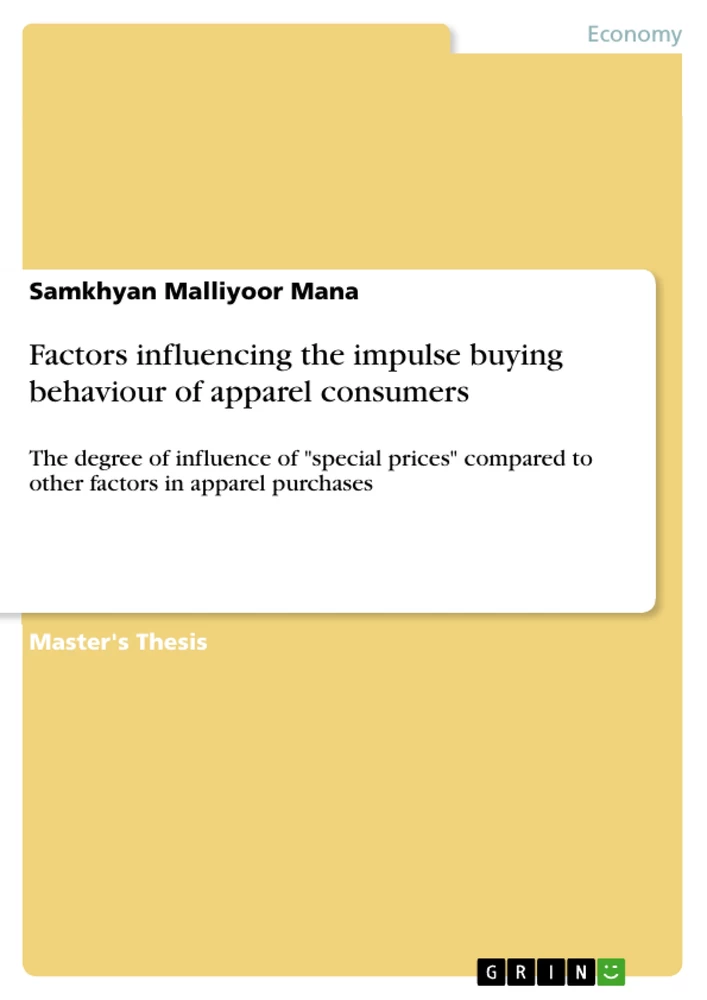
Table of Contents
1. CHAPTER 1
1.1 INTRODUCTION
1.2 AIM AND OBJECTIVES OF THE RESEARCH
1.2.1. RESEARCH QUESTIONS:
1.3 RATIONALE FOR THE CHOSEN TOPIC
1.4 STRUCTURE OF THE RESEARCH
1.4.1. CHAPTER 1- INTRODUCTION
1.4.2. CHAPTER2- LITERATURE REVIEW
1.4.3. CHAPTER 3- METHODOLOGY
1.4.4. CHAPTER 4- ANALYSIS& FINDINGS
1.4.5. CHAPTER 5- DISCUSSION
1.4.6. CHAPTER 6- CONCLUSION
1.4.7. CHAPTER 7- RECOMMENDATIONS
1.5 CONCLUSION
2. CHAPTER 2
2.1 INTRODUCTION
2.2 CONSUMER BEHAVIOUR
2.2.1. CONSUMER BUYING PROCESS
2.3 IMPULSE BUYING
2.3.1. DEFINITIONS
2.3.2. TYPES OF IMPULSE BUYING
2.3.3. FACTORS DETERMINING IMPULSE BUYING
2.3.4. IMPULSE BUYING IN APPARELS AND OTHER PRODUCTS
2.4 CONCLUSION
3. CHAPTER 3
3.1 INFLUENCING VARIABLES
3.1.1. INFLUENCE OF PRICE& OTHER PROMOTIONAL DEALS
3.1.2. INFLUENCE OF IN-STORE DISPLAYS& STORE ATMOSPHERE
3.1.3. INFLUENCE OF FASHION& OTHER EXTERNAL INFLUENCING FACTORS
3.1.4. SECTION IV
3.2 SURVEY DEVELOPMENT
3.3 DATA COLLECTION& ANALYSIS
3.4 LIMITATIONS
3.5 SUMMARY
4. CHAPTER 4
4.1 SECTION I- BUYER PROFILE
4.1.1 SEX
4.1.2 AGE
4.1.3 ETHNICITY
4.1.4 EMPLOYMENT STATUS
4.1.5 ANNUAL INCOME
4.1.6 PURPOSE FOR BEING DOWN TOWN
4.2 IMPULSE BUYING AWARENESS
4.3 SECTION II
4.4 SECTION III
4.4.1. PRICE OF THE PRODUCT
4.4.2. PRICE & CUSTOMER ATTITUDE
4.4.3. PRICE, PLANNING AND BRAND
4.4.4. STORE DISPLAYS & IMPULSE BUYING
4.4.5. STORE ENVIRONMENT & IMPULSE BUYING
4.4.6. IMPULSE BUYING & OTHER FACTORS
4.5 SECTION IV
5. CHAPTER 5
6. CHAPTER 6
7. CHAPTER 7
7.1 LIMITATIONS
Research Objectives and Themes
This dissertation investigates the factors influencing impulse buying behavior among apparel consumers in London, specifically comparing the impact of "special prices" against other in-store and environmental variables.
- Impact of special pricing and promotional offers on unplanned apparel purchases.
- The influence of in-store displays, store atmosphere, and environmental factors.
- The relationship between consumer brand loyalty, variety-seeking personality, and impulse buying.
- Comparison of impulse buying tendencies across different demographic profiles.
- Evaluation of the role of store personnel and social influences in the shopping experience.
Excerpt from the Book
1.1 INTRODUCTION
Jim Blythe et. al (2005) tells us a story: “A consumer is on a shopping trip to buy a new jacket for a weekend party. In the shop he notices a rack of bow ties, and buys one because he has never owned one before (pure impulse). Next he remembers that he has not got a suitable summer shirt, so he picks up one from the counter (reminder impulse), and near it he sees a rack of cotton trousers which are on offer (suggestion impulse). Finally he sees a safari jacket which, although it is not the style he was thinking of, is actually ideal for the job so he buys it (planned purchase).” This is how exactly impulse purchases happen for apparel consumers. This is an age of fierce competition for retailers in all aspects, where, marketers, especially in apparel business, are desperately trying to find out new ways and tools to attract customers and sometimes even to, at least, sustain in the market. The discovery of Impulse Buying Behaviour happened as part of such an intensive study on the consumers’ behaviour patterns while in the store.
According to American Marketing Association (2008), impulse buying is “a purchase behaviour that is assumed to be made without prior planning or thought”. “The early studies viewed impulse purchasing strictly similar to unplanned purchasing (Clover 1950, du Pont studies 1945- 51) and were conducted with managerial interests in mind (i.e. for retailer’s benefit). The purchases, not the consumer, were investigated”. A more comprehensive definition for impulse buying brought by Piron F. (1991) as; “Impulse purchasing is formally defined as a purchase that is: 1) Unplanned, 2) the result of an exposure to a stimulus 3) decided ‘on-the-spot”.
Summary of Chapters
CHAPTER 1: Provides an overview of the impulse buying phenomenon, introduces the study's research questions, and outlines the rationale and structure of the dissertation.
CHAPTER 2: Reviews existing academic literature regarding consumer behavior, the definition of impulse buying, and various theoretical frameworks developed by past experts.
CHAPTER 3: Details the research methodology, explaining the use of questionnaire surveys and personal interviews conducted with apparel shoppers in London.
CHAPTER 4: Presents the primary data collected, including buyer profiles and detailed findings on the variables influencing impulse decisions.
CHAPTER 5: Discusses the findings of the study, linking them back to the literature review and interpreting the implications of the data for apparel retailers.
CHAPTER 6: Concludes the study by summarizing key insights, highlighting that impulse buying is driven by a combination of factors rather than a single variable.
CHAPTER 7: Offers recommendations for marketers based on the findings and acknowledges the limitations encountered during the research process.
Keywords
Impulse Buying, Apparel Consumers, Consumer Behavior, Special Pricing, In-store Displays, Retail Marketing, Purchase Decision, Brand Loyalty, Variety-seeking Behavior, Store Atmosphere, Promotional Deals, Customer Psychology, Unplanned Purchasing.
Frequently Asked Questions
What is the core focus of this research study?
The study investigates the factors that stimulate impulse buying behavior among apparel consumers, with a specific focus on the degree of influence "special prices" have compared to other environmental variables.
What are the primary thematic areas covered?
The research covers consumer decision-making processes, the impact of in-store merchandising (displays and atmosphere), the role of fashion and brand consciousness, and the variety-seeking personality of shoppers.
What is the primary research objective?
The main objective is to evaluate whether "special price" is the most influential variable in driving impulse purchases or if other collective factors, such as store environment and brand appeal, play a more significant role.
Which scientific methodology was applied?
The research employed a quantitative and qualitative approach, using a questionnaire survey of 60 consumers and supplementary personal interviews conducted at apparel retail stores in London.
What topics are discussed in the main body of the work?
The main body covers consumer buying models, definitions of impulse buying types, the impact of situational factors like lighting and music, and an analysis of survey data relating to consumer price sensitivity and brand loyalty.
Which keywords best characterize this dissertation?
Key terms include Impulse Buying, Apparel Consumers, Retail Marketing, Consumer Behavior, Special Pricing, and In-store Merchandising.
How do window displays influence the shoppers' behavior in this study?
The study finds that window displays are crucial in attracting customers from the street, even those without a prior intention to shop, serving as a primary stimulus for initiating impulse buying journeys.
Does the research conclude that impulse buying is primarily driven by price alone?
No, the research concludes that while special pricing is highly influential, impulse purchases are typically the result of a synergistic combination of multiple variables, including store environment, branding, and individual customer personality traits.
What do the findings suggest regarding the post-purchase behavior of impulse shoppers?
Interestingly, the study reveals that approximately 83% of participants reported feeling happy and satisfied after making an impulse purchase, suggesting that these consumers often enjoy the impulse shopping experience.
Ende der Leseprobe aus 74 Seiten
- nach oben
- Arbeit zitieren
- Samkhyan Malliyoor Mana (Autor:in), 2009, Factors influencing the impulse buying behaviour of apparel consumers, München, Page::Imprint:: GRINVerlagOHG, https://www.diplomarbeiten24.de/document/263814

neugierig - aktuell - relevant
Entdecken Sie hilfreiche Tipps und Tricks rund ums Studium!

Entdecken Sie hilfreiche Tipps und Tricks rund ums Studium!
Ihre Hausarbeit / Abschlussarbeit:

- - Publikation als E-Book und Buch
- - Hohes Honorar auf die Verkäufe
- - Für Sie komplett kostenlos - mit ISBN
- - Es dauert nur 5 Minuten
- - Jede Arbeit findet Leser

- © GRIN Publishing GmbH.
- Alle Inhalte urheberrechtlich geschützt. Kopieren und verbreiten untersagt.
- info@grin.com
- AGB
- Open Publishing
Der GRIN Verlag hat sich seit 1998 auf die Veröffentlichung akademischer eBooks und Bücher spezialisiert. Der GRIN Verlag steht damit als erstes Unternehmen für User Generated Quality Content. Die Verlagsseiten GRIN.com, Hausarbeiten.de und Diplomarbeiten24 bieten für Hochschullehrer, Absolventen und Studenten die ideale Plattform, wissenschaftliche Texte wie Hausarbeiten, Referate, Bachelorarbeiten, Masterarbeiten, Diplomarbeiten, Dissertationen und wissenschaftliche Aufsätze einem breiten Publikum zu präsentieren.
Kostenfreie Veröffentlichung: Hausarbeit, Bachelorarbeit, Diplomarbeit, Dissertation, Masterarbeit, Interpretation oder Referat jetzt veröffentlichen!
Folgen Sie GRIN auf


- GRIN Verlag GmbH
-
- Nymphenburger Str. 86
- 80636
- Munich, Deutschland
- +49 89-550559-0
- +49 89-550559-10
- info@grin.com
-
