
präsentiert von

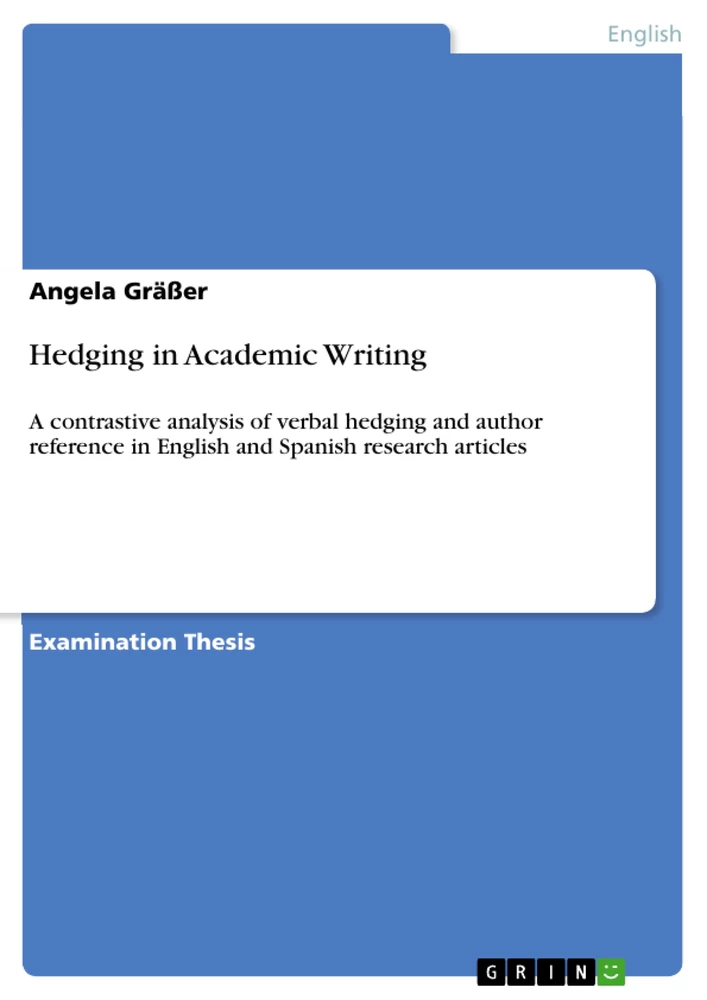
Table of Contents
1. Introduction
2. Theoretical Framework
2.1 Approaches to a Definition of Hedging
2.2 Anglophonization vs. Multilingualism in Academic Discourse
2.3 The Importance of Hedging in Academic Writing
2.4 Cross-cultural Research on Hedging
2.5 Hedging Strategies in Academic Writing
2.5.1 Modal Verbs (1st Category)
2.5.2 Lexical Verbs (2nd Category)
2.5.3 Reference to Author and Addressee (3rd category)
3. Contrastive Analysis
3.1 Corpus Description
3.2 Methodology
3.3 Results
3.3.1 Modal Verbs
3.3.2. Lexical Verbs
3.3.3 Reference to Author and Addressee
3.4 Some General Observations and Problems
4. Conclusion
Objectives & Scope
This research paper investigates the distinct linguistic strategies used to express vagueness and authorial presence in academic writing, specifically comparing native English speakers with native Spanish speakers in the context of research journal articles. The study seeks to determine whether cultural backgrounds influence the frequency and type of hedging methods employed to navigate scientific argumentation and reader-writer relationships.
- The theoretical role and definition of hedging in academic discourse.
- The impact of English as a global language on academic publishing conventions.
- Contrastive analysis of modal verbs, lexical verbs, and authorial reference markers.
- Empirical evaluation of twenty research papers to identify cross-cultural differences.
- Psycholinguistic insights into how authorial confidence and cooperation affect hedging.
Excerpt from the Book
2.5 Hedging Strategies in Academic Writing
Numerous researchers have pointed to the fact that hedges form a contextual category (e. g. Clemen 1997: 243, Mendiluce/Hernández 2005: 74, Poveda Cabanes 2008: 121, Meyer 1997: 23, Kreutz 1997: 183). In other words, hedges cannot be pinned down to a fixed set of lexical items on a formal basis; in two different contexts one and the same word or phrase can act as a hedge while in the other it does not; depending on the situation, the writer’s intention and the background knowledge of reader and writer. Clemen (1997: 243) summarizes that [h]edging can be deduced only from the combination of the individual clausal elements plus the relevant illocution. The pragmatic function of hedging is implicit at the level of utterance and not explicit in any lexical unit.
Consider the following examples:
(1) Based on this study, we argue [my emphasis] that migration should be considered as a multifaceted and non-uniform social factor in Appalachia that cannot be treated in isolation from other factors. (E10: 124)
(2) My brothers are always arguing [my emphasis]. (Oxford Advanced Learner’s Dictionary)
Although the preceding sentences present a fairly obvious example, they illustrate the discrepancy between form and function when analyzing hedges and the resulting difficulty of carrying out a quantitative study, since every single items has to be considered in its individual context. In the method section of the analysis some cases of doubt will be demonstrated.
Generally, nearly every formal item can serve as a hedge, e.g. modal verbs, full verbs, adverbs, nouns or adjectives; even (rhetoric) questions, question tags or quotation marks. Take, for example, the following sentence:
Summary of Chapters
1. Introduction: Introduces the concept of vagueness and hedging in academic writing, establishing the research goal of comparing English and Spanish academic norms.
2. Theoretical Framework: Outlines the definitions of hedging, its interpersonal functions, and how different languages and cultures influence academic discourse conventions.
3. Contrastive Analysis: Presents the methodology for the corpus analysis and details the specific findings regarding modal verbs, lexical verbs, and authorial references in English and Spanish texts.
4. Conclusion: Synthesizes the findings, noting that while English writers generally show more authorial presence, both groups utilize hedging as an essential interpersonal strategy for scientific communication.
Key Terms
Hedging, Academic Writing, Epistemic Modality, Cross-cultural Pragmatics, Lingua Franca, Authorial Presence, Contrastive Analysis, Lexical Verbs, Modal Verbs, Impersonality, Pluralis Modestiae, Discourse Strategy, Scientific Argumentation, Metadiscourse, Politeness Theory.
Frequently Asked Questions
What is the core focus of this research paper?
The paper examines how academic writers express uncertainty and authorial stance through "hedging"—linguistic devices used to soften claims—and explores if cultural backgrounds lead to differences between English and Spanish research papers.
What are the primary thematic fields addressed?
The study covers linguistics, pragmatics, academic discourse, cross-cultural communication, and the sociolinguistic impact of English as a global scientific language.
What is the main research question or objective?
The objective is to investigate how native English and native Spanish speakers differ when writing research journal articles, particularly concerning their use of hedges and the extent of authorial presence in their arguments.
Which scientific methods are applied in this study?
The author performs a contrastive corpus analysis of twenty academic journal articles (ten in English, ten in Spanish), manually identifying and quantifying hedging devices such as modal verbs, lexical verbs, and authorial pronouns.
What topics are covered in the main body?
The main body examines the definition of hedging, reviews existing cross-cultural research, categorizes hedging strategies into modal and lexical verbs, and discusses the role of impersonality and authorial referencing in academic texts.
Which keywords best characterize the work?
The most important terms include Hedging, Academic Writing, Epistemic Modality, Cross-cultural Pragmatics, Authorial Presence, and Contrastive Analysis.
How does the usage of the "pluralis modestiae" function in Spanish academic writing?
It acts as a politeness strategy where the author uses the first-person plural ("we") to avoid giving undue importance to themselves or to seek solidarity with the reader, effectively softening the directness of a claim.
Why does the author argue that academic writing is becoming more informal?
The author observes that recent trends show an increased use of imperatives and a tendency for scholars to use more personal, cooperative language to guide the reader through complex arguments, departing from older, purely detached academic styles.
Ende der Leseprobe aus 52 Seiten
- nach oben
- Arbeit zitieren
- Angela Gräßer (Autor:in), 2013, Hedging in Academic Writing, München, Page::Imprint:: GRINVerlagOHG, https://www.diplomarbeiten24.de/document/268344

neugierig - aktuell - relevant
Entdecken Sie hilfreiche Tipps und Tricks rund ums Studium!

Entdecken Sie hilfreiche Tipps und Tricks rund ums Studium!
Ihre Hausarbeit / Abschlussarbeit:

- - Publikation als E-Book und Buch
- - Hohes Honorar auf die Verkäufe
- - Für Sie komplett kostenlos - mit ISBN
- - Es dauert nur 5 Minuten
- - Jede Arbeit findet Leser

- © GRIN Publishing GmbH.
- Alle Inhalte urheberrechtlich geschützt. Kopieren und verbreiten untersagt.
- info@grin.com
- AGB
- Open Publishing
Der GRIN Verlag hat sich seit 1998 auf die Veröffentlichung akademischer eBooks und Bücher spezialisiert. Der GRIN Verlag steht damit als erstes Unternehmen für User Generated Quality Content. Die Verlagsseiten GRIN.com, Hausarbeiten.de und Diplomarbeiten24 bieten für Hochschullehrer, Absolventen und Studenten die ideale Plattform, wissenschaftliche Texte wie Hausarbeiten, Referate, Bachelorarbeiten, Masterarbeiten, Diplomarbeiten, Dissertationen und wissenschaftliche Aufsätze einem breiten Publikum zu präsentieren.
Kostenfreie Veröffentlichung: Hausarbeit, Bachelorarbeit, Diplomarbeit, Dissertation, Masterarbeit, Interpretation oder Referat jetzt veröffentlichen!
Folgen Sie GRIN auf


- GRIN Verlag GmbH
-
- Nymphenburger Str. 86
- 80636
- Munich, Deutschland
- +49 89-550559-0
- +49 89-550559-10
- info@grin.com
-
