
präsentiert von

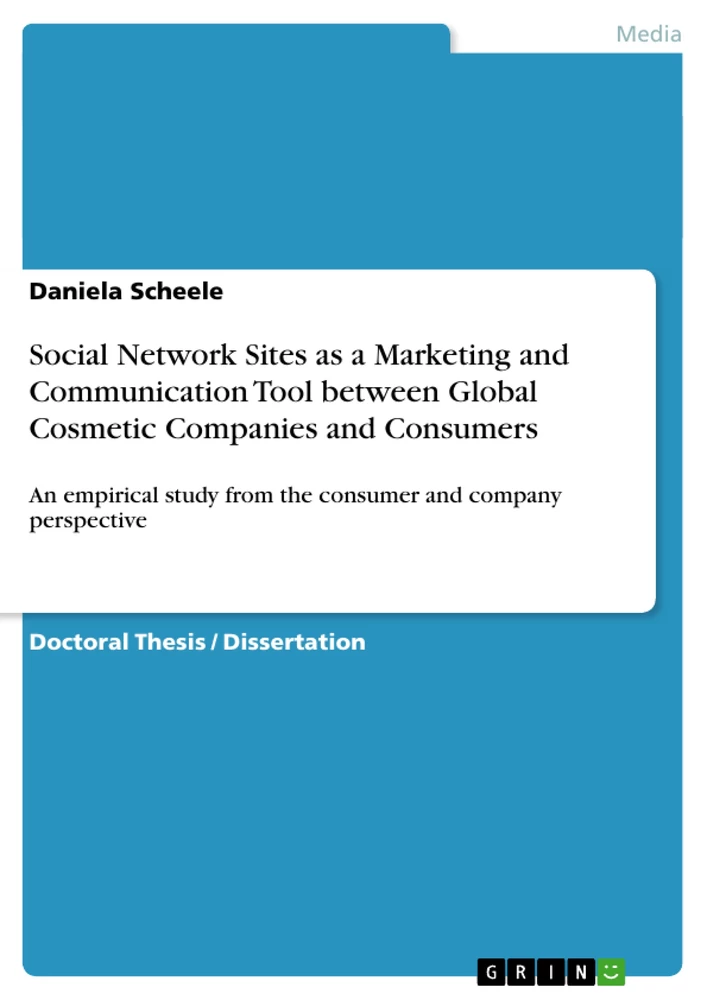
Table of Contents
1. Introduction
2. Literature Review
2.1 Social Media
2.1.1 Social Network Sites
2.2 Uses & Gratification Theory
2.2.1 Uses & Gratification for Social Network Sites
2.2.2 Uses & Gratification Criticism
2.3 Relationship Management
2.3.1 Relationship Marketing
2.3.2 Online Relationship Cultivation Strategies of Companies
2.3.3 Online Relationship Cultivation on Social Network Sites
3. Methodology
3.1 Research Process ‘Onion’
3.2 Secondary Research and Literature Review
3.3 Sample Selection – Selection of Cosmetic Companies
3.4 Primary Research
3.4.1 Qualitative – Focus Group
3.4.2 Quantitative – Content Analysis of Cosmetic Companies’ SNSs
3.4.3 Data Analysis
4. Results of Analysis
4.1 Focus Groups
4.1.1 Research Objective 1
4.1.2 Research Objective 2
4.1.3. Research Objective 3
4.2 Content Analysis
4.2.1 Fans
4.2.2 Online Relationship Cultivation Strategies
4.2.3 Response Time
4.2.4 Post Frequency
5. Conclusion and Recommendation
5.1 Findings
5.2 Conclusions
5.3 Marketing Implications
5.4 Limitations
5.5 Future Research
Research Objectives and Focus
This study investigates the usage habits and motivations of young females regarding social network sites (SNSs) and examines how global cosmetic companies utilize these platforms as marketing and communication tools. The core research focus is on the interplay between consumer gratifications and the relationship cultivation strategies employed by companies on Facebook, Twitter, and Google+.
- Habits and motives of young females using SNSs.
- Perceived gratifications of consumers when interacting with cosmetic brands.
- Analysis of relationship cultivation strategies on major SNS platforms.
- Evaluation of cosmetic companies' content delivery versus consumer expectations.
- Recommendations for improving corporate communication on social media.
Excerpt from the Book
2.3.1 Relationship Marketing
The traditional approach of marketing based on a transactional approach and the marketing mix has dominated the marketing industry over the last 40 years. Due to changes in the economy and in the environment, the traditional view is losing its position and a new approach is emerging with a relational focus on customer retention and customer relationship (Grönroos, 1994; Iglesias et al., 2011).
Grönroos (1994) and his fellow scholars (Berry, 1983; Rapp & Collins, 1990; Copulinsky & Wolf, 1990; Blomqvist et al., 1993; Gummesson, 1993; cited by Grönross, 1994) define relationship marketing with the main focus on the relationship development and maintenance between consumer and the organisation and the provision of customer service and retention. They see relationship marketing as a strategic alternative to the short-term traditional marketing tactics for building and enhancing a firm’s long-term relationship with its publics “at a profit, so that the objectives of the parties involved are met. This is achieved by a mutual exchange and fulfilment of promises." (Grönroos, 1994, p. 9).
Relationship marketing is seen as relationships, networks and interaction (Gummesson, 1997), thus the Internet provides an appropriate environment in which interaction between the company and its consumer can take place in real time or asynchronous. If a constant and ongoing communication is a prerequisite for building and strengthen a relationship, then the Internet is the best medium to fulfil this requirement, as compared to traditional media such as advertisement. However, relationship marketing is still in its infancy and has not yet been adopted by many companies (Grönroos, 1994).
Summary of Chapters
1. Introduction: Outlines the rise of social network sites as revolutionary communication tools and establishes the research gap regarding cosmetic companies' social media strategies.
2. Literature Review: Provides a theoretical foundation covering social media, the uses and gratifications theory, and relationship management strategies in an online context.
3. Methodology: Details the inductive mixed-methods research approach, including the qualitative focus groups and quantitative content analysis used to evaluate company SNS pages.
4. Results of Analysis: Presents the findings from the focus groups and content analysis regarding user habits, company performance, and consumer engagement levels.
5. Conclusion and Recommendation: Synthesizes the study's findings to offer strategic marketing implications and suggests future research directions for the beauty industry.
Keywords
Social Network Sites, SNS, Uses and Gratification Theory, U&G, Relationship Marketing, Cosmetic Industry, Online Relationship Cultivation, Consumer Behavior, Social Media Marketing, Digital Communication, Focus Groups, Content Analysis, Interactive Marketing, Brand Engagement, Young Females.
Frequently Asked Questions
What is the core focus of this research?
The research explores the habits, motives, and perceived gratifications of young females using social network sites, specifically in their interactions with global cosmetic companies' pages on Facebook, Twitter, and Google+.
Which theoretical frameworks are applied?
The study combines the Uses and Gratifications theory (U&G) to understand consumer behavior and the online relationship cultivation theory to analyze how companies manage their social media presence.
What is the primary research goal?
The goal is to determine how cosmetic companies utilize SNSs for marketing and communication and to formulate recommendations that help these companies better meet consumer expectations and foster deeper relationships.
What methodology does the author use?
The dissertation employs an inductive mixed-methods approach, utilizing qualitative focus groups with 40 young females and a quantitative content analysis of the UK social media pages of five selected cosmetic brands.
What are the main topics discussed in the literature review?
The review covers the definition and landscape of social media, the psychological and sociological underpinnings of the U&G theory, and traditional versus modern relationship management in digital environments.
Which keywords best describe this work?
Key terms include Social Network Sites (SNS), Uses and Gratification Theory, Relationship Marketing, Cosmetic Industry, Digital Communication, and Online Relationship Cultivation.
Why was Google+ included in the analysis alongside Facebook and Twitter?
Google+ was selected as one of the major players in the social media landscape at the time of the study, and the author identified that it had been under-analyzed in previous academic research.
What were the main findings regarding user engagement?
The study found that participants generally exhibit passive behavior toward brand pages, mainly reading content or occasionally "liking" posts, but they rarely initiate dialogue or interact with other fans.
How do companies currently fail to meet consumer needs on social media?
The study indicates that many companies lack consistency in posting, provide content that feels like impersonal advertising rather than engaging dialogue, and often miss the mark regarding providing desired educational tutorials or specific product information.
What does the author suggest to improve brand-consumer relationships?
The author recommends that companies shift to a true relationship marketing perspective, incorporate more creative/aesthetic visuals, offer more educational/tutorial content, and ensure responses to user inquiries are personalized and friendly.
Ende der Leseprobe aus 107 Seiten
- nach oben
- Arbeit zitieren
- Daniela Scheele (Autor:in), 2014, Social Network Sites as a Marketing and Communication Tool between Global Cosmetic Companies and Consumers, München, Page::Imprint:: GRINVerlagOHG, https://www.diplomarbeiten24.de/document/268900

neugierig - aktuell - relevant
Entdecken Sie hilfreiche Tipps und Tricks rund ums Studium!

Entdecken Sie hilfreiche Tipps und Tricks rund ums Studium!
Ihre Hausarbeit / Abschlussarbeit:

- - Publikation als E-Book und Buch
- - Hohes Honorar auf die Verkäufe
- - Für Sie komplett kostenlos - mit ISBN
- - Es dauert nur 5 Minuten
- - Jede Arbeit findet Leser

- © GRIN Publishing GmbH.
- Alle Inhalte urheberrechtlich geschützt. Kopieren und verbreiten untersagt.
- info@grin.com
- AGB
- Open Publishing
Der GRIN Verlag hat sich seit 1998 auf die Veröffentlichung akademischer eBooks und Bücher spezialisiert. Der GRIN Verlag steht damit als erstes Unternehmen für User Generated Quality Content. Die Verlagsseiten GRIN.com, Hausarbeiten.de und Diplomarbeiten24 bieten für Hochschullehrer, Absolventen und Studenten die ideale Plattform, wissenschaftliche Texte wie Hausarbeiten, Referate, Bachelorarbeiten, Masterarbeiten, Diplomarbeiten, Dissertationen und wissenschaftliche Aufsätze einem breiten Publikum zu präsentieren.
Kostenfreie Veröffentlichung: Hausarbeit, Bachelorarbeit, Diplomarbeit, Dissertation, Masterarbeit, Interpretation oder Referat jetzt veröffentlichen!
Folgen Sie GRIN auf


- GRIN Verlag GmbH
-
- Nymphenburger Str. 86
- 80636
- Munich, Deutschland
- +49 89-550559-0
- +49 89-550559-10
- info@grin.com
-
