
präsentiert von

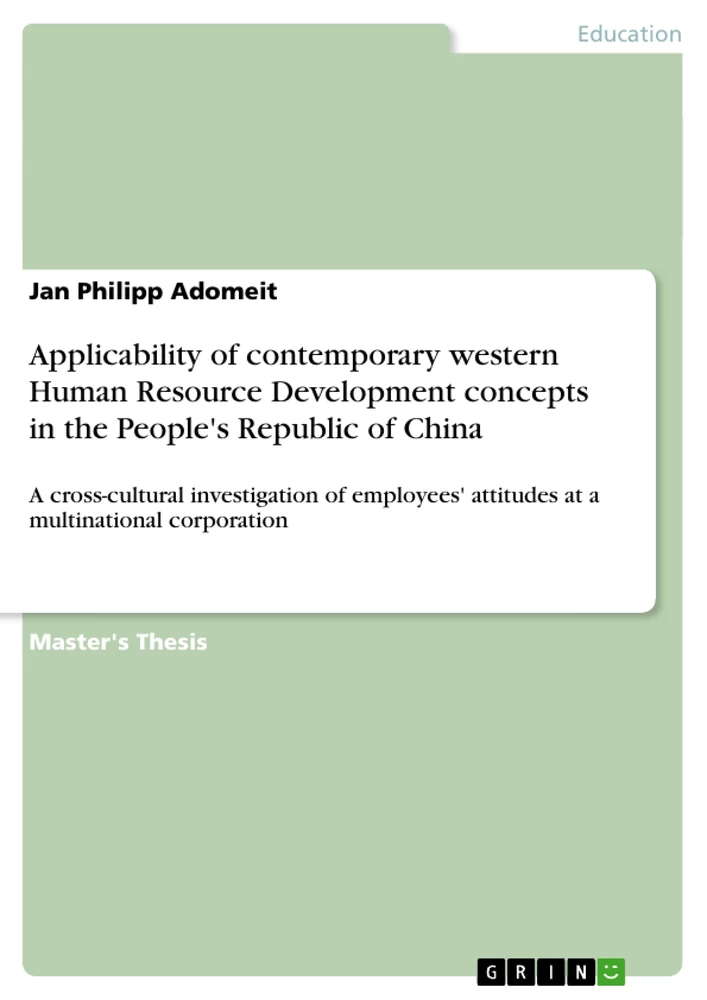
Table of Contents
2. INTRODUCTION
2.1 Context and Purpose of the Research
2.2 Structure of the Paper
3. REVIEW OF THE LITERATURE
3.1 The Strategic Human Resource Development Proposition
3.2 The Shift from Training to Learning
3.2.1 Coaching
3.2.2 Action Learning
3.3 The Chinese Culture of Learning
3.4 Conclusions from the Literature Review
4. RESEARCH DESIGN AND METHODOLOGY
4.1 Refratechnik – The Unit of Analysis
4.2 Research Approach and Strategy
4.3 Data Analysis, Sampling and other Quality Aspects
4.4 The Primary Data Gathering Instrument
4.5 Ethical Considerations
5. PRESENTATION AND DISCUSSION OF FINDINGS
5.1 Response Rate and Profile of Survey Participants
5.2 Cultural Conservatism in Training Situations
5.3 Attitudes towards Contemporary Western HRD Concepts
5.4 Expected Trainer / Trainee Role Allocation
5.5 Self-Assessed Learning Style Disposition
5.6 Self-Assessed Training Needs
5.7 Final Discussion and Recommendations
6. CONCLUSION
7. REFERENCES
Research Objectives and Themes
The dissertation aims to investigate the applicability of contemporary Western human resource development (HRD) concepts—specifically learner-centered interventions—within a multinational corporation operating in China. The core research question addresses whether a conflict exists between these modern, proactive training methods and the traditional, Confucian-influenced learning culture of Chinese employees, who are often accustomed to passive, instructor-led educational environments.
- Comparison of Western HRD paradigms versus traditional Chinese learning styles.
- Evaluation of cultural conservatism and its impact on training effectiveness in China.
- Analysis of employee attitudes toward learner-centered methodologies like coaching and action learning.
- Exploration of cross-cultural differences in trainer-trainee role expectations.
- Practical recommendations for adapting HRD strategies to local cultural contexts.
Excerpt from the Book
3.3 The Chinese Culture of Learning
Although literally hundreds of multi-faceted attempts have been made to define culture, most of them concur in that it is a complex abstraction of concrete behaviour, which transmits the distinctiveness of a given group of people to its new members through the recognition, acquisition or interpretation of meaningful symbols and artefacts which reflect a shared pattern of values, beliefs, thinking, customs and habits, moral, feelings, acting and interacting (Hofstede 2001, Trompenaars 1993).
The predominant characteristics of the Chinese culture’s distinctiveness date back more than 2,500 years to the teachings of the philosopher Confucius. He proclaimed a highly hierarchical society in which the minister serves the king, the wife is servant to the husband, the father is the master of the son and the elder brother the role model for the younger. This society should be governed by the following five norms. At the centre of Confucianism is the concept of harmony, which can be achieved through goodness (1), which consists of virtues such as tolerance, forgiveness and filial piety as a pivotal aspect. Rightness (2) emphasises personal loyalty in friendships and fraternity. It also means relinquishing one’s own benefits for the good of someone else, hence yielding an omnipresent sense of reciprocal obligation. People should always abide to ethical norms, as harmony should be strived for by establishing rituals (3) in society that maintain law and order instead of reverting to sanctioning and castigation. In order to be good, right and apply rituals for the benefit of the whole society, people must achieve wisdom (4) through knowledge and experience, which highlights the crucial importance that learning has always had in Chinese Culture for millennia. All of these components require a high degree of personal credibility (5) in order to act jointly, and ultimately to secure harmony (Le 2003).
Summary of Chapters
2. INTRODUCTION: Outlines the context of China's economic rise and the resulting challenge of applying Western HRD concepts within a culture traditionally defined by Confucian values.
3. REVIEW OF THE LITERATURE: Discusses the shift from traditional training to learner-centered paradigms, explores the specific characteristics of Chinese learning culture, and examines coaching and action learning as HRD instruments.
4. RESEARCH DESIGN AND METHODOLOGY: Details the cross-cultural comparative research strategy used to study Refratechnik employees, including the development of an online survey to measure attitudes toward training.
5. PRESENTATION AND DISCUSSION OF FINDINGS: Analyzes the survey results, comparing the responses of Chinese and non-Chinese employees regarding cultural conservatism, learning style preferences, and training needs.
6. CONCLUSION: Synthesizes the findings, noting that while Chinese employees are surprisingly open to Western concepts, structural and cultural obstacles persist, requiring a careful, sensitized approach to implementation.
Keywords
Human Resource Development, HRD, China, Confucianism, Cross-Cultural Investigation, Learner-Centred Methodology, Coaching, Action Learning, Training Culture, Cultural Conservatism, Experiential Learning, Multinational Corporation, Employee Attitudes, Organizational Learning, Refratechnik.
Frequently Asked Questions
What is the primary focus of this research?
This research examines whether contemporary Western HRD concepts—which emphasize active, learner-centered participation—can be effectively applied in a Chinese multinational corporate environment, given the strong historical influence of Confucian educational norms.
What are the central thematic areas of the dissertation?
The work focuses on the conflict between traditional, lecture-based learning models in China and proactive Western training methods, assessing cultural conservatism, employee learning style dispositions, and role expectations between trainers and trainees.
What is the core research question?
The study aims to determine if a conflict exists between Western learner-centered training methods and the expectations of Chinese employees, and to assess if this conflict hinders the transferability of such methodologies.
Which scientific methodology was employed?
The author utilized a quantitative cross-cultural comparative research design, employing an anonymous online survey to gather data from administrative employees at a German multinational corporation's subsidiaries in Germany and Northeast China.
What topics are covered in the main body of the work?
The main body covers the theoretical foundations of Strategic HRD, a detailed breakdown of coaching and action learning, an analysis of the "Chinese culture of learning," and an empirical discussion of survey findings regarding participant responses to various training methods.
Which keywords best characterize this work?
Key terms include Human Resource Development, Chinese Learning Culture, Confucianism, Cross-Cultural Research, and Learner-Centred Interventions.
How does the author define the "Culture of Learning" in a Chinese context?
It is defined as a set of taken-for-granted frameworks, values, and beliefs shaped by Confucianism that prioritize harmony, hierarchy, and a teacher-centered, rote-learning educational approach.
What were the key findings regarding the "Action Learning" and "Coaching" concepts?
The study surprisingly found that Chinese employees, despite their conservative educational background, were significantly more open and positive toward these Western learner-centered concepts than the German control group, though they still retained a strong preference for instructor-led elements.
Does the author conclude that Western HRD is inapplicable in China?
No, the author concludes that while Western methods are not blindly transferable, they can be successfully adapted if trainers are sensitized to the cultural context and if trainees are given proper preparation and explanations.
What is the significance of the qualitative interview included in the study?
The interview with the HR manager at the Chinese subsidiary provided a "real-world" verification of the survey findings, confirming the existing status-quo of conservative, lecture-based training while acknowledging the potential benefits of adopting more modern, interactive practices.
Ende der Leseprobe aus 79 Seiten
- nach oben
- Arbeit zitieren
- Jan Philipp Adomeit (Autor:in), 2010, Applicability of contemporary western Human Resource Development concepts in the People's Republic of China, München, Page::Imprint:: GRINVerlagOHG, https://www.diplomarbeiten24.de/document/269377

neugierig - aktuell - relevant
Entdecken Sie hilfreiche Tipps und Tricks rund ums Studium!

Entdecken Sie hilfreiche Tipps und Tricks rund ums Studium!
Ihre Hausarbeit / Abschlussarbeit:

- - Publikation als E-Book und Buch
- - Hohes Honorar auf die Verkäufe
- - Für Sie komplett kostenlos - mit ISBN
- - Es dauert nur 5 Minuten
- - Jede Arbeit findet Leser

- © GRIN Publishing GmbH.
- Alle Inhalte urheberrechtlich geschützt. Kopieren und verbreiten untersagt.
- info@grin.com
- AGB
- Open Publishing
Der GRIN Verlag hat sich seit 1998 auf die Veröffentlichung akademischer eBooks und Bücher spezialisiert. Der GRIN Verlag steht damit als erstes Unternehmen für User Generated Quality Content. Die Verlagsseiten GRIN.com, Hausarbeiten.de und Diplomarbeiten24 bieten für Hochschullehrer, Absolventen und Studenten die ideale Plattform, wissenschaftliche Texte wie Hausarbeiten, Referate, Bachelorarbeiten, Masterarbeiten, Diplomarbeiten, Dissertationen und wissenschaftliche Aufsätze einem breiten Publikum zu präsentieren.
Kostenfreie Veröffentlichung: Hausarbeit, Bachelorarbeit, Diplomarbeit, Dissertation, Masterarbeit, Interpretation oder Referat jetzt veröffentlichen!
Folgen Sie GRIN auf


- GRIN Verlag GmbH
-
- Nymphenburger Str. 86
- 80636
- Munich, Deutschland
- +49 89-550559-0
- +49 89-550559-10
- info@grin.com
-
