
präsentiert von

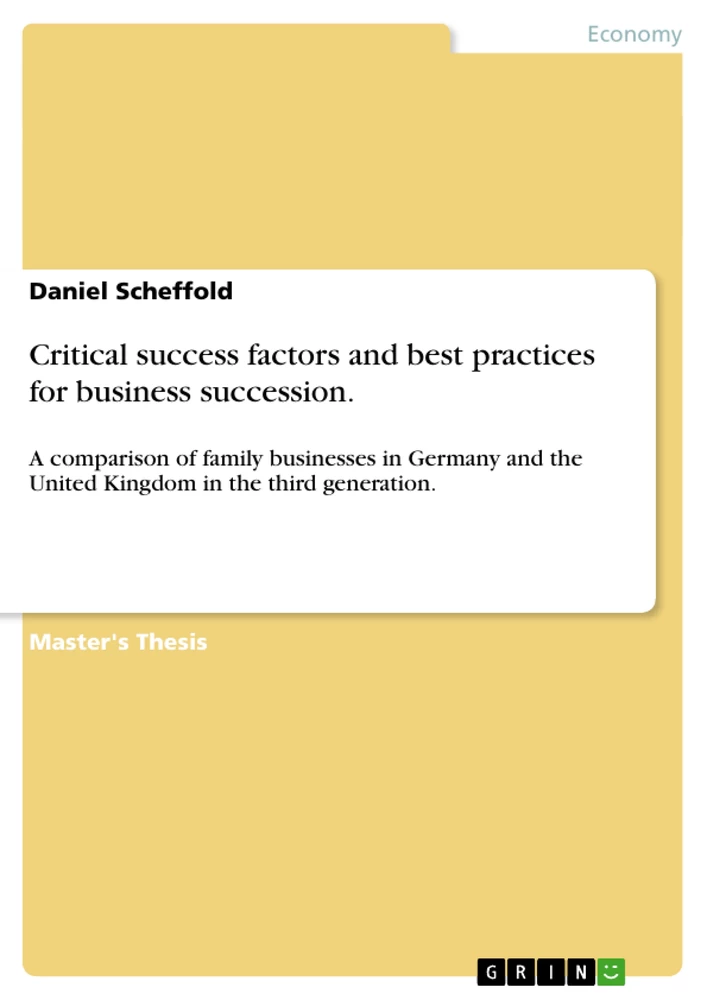
Table of Contents
1. Introduction
1.1. Research Background
1.2. Aim And Objectives
1.3. Overview of Research Methodology
1.4. Structure Of The Dissertation
1.5. Summary
2. Literature Review
2.1. Introduction
2.2. Sources
2.3. Overview of Family Business Studies
2.3.1. Introducing The Family Business
2.3.2. Current Status Of Family Business Studies
2.3.3. Succession
2.3.4. Success In Succession
2.4. Related Business Studies
2.4.1. Entrepreneurship
2.4.2. SMEs
2.4.3. Differences Between SMEs In The UK And The German “Mittelstand”
2.5. Generating The Hypotheses
2.5.1. The Business
2.5.2. Ownership And Corporate Finance
2.5.3. The Family
2.5.4. Time Horizon
2.6. Conclusion And Research Gaps
3. Research Methodology
3.1. Introduction
3.2. Research Philosophy
3.3. Data Collection
3.3.1. Research Strategy
3.3.2. Case Study Design
3.3.3. Research Methods
3.3.4. Selection Of Cases
3.4. Data Analysis
3.5. Reliability, Validity And Limitations
3.6. Ethical Considerations
3.7. Summary
4. Presentation Of Case Studies
4.1. Introduction
4.2. Case Study Macsween: The Chieftain Of Scottish National Dish Haggis
4.3. Case Study Kammerer: From A Basement To International Success
4.4. Case Study Wiesbadener Wach- und Schließgesellschaft: In 100 Years From Night Watchmen To Modern Security Solutions
4.5. Summary
5. Analysis Of Findings
5.1. Introduction
5.2. Background Information
5.3. Cross-Case Analysis
5.3.1. The Business – How To Change Without Changing Too Much
5.3.2. Ownership – How To Keep Control
5.3.3. The Family – Trust And Support Or Source Of Conflict?
5.3.4. Time Horizon – Inheriting The Past, Building The Future
5.3.5. Communication – Connecting The Perspectives
5.4. Single-Case Analysis
5.4.1. Critical Success Factors For Macsween Of Edinburgh
5.4.2. Critical Success Factors For Kammerer Gewindetechnik
5.4.3. Critical Success Factors For Wiesbadener Wach- und Schließgesellschaft
5.5. Summary
6. Conclusion And Recommendations
6.1. Introduction
6.2. Summary Of Findings And Conclusions
6.3. Recommendations And Best Practices
6.4. Limitations
6.5. Suggestions For Future Research
Objectives and Research Focus
This dissertation aims to identify the critical success factors for family business succession by comparing medium-sized, third-generation family businesses from Germany and the United Kingdom. The research seeks to understand why such a small percentage of family firms reach the third generation and how they can be better supported during the transition process.
- Investigation of internal critical success factors in family business transitions.
- Comparative analysis of family firms in Germany and the United Kingdom.
- Evaluation of professionalization, knowledge transfer, and succession planning.
- Analysis of the role of family harmony and shared leadership in succession.
- Development of a new succession model and best practice recommendations.
Excerpt from the Book
4.2. Case Study Macsween: The Chieftain Of Scottish National Dish Haggis
Haggis is a traditional Scottish dish made of offals, oatmeal and herbs originally filled into a sheep’s stomach to be able to cook it, as described by Joanna “Jo” Macsween in the haggis bible (Macsween, 2013a). The production of Haggis and other meat products, such as black pudding is the business of Macsween of Edinburgh (Macsween of Edinburgh Ltd, 2013a). Starting as a little butcher shop out of “economic necessity” (Macsween, 2013b), the company today has 50 employees and an annual turnover of about £4.6 million in 2013 (Macsween, 2013b). Currently, the family business is led by the siblings Jo and James Macsween, representing the third generation.
Charlie and Jean Macsween started the business in 1953 by opening a butcher shop in Edinburgh. Their oldest son, John soon joined the company in 1957 and started to develop it after he had taken over in 1975 when Charlie Macsween passed away, a critical moment in the history of Macsween. Jo Macsween remembers her father saying to her mother: “Just leave me alone, don’t expect me to help in the family or to be home by a certain time, I’ve got my work to do.”
But John Macsween was a “true entrepreneur” (Macsween, 2013b) and saw the opportunity to develop the niche market of haggis production. Early modernization of the production line, product innovation, such as the vegetarian haggis, and reaching out to supermarkets ensured Macsween the market leadership in Haggis production (Levy, 2006). James and Jo Macsween representing the third generation entered the business in the early 1990s (Macsween of Edinburgh Ltd, 2013b). After the company joined the Centre for Family Enterprise at Glasgow Caledonian University in 1997 (Barry, 1998), they started to develop a succession plan that led to the official transition of the business in 2006 (Macsween, 2013b). Just in time, as Jo Macsween points out: “(…) in 2004 when we were way through this process and James and I were running the business our father was diagnosed with cancer (…).”
Summary of Chapters
1. Introduction: Outlines the research background regarding high failure rates in family business successions and defines the objectives and methodological approach.
2. Literature Review: Critically evaluates existing research on family businesses, succession processes, and critical success factors, forming the basis for the study's hypotheses.
3. Research Methodology: Details the qualitative, multiple-case study design used to investigate three specific family firms in Germany and the UK.
4. Presentation Of Case Studies: Introduces the three selected companies, providing narrative backgrounds on their history, ownership structures, and family dynamics.
5. Analysis Of Findings: Reports the results from hypotheses testing and provides a cross-case analysis of factors influencing successful succession.
6. Conclusion And Recommendations: Summarizes the key findings, proposes a new model for family business succession, and offers practical best practice recommendations.
Keywords
Family Business, Succession, Critical Success Factors, Germany, United Kingdom, Third Generation, Business Management, Entrepreneurship, SMEs, Knowledge Transfer, Family Harmony, Shared Leadership, Corporate Governance, Succession Planning, Long-Term Orientation
Frequently Asked Questions
What is the core focus of this research?
The research focuses on identifying critical success factors (CSFs) that enable family businesses to successfully transition from the second to the third generation.
What are the primary themes analyzed in the dissertation?
Key themes include successor development, formalization, knowledge transfer, ownership structure, family harmony, succession planning, and long-term strategic orientation.
What is the primary goal of the study?
The goal is to provide a deeper understanding of why so few family businesses reach the third generation and to develop practical recommendations to improve succession outcomes.
Which scientific methodology was applied?
A qualitative, multiple-case study design was employed, analyzing three medium-sized family businesses—one from the UK and two from Germany—using semi-structured interviews and documentation.
What is addressed in the main body of the work?
The main body contains a literature review, the derivation of hypotheses, detailed presentation of the case studies, and a comprehensive cross-case analysis of the findings.
What are the key terms characterizing this research?
Key terms include family business, business succession, critical success factors, Mittelstand, and multi-generational business transition.
How does the author define a "successful succession"?
A successful succession is defined by the satisfaction of stakeholders with the process and positive post-transition business performance.
Did the study find significant differences between German and British firms?
No significant differences in critical success factors were found to be rooted specifically in national influence; instead, common success factors emerged across both countries.
What role does the family play in the proposed model?
The proposed model emphasizes that the family perspective is the dominant component that requires management during a succession, supported by communication and long-term orientation.
Is formal succession planning considered essential for success?
Surprisingly, the study indicates that formal succession planning is rare and not necessarily a critical success factor; informal approaches often prevail in successful transitions.
Ende der Leseprobe aus 71 Seiten
- nach oben
- Arbeit zitieren
- Daniel Scheffold (Autor:in), 2013, Critical success factors and best practices for business succession., München, Page::Imprint:: GRINVerlagOHG, https://www.diplomarbeiten24.de/document/269949

neugierig - aktuell - relevant
Entdecken Sie hilfreiche Tipps und Tricks rund ums Studium!

Entdecken Sie hilfreiche Tipps und Tricks rund ums Studium!
Ihre Hausarbeit / Abschlussarbeit:

- - Publikation als E-Book und Buch
- - Hohes Honorar auf die Verkäufe
- - Für Sie komplett kostenlos - mit ISBN
- - Es dauert nur 5 Minuten
- - Jede Arbeit findet Leser

- © GRIN Publishing GmbH.
- Alle Inhalte urheberrechtlich geschützt. Kopieren und verbreiten untersagt.
- info@grin.com
- AGB
- Open Publishing
Der GRIN Verlag hat sich seit 1998 auf die Veröffentlichung akademischer eBooks und Bücher spezialisiert. Der GRIN Verlag steht damit als erstes Unternehmen für User Generated Quality Content. Die Verlagsseiten GRIN.com, Hausarbeiten.de und Diplomarbeiten24 bieten für Hochschullehrer, Absolventen und Studenten die ideale Plattform, wissenschaftliche Texte wie Hausarbeiten, Referate, Bachelorarbeiten, Masterarbeiten, Diplomarbeiten, Dissertationen und wissenschaftliche Aufsätze einem breiten Publikum zu präsentieren.
Kostenfreie Veröffentlichung: Hausarbeit, Bachelorarbeit, Diplomarbeit, Dissertation, Masterarbeit, Interpretation oder Referat jetzt veröffentlichen!
Folgen Sie GRIN auf


- GRIN Verlag GmbH
-
- Nymphenburger Str. 86
- 80636
- Munich, Deutschland
- +49 89-550559-0
- +49 89-550559-10
- info@grin.com
-
