
präsentiert von

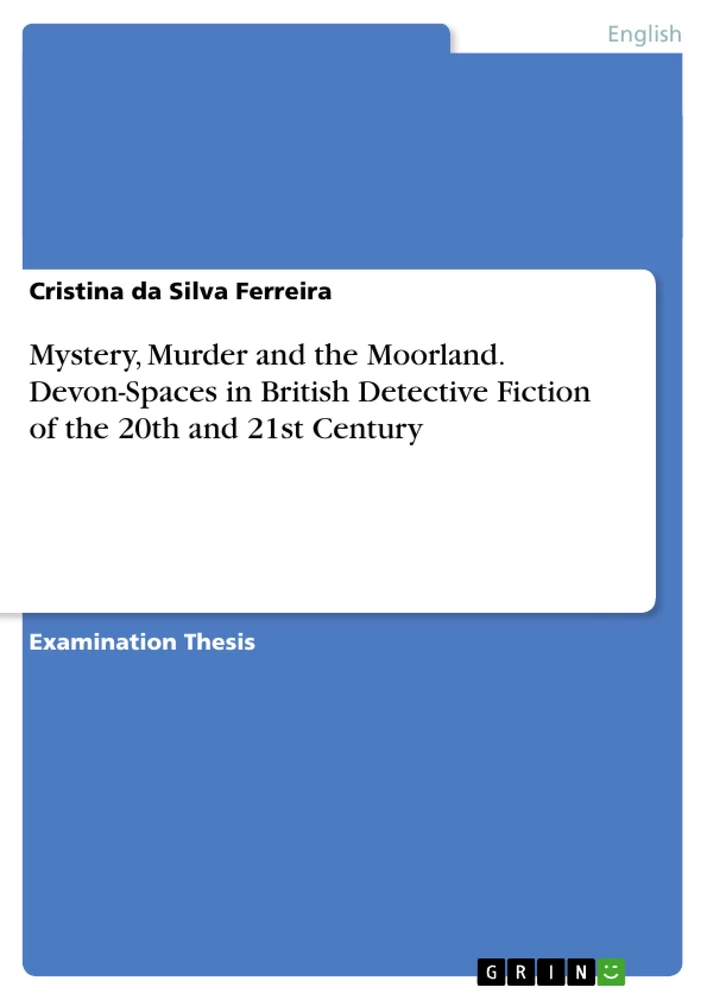
Table of Contents
1 Introduction
2 Spatiality and (Detective) Fiction
2.1 Theories on Space and Place
2.2 The Setting: Geographical and Physical Context
3 Literary Representation of Devon in Detective Fiction
3.1 Devon in Doyle’s The Hound of the Baskervilles (1902)
3.1.1 Open Spaces: The Supernatural Moorland as Ostensible Reality
3.1.2 Enclosed Spaces: The Dwelling as Locus of Truth
3.2 Devon in Christie’s The Sittaford Mystery (1931)
3.2.1 Open Spaces: External Circumstances as Initiator of the Crime
3.2.2 Enclosed Spaces: The Locked Room as Place of Discovery
3.3 Devon in Beckett’s The Calling of the Grave (2010)
3.3.1 Open Spaces: Dartmoor as Danger and Hiding Place
3.3.2 Enclosed Spaces: The Home as Place of ‘False Security’
3.4 Comparative Analysis: Devon-Spaces in Detective Literature and the Importance of the Prison
4 Medial Representation of Doyle’s Devon
4.1 Film Adaptation: The Hound of the Baskervilles (1939)
4.2 Television Adaptation: BBC Series Sherlock, Episode “The Hounds of Baskerville” (2011)
5 Conclusion
Objectives and Themes
This thesis examines the pivotal role of Devon’s unique landscape and spatial characteristics in British detective fiction from the 20th and 21st centuries. By analyzing novels by Arthur Conan Doyle, Agatha Christie, and Simon Beckett, the research explores how the region’s geography—specifically the interplay between the uncanny, open moorland and the claustrophobic, enclosed dwellings—serves not merely as a backdrop, but as a dynamic factor that shapes narrative suspense, character development, and the reader’s perception of the crime itself.
- The dichotomy of open versus enclosed spaces in detective narratives.
- The impact of geographical and physical settings on crime construction and detection.
- Evolution of the "Devon-space" representation across different literary eras.
- Medial shifts: How film and television adaptations reinterpret literary spaces.
- The role of atmospheric elements like weather in creating "spatial suspense."
Excerpt from the Book
3.1.1 Open Spaces: The Supernatural Moorland as Ostensible Reality
The moorland, including the tors, hills and mires can be identified as the main outdoor space in this novel. It is not only the place of history and untouched nature, but especially, since the legend of the “gigantic hound”88, the place of the mortal supernatural. Even if it is never proven that this hound, or any other dangerous being, really exists, the ubiquitous fear and anxiety dominate this place. This negative connotation about this setting is then, in addition, apparently verified by a second and third victim. In reality this place is only transformed into a dangerous one by how it is used by the delinquent Stapleton and perceived by Dr Watson who falls into his trap. Stapleton is the one in charge who manipulates and controls the place in order to reach his aim. By making the legend reality and therefore making everybody believe that the supernatural hound really exists, he is nearly able to commit his crimes undiscovered.
Summary of Chapters
1 Introduction: This chapter contextualizes Devon's reputation for isolation and wild landscapes, establishing its significance as a prime setting for detective fiction.
2 Spatiality and (Detective) Fiction: This section outlines theoretical frameworks concerning space and place, specifically introducing the dichotomy between open and enclosed spaces.
3 Literary Representation of Devon in Detective Fiction: This primary chapter analyzes the specific use of Devon's geography in works by Doyle, Christie, and Beckett to determine how settings influence narrative plots.
4 Medial Representation of Doyle’s Devon: This chapter investigates how visual media, specifically the 1939 film and the BBC series Sherlock, adapt and reinterpret the literary spaces established by Doyle.
5 Conclusion: The concluding chapter synthesizes findings to argue that Devon has been deeply shaped by its fictional representation, creating an enduring, coherent image for readers and viewers alike.
Keywords
Devon, Dartmoor, Detective Fiction, Spatiality, Crime Narrative, Open Spaces, Enclosed Spaces, Setting, Landscape, Supernatural, Adaptation, Sherlock Holmes, Golden Age, Forensic Thriller, Atmosphere.
Frequently Asked Questions
What is the core focus of this academic work?
The work examines how the English county of Devon acts as a fundamental setting in British detective fiction, analyzing how authors utilize its unique geography to construct suspense and drive the narrative.
What are the primary thematic areas covered?
The text focuses on literary and physical geography, the distinction between "open" and "enclosed" spaces, the role of weather in setting an atmosphere, and how these elements have evolved from early 20th-century mysteries to contemporary forensic thrillers.
What is the central research question?
The thesis aims to answer how Devon’s landscape has shaped detective fiction, while simultaneously demonstrating how detective fiction has, in turn, shaped public perception and the literary identity of the Devon region.
Which scientific methods are employed?
The author uses spatial theory—drawing upon scholars like Michel de Certeau, Henri Lefebvre, and Jurij Lotman—to conduct a comparative literary analysis of chosen detective novels and their medial adaptations.
What does the main body explore?
The body analyzes three distinct literary representations: Doyle's use of the supernatural moorland, Christie's manipulation of locked-room mysteries, and Beckett’s integration of both in a modern forensic context, followed by an analysis of filmic adaptations.
What key terms characterize this research?
The research is characterized by terms such as "spatiality," "uncanny landscapes," "locked-room mystery," "geographical realism," and "medial adaptation."
How does the "locked room" concept function in the analysis of Christie's work?
In the analysis of Christie, the locked room is identified as an enclosed space where the initial promise of safety is subverted by the criminal, turning the dwelling into a site of psychological pressure and discovery.
How do media adaptations compare to the original literature regarding space?
The study finds that while film adaptations often serve as homages that preserve the "scary" atmosphere of the original moorland, modern television versions like the BBC's Sherlock use more "radical" strategies to adapt these spaces to a contemporary audience, sometimes shifting focus toward high-tech research facilities.
Ende der Leseprobe aus 63 Seiten
- nach oben
- Arbeit zitieren
- Cristina da Silva Ferreira (Autor:in), 2014, Mystery, Murder and the Moorland. Devon-Spaces in British Detective Fiction of the 20th and 21st Century, München, Page::Imprint:: GRINVerlagOHG, https://www.diplomarbeiten24.de/document/270522

neugierig - aktuell - relevant
Entdecken Sie hilfreiche Tipps und Tricks rund ums Studium!

Entdecken Sie hilfreiche Tipps und Tricks rund ums Studium!
Ihre Hausarbeit / Abschlussarbeit:

- - Publikation als E-Book und Buch
- - Hohes Honorar auf die Verkäufe
- - Für Sie komplett kostenlos - mit ISBN
- - Es dauert nur 5 Minuten
- - Jede Arbeit findet Leser

- © GRIN Publishing GmbH.
- Alle Inhalte urheberrechtlich geschützt. Kopieren und verbreiten untersagt.
- info@grin.com
- AGB
- Open Publishing
Der GRIN Verlag hat sich seit 1998 auf die Veröffentlichung akademischer eBooks und Bücher spezialisiert. Der GRIN Verlag steht damit als erstes Unternehmen für User Generated Quality Content. Die Verlagsseiten GRIN.com, Hausarbeiten.de und Diplomarbeiten24 bieten für Hochschullehrer, Absolventen und Studenten die ideale Plattform, wissenschaftliche Texte wie Hausarbeiten, Referate, Bachelorarbeiten, Masterarbeiten, Diplomarbeiten, Dissertationen und wissenschaftliche Aufsätze einem breiten Publikum zu präsentieren.
Kostenfreie Veröffentlichung: Hausarbeit, Bachelorarbeit, Diplomarbeit, Dissertation, Masterarbeit, Interpretation oder Referat jetzt veröffentlichen!
Folgen Sie GRIN auf


- GRIN Verlag GmbH
-
- Nymphenburger Str. 86
- 80636
- Munich, Deutschland
- +49 89-550559-0
- +49 89-550559-10
- info@grin.com
-
