
präsentiert von

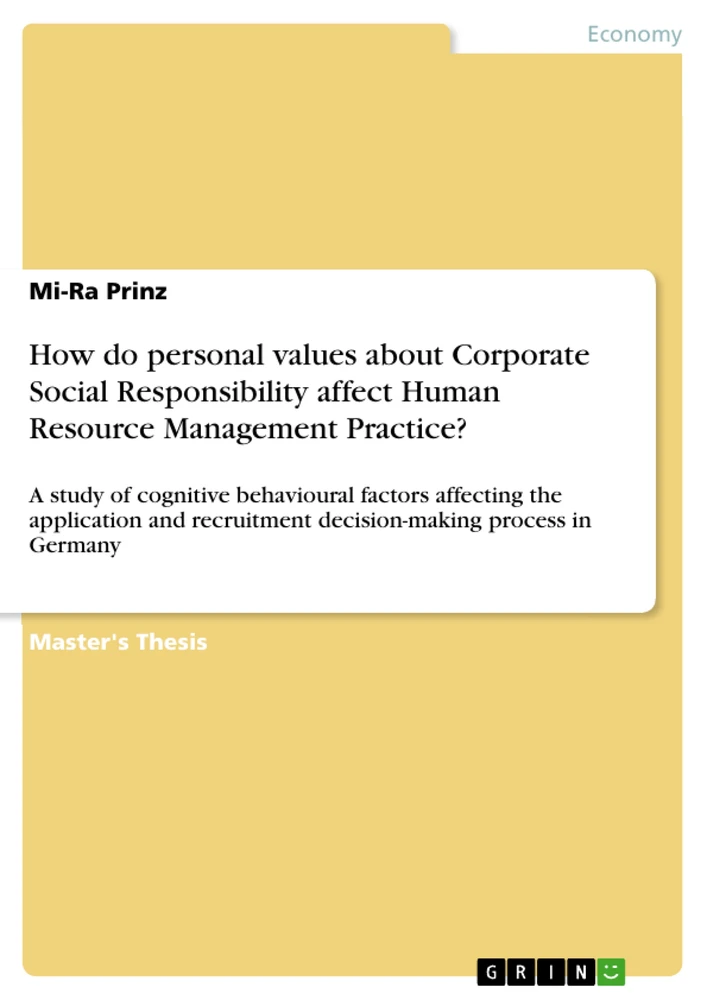
Table of Contents
1. Introduction
2. CSR and its impact on recruitment – A literature review
3. Methodological approach
3.1 Design and Procedure
3.2 Reflexivity
3.3 Participants
3.4 Ethical considerations
3.5 The context of research: Germany
4. Findings/ observations and analysis
4.1 How do individuals understand and define CSR?
4.2 What factors influence these understandings of CSR?
4.3 What role do individual understandings of CSR play in the application and recruiting process?
5. Discussion
6. Conclusion
6.1 Research design limitations
6.2 Recommendations for further research
Research Objectives and Themes
This study aims to examine how personal values regarding Corporate Social Responsibility (CSR) influence human resource management practices, specifically within the application and recruitment decision-making process in Germany. By utilizing Carroll’s pyramid of CSR and Festinger’s theory of cognitive dissonance, the research investigates the disconnect between academic teachings and practical business realities, as well as the impact of socio-economic and cultural contexts on individual perceptions of responsibility.
- Analysis of individual interpretations and definitions of CSR.
- Examination of cognitive behavioural factors influencing CSR awareness.
- Evaluation of the role of CSR in attracting potential job applicants.
- Investigation of the influence of educational and professional background on CSR values.
- Assessment of the gap between corporate CSR communication and actual implementation.
Excerpt from the Book
The generally perceived importance of CSR
Even though the numerous understandings of CSR could be recognized, there was a general agreement about the importance of CSR. German society seems to be sensitised to CSR relevant topics. Companies were perceived as a part of society that also has to contribute and engage. Student 8 stated:
[…] the state cannot cope with [the social responsibility] by itself […], instead companies have to function like little states and also have a responsibility towards society and are in charge to do something good.
The HR managers also recognized that companies have social responsibilities. Some referred to responsibilities towards the immediate environment, e.g. HR manager F pointed out his company’s societal engagement in Berlin, while others, such as HR manager A, stated the importance of helping to alleviate general problems in the world such as poverty in Africa.
The emphasis on sustainability in the context of CSR is characteristic of German society (see Dryzek et al., 2003). Active engagement was perceived as relevant and individual examples about personal values and educational experiences shaped the individual arguments. Student 7 drew a connection with her personal feelings:
If I knew that a company felt responsible for society and not simply the wish to create surplus value, then it might also be more rewarding to work there. […] I think it is important that a company has values. I mean, it is the same as with human beings. I do not feel like being friends with someone who does not fulfil certain moral criteria.
Summary of Chapters
1. Introduction: Outlines the research focus on how personal CSR values influence recruitment in Germany, supported by Carroll’s CSR pyramid and Festinger’s cognitive dissonance theory.
2. CSR and its impact on recruitment – A literature review: Provides an overview of existing research linking CSR to corporate attractiveness and identifies a gap in qualitative studies regarding individual decision-making processes.
3. Methodological approach: Describes the interpretive research design, including 16 semi-structured interviews with students and HR managers, and highlights the specific cultural context of Germany.
4. Findings/ observations and analysis: Presents the primary data regarding individual definitions of CSR, the influence of university education, and the perceived credibility of corporate CSR strategies.
5. Discussion: Reflects on the heterogeneity of CSR interpretations and how cognitive dissonance impacts the practical application of social values in recruitment.
6. Conclusion: Summarizes the study’s findings, acknowledging the multi-faceted nature of CSR and suggesting areas for future empirical research.
Keywords
Corporate Social Responsibility, CSR, Human Resource Management, Recruitment, Germany, Cognitive Dissonance, Carroll's Pyramid, Sustainability, Personal Values, Employer Attractiveness, Business Students, HR Managers, Qualitative Research, Corporate Strategy, Ethical Predisposition
Frequently Asked Questions
What is the core focus of this research?
The research focuses on the impact of personal values concerning Corporate Social Responsibility (CSR) on the application and recruitment processes of HR departments in Germany.
Which theoretical frameworks does the author utilize?
The study applies Archie Carroll’s (1991) Pyramid of Corporate Social Responsibility and Leon Festinger’s (1962) theory of cognitive dissonance to analyze the findings.
What is the primary research goal?
The goal is to understand the cognitive behavioural factors that influence how CSR is perceived and integrated into the decision-making processes of job applicants and HR professionals.
What research methodology was employed?
The study uses a qualitative approach, consisting of an analysis of 16 semi-structured interviews conducted with German business students and HR managers.
What does the main body cover?
The main body covers a literature review on CSR in recruitment, a detailed methodology section, the presentation of thematic analysis findings, and a critical discussion of the results.
Which keywords define this dissertation?
Key terms include Corporate Social Responsibility, Recruitment, Cognitive Dissonance, Germany, and Employer Attractiveness.
How do university programs in Germany impact students' views on CSR?
The study finds that most German business programs focus primarily on profit maximization, leading students to view CSR as a lower priority or a conflict with economic goals.
What role does 'green-washing' play in the recruitment process?
Participants expressed skepticism toward companies that use CSR primarily for marketing purposes, suggesting that perceived lack of credibility negatively impacts a company's attractiveness to potential recruits.
How do HR managers perceive the implementation of CSR?
While HR managers acknowledge the importance of CSR, many view it as a long-term cultural change or a strategic tool for competitive advantage rather than an immediate, core requirement in daily recruitment tasks.
Ende der Leseprobe aus 54 Seiten
- nach oben
- Arbeit zitieren
- Mi-Ra Prinz (Autor:in), 2011, How do personal values about Corporate Social Responsibility affect Human Resource Management Practice?, München, Page::Imprint:: GRINVerlagOHG, https://www.diplomarbeiten24.de/document/271191

neugierig - aktuell - relevant
Entdecken Sie hilfreiche Tipps und Tricks rund ums Studium!

Entdecken Sie hilfreiche Tipps und Tricks rund ums Studium!
Ihre Hausarbeit / Abschlussarbeit:

- - Publikation als E-Book und Buch
- - Hohes Honorar auf die Verkäufe
- - Für Sie komplett kostenlos - mit ISBN
- - Es dauert nur 5 Minuten
- - Jede Arbeit findet Leser

- © GRIN Publishing GmbH.
- Alle Inhalte urheberrechtlich geschützt. Kopieren und verbreiten untersagt.
- info@grin.com
- AGB
- Open Publishing
Der GRIN Verlag hat sich seit 1998 auf die Veröffentlichung akademischer eBooks und Bücher spezialisiert. Der GRIN Verlag steht damit als erstes Unternehmen für User Generated Quality Content. Die Verlagsseiten GRIN.com, Hausarbeiten.de und Diplomarbeiten24 bieten für Hochschullehrer, Absolventen und Studenten die ideale Plattform, wissenschaftliche Texte wie Hausarbeiten, Referate, Bachelorarbeiten, Masterarbeiten, Diplomarbeiten, Dissertationen und wissenschaftliche Aufsätze einem breiten Publikum zu präsentieren.
Kostenfreie Veröffentlichung: Hausarbeit, Bachelorarbeit, Diplomarbeit, Dissertation, Masterarbeit, Interpretation oder Referat jetzt veröffentlichen!
Folgen Sie GRIN auf


- GRIN Verlag GmbH
-
- Nymphenburger Str. 86
- 80636
- Munich, Deutschland
- +49 89-550559-0
- +49 89-550559-10
- info@grin.com
-
