
präsentiert von

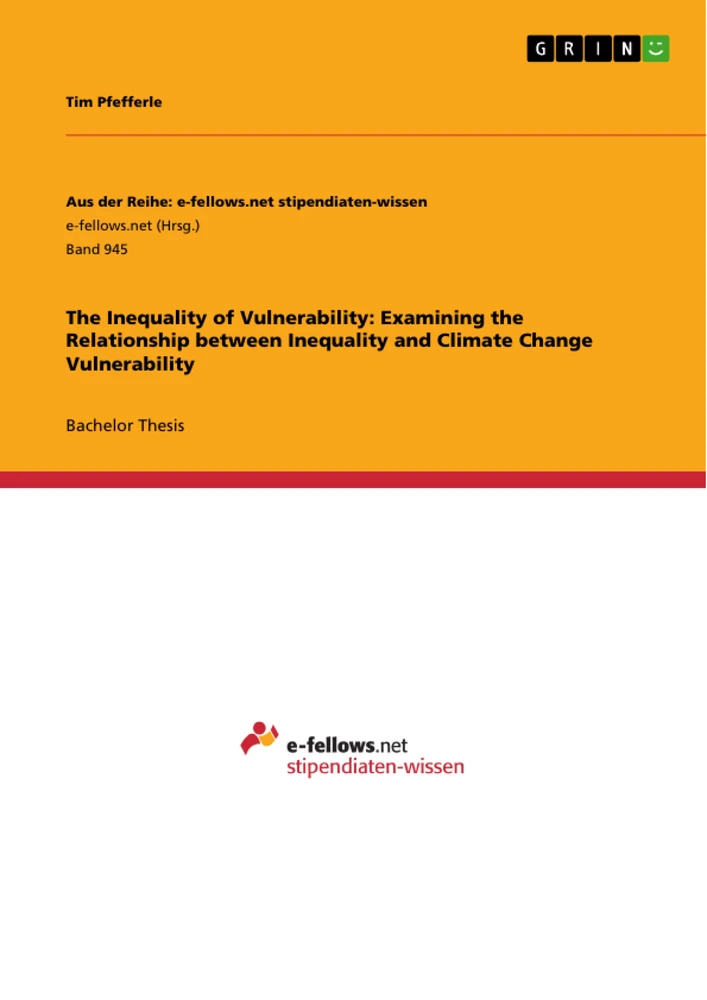
Table of Contents
1. Introduction
2. Literature Review
2.1. Vulnerability
2.2. Inequality
2.3. Inequality and Climate Change Vulnerability
3. Methodology
4. Case Study 1: Papua New Guinea
4.1. Society, Economy and the Environment in Papua New Guinea
4.2. Inequality, Growth and Poverty in Papua New Guinea
4.3. Formal Social Security
4.4. Informal Social Security Systems
4.5. Conclusion: Papua New Guinea
5. Case Study 2: Tonga
5.1. Society, Economy and the Environment in Tonga
5.2. Food Security and Import Dependency
5.3. The Role of Remittances: Labor Mobility and Resilience
5.4. Urbanization, Inequality and Climate Change
5.5. Conclusion: Tonga
6. Conclusion
Research Objectives and Key Topics
This research project investigates the interrelationship between economic inequality and climate change vulnerability. It aims to determine how inequality shapes the ability of different socio-economic groups to adapt to climate risks, while examining how globalization mediates these dynamics. Through a comparative case study approach, the research identifies how unequal access to resources and institutional shortcomings influence climate resilience.
- The nexus between economic inequality and social vulnerability to environmental change.
- The impact of globalization on local resilience and social security structures.
- Comparative analysis of Papua New Guinea (resource-dependent) and Tonga (remittance-dependent).
- Institutional barriers to adaptation in societies with high wealth polarization.
- The role of formal social security versus informal, traditional support systems (e.g., the wantok system).
Excerpt from the Book
Informal Social Security Systems
While a formal social safety net essentially does not exist in PNG, like in other Pacific island states, informal traditional social security measures are widespread. Not entirely surprisingly in a country as geographically and culturally heterogeneous as PNG, family and community play a much more significant role than the state apparatus. Wood and Gough refer to informal social protection as ‘institutional arrangements where people rely upon community and family relationships to meet their security needs’ (2006: 1699). Hence, there are a plethora of measures which could be subsumed under the heading of informal social security, ranging from cash-based and in kind support to the provision of services. Therefore, the lack of formal social security needs to be looked at with this in mind.
In PNG, one widely practiced traditional security arrangement is the wantok system. Given that society is, to a large extent, based on group membership, this is a system of collective reciprocity in which people of a shared kinship and history provide support to each other in the community (Monsell-Davis, 1993). Crucially within the context of PNG, this is often based on language. However, these support mechanisms not only act as social safety nets, but are also vital in terms of ensuring continuity and creating and sustaining relationships. Moreover, they can often represent the societal organization into hierarchical social structures. Given the prevalence of this form of communal provision of social services and social security, it is not surprising that state-provided measures are underdeveloped.
Summary of Chapters
Introduction: Outlines the global phenomenon of climate change as a contemporary challenge and poses the central research question regarding the relationship between climate change and economic inequality.
Literature Review: Explores existing scholarship on vulnerability, the theoretical approaches to inequality (psychosocial vs. neo-material), and links these concepts to climate change research.
Methodology: Details the case-study approach focusing on Papua New Guinea and Tonga, justified by their divergent geographic, economic, and social characteristics.
Case Study 1: Papua New Guinea: Analyzes how resource dependency and persistent inequality create vulnerability in a highly diverse and localized society, highlighting the role of informal support systems.
Case Study 2: Tonga: Examines the role of remittances and urbanization in shaping climate vulnerability in a small island state, contrasting its institutional framework with that of Papua New Guinea.
Conclusion: Synthesizes the findings, confirming that inequality is a fundamental driver of climate vulnerability and advocating for no-regrets policies that foster general social resilience.
Keywords
Climate change, vulnerability, economic inequality, globalization, Papua New Guinea, Tonga, social security, resilience, adaptive capacity, remittances, urbanization, wantok system, neo-materialism, psychosocial approach, sustainability.
Frequently Asked Questions
What is the core subject of this research project?
The work investigates how economic inequality influences the vulnerability of communities to the effects of climate change, specifically exploring the interplay between these two phenomena.
What are the primary thematic fields addressed?
The study centers on the intersection of social science and climate policy, covering inequality theory, social security, globalization impacts, and comparative regional analysis in the South Pacific.
What is the central research question?
The project asks how inequality shapes climate vulnerability across different socio-economic groups and how this nexus is mediated by the forces of globalization.
Which scientific methods were applied?
The study utilizes a comparative case-study approach, analyzing primary data from institutions like the World Bank and the Asian Development Bank, supported by a critical review of literature on vulnerability and inequality.
What does the main body of the work cover?
It provides a theoretical foundation on vulnerability and inequality, followed by detailed empirical analyses of Papua New Guinea and Tonga, focusing on social systems and economic structures.
Which keywords characterize this work?
Key terms include climate change, social vulnerability, economic inequality, globalization, adaptive capacity, and resource dependency.
How does the "wantok system" affect vulnerability in Papua New Guinea?
It functions as an informal, traditional social safety net based on kinship, which provides rapid support but may also hinder the development of state-led, progressive welfare systems.
Why does the author consider land ownership in Tonga a critical vulnerability factor?
The land tenure system limits formal ownership, forcing low-income migrants into insecure, informal settlements that are highly susceptible to climate-related hazards and lack access to essential infrastructure.
Ende der Leseprobe aus 50 Seiten
- nach oben
- Arbeit zitieren
- Tim Pfefferle (Autor:in), 2014, The Inequality of Vulnerability: Examining the Relationship between Inequality and Climate Change Vulnerability, München, Page::Imprint:: GRINVerlagOHG, https://www.diplomarbeiten24.de/document/275947

neugierig - aktuell - relevant
Entdecken Sie hilfreiche Tipps und Tricks rund ums Studium!

Entdecken Sie hilfreiche Tipps und Tricks rund ums Studium!
Ihre Hausarbeit / Abschlussarbeit:

- - Publikation als E-Book und Buch
- - Hohes Honorar auf die Verkäufe
- - Für Sie komplett kostenlos - mit ISBN
- - Es dauert nur 5 Minuten
- - Jede Arbeit findet Leser

- © GRIN Publishing GmbH.
- Alle Inhalte urheberrechtlich geschützt. Kopieren und verbreiten untersagt.
- info@grin.com
- AGB
- Open Publishing
Der GRIN Verlag hat sich seit 1998 auf die Veröffentlichung akademischer eBooks und Bücher spezialisiert. Der GRIN Verlag steht damit als erstes Unternehmen für User Generated Quality Content. Die Verlagsseiten GRIN.com, Hausarbeiten.de und Diplomarbeiten24 bieten für Hochschullehrer, Absolventen und Studenten die ideale Plattform, wissenschaftliche Texte wie Hausarbeiten, Referate, Bachelorarbeiten, Masterarbeiten, Diplomarbeiten, Dissertationen und wissenschaftliche Aufsätze einem breiten Publikum zu präsentieren.
Kostenfreie Veröffentlichung: Hausarbeit, Bachelorarbeit, Diplomarbeit, Dissertation, Masterarbeit, Interpretation oder Referat jetzt veröffentlichen!
Folgen Sie GRIN auf


- GRIN Verlag GmbH
-
- Nymphenburger Str. 86
- 80636
- Munich, Deutschland
- +49 89-550559-0
- +49 89-550559-10
- info@grin.com
-
