
präsentiert von

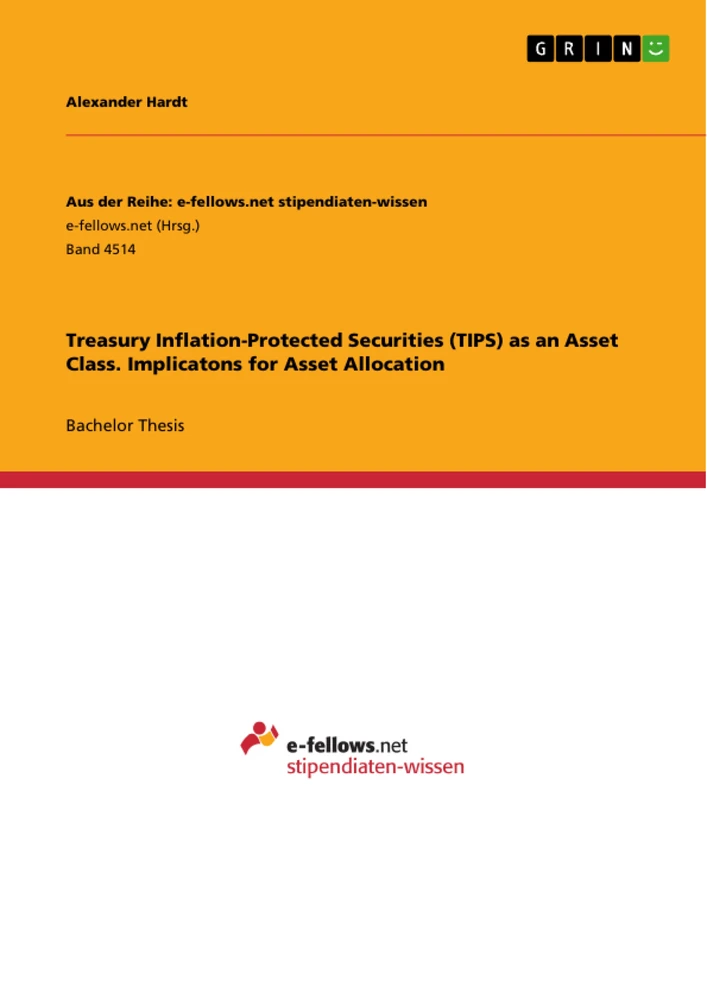
Table of Contents
I. Introduction
II. Features
III. TIPS in an Asset Allocation Framework
IV. Literature Review
V. Methodology
VI. Conclusions
Objectives & Topics
This thesis investigates the impact of Treasury Inflation-Protected Securities (TIPS) on the performance of optimized investment portfolios across different time horizons and investor risk profiles, aiming to determine whether they merit a distinct asset class status.
- Analysis of portfolio optimization using Markowitz’s efficient frontier model.
- Evaluation of risk-adjusted performance through the Sharpe ratio.
- Comparison of portfolio performance across different investor types and market conditions.
- Examination of the role of TIPS as an inflation hedge and diversification tool.
- Assessment of the correlation between TIPS and other traditional asset classes.
Excerpt from the Book
II. Features
Treasury Inflation-Protected Securities (TIPS) are U.S. Treasury-issued notes and bonds. Their principal value is adjusted monthly for changes in the level of inflation as measured by the non-seasonally adjusted Consumer Price Index for All Urban Consumers (CPI-U) on a 2-month lag. Inflation-indexed bonds were created to meet the needs of longer-term investors wanting to insulate their investment principal from erosion due to inflation. These bonds have been issued in the United Kingdom (1981), Australia (1985), Canada (1991), the United States (1997) and France (1998).
The basic structure is the same for all US TIPS. A fixed coupon interest rate is paid semi-annually on the inflation-adjusted principal. At maturity, the principal is redeemed at the inflation-adjusted principal amount (but not less than par value). In other words, unlike the Canadian counterparts, TIPS issued in the U.S. are protected against the risk of deflation. The Department of Treasury provides a guarantee (floor) at the par value in a deflationary environment. As a result of this “guaranteed principal floor”, TIPS incorporate a minimal hedge against sustained deflation.
In the event of an absolute decline in the price level; i.e., deflation, over the life of an inflation protected bond, the Treasury will repay the full face value at maturity, insuring a floor for investors. That is, the principal of TIPS is increased by the percentage increase in the CPI or decreased by the percentage decrease in the CPI unless such adjustment would reduce the principal below its initial value. This asymmetric price-level adjustment feature provides TIPS investors with some protection against deflation in addition to the complete inflation protection.
Summary of Chapters
I. Introduction: This chapter provides an overview of U.S. government debt, focusing on the evolution and purpose of Treasury Inflation-Protected Securities (TIPS) and the researcher’s interest in their role for institutional investors.
II. Features: This chapter explains the structural characteristics of TIPS, including their inflation-adjustment mechanism, principal protection against deflation, and tax treatment.
III. TIPS in an Asset Allocation Framework: This chapter explores the theoretical rationale for treating TIPS as a unique asset class and discusses how they interact with other assets to improve portfolio diversification.
IV. Literature Review: This chapter reviews previous scholarly research regarding the relationship between TIPS, nominal bonds, and other asset classes, highlighting gaps in existing knowledge that this study addresses.
V. Methodology: This chapter details the use of the Modern Portfolio Theory, the efficient frontier algorithm, and the Sharpe ratio to evaluate the risk/return impact of including TIPS in various investment portfolios.
VI. Conclusions: This chapter summarizes the empirical findings, noting that TIPS provide significant efficiency gains particularly in specific market conditions, and discusses the trade-offs between portfolio concentration and diversification.
Keywords
TIPS, Treasury Inflation-Protected Securities, Asset Allocation, Modern Portfolio Theory, Markowitz, Sharpe Ratio, Efficient Frontier, Inflation Hedge, Portfolio Optimization, Institutional Investors, Risk Tolerance, Diversification, Correlation, Financial Efficiency, Inflation.
Frequently Asked Questions
What is the core focus of this thesis?
The thesis examines the role and effectiveness of Treasury Inflation-Protected Securities (TIPS) when integrated into optimized investment portfolios for different types of institutional investors.
What are the primary thematic areas covered?
The study centers on asset allocation, the application of Modern Portfolio Theory (MPT), inflation hedging, and the comparative risk-return performance of portfolios with and without TIPS.
What is the primary research objective?
The goal is to determine if adding TIPS improves the risk-return profile of a portfolio and whether these securities warrant being treated as a distinct asset class.
Which scientific methods are employed?
The researcher utilizes efficient frontier analysis (based on Markowitz’s model) and the Sharpe ratio to measure risk-adjusted performance across different time periods and constraints.
What topics are discussed in the main body?
The main body covers the technical structure of TIPS, the logic of asset allocation, literature review of relevant studies, and a quantitative analysis of various portfolio scenarios from 1998 to 2013.
What are the characterizing keywords of this work?
Key terms include TIPS, Asset Allocation, Efficient Frontier, Sharpe Ratio, Portfolio Optimization, and Inflation Hedge.
How does the study define different investor types?
Investor types are categorized by risk tolerance and portfolio constraints: Investor A is "progressive" (fully diversified), Investor B is "diversified" (excludes hedge funds/commodities), and Investor C is "traditional" (highly constrained).
What conclusion is drawn regarding the TIPS market?
The research concludes that the TIPS market is dynamic and that investors must incorporate forward-looking information to effectively profit from their inclusion in a portfolio.
What is the significance of the "guaranteed principal floor"?
It provides an asymmetric protection for investors, ensuring that even in sustained deflationary environments, the principal repaid at maturity is not less than the initial par value.
Ende der Leseprobe aus 65 Seiten
- nach oben
- Arbeit zitieren
- Alexander Hardt (Autor:in), 2014, Treasury Inflation-Protected Securities (TIPS) as an Asset Class. Implicatons for Asset Allocation, München, Page::Imprint:: GRINVerlagOHG, https://www.diplomarbeiten24.de/document/276591

neugierig - aktuell - relevant
Entdecken Sie hilfreiche Tipps und Tricks rund ums Studium!

Entdecken Sie hilfreiche Tipps und Tricks rund ums Studium!
Ihre Hausarbeit / Abschlussarbeit:

- - Publikation als E-Book und Buch
- - Hohes Honorar auf die Verkäufe
- - Für Sie komplett kostenlos - mit ISBN
- - Es dauert nur 5 Minuten
- - Jede Arbeit findet Leser

- © GRIN Publishing GmbH.
- Alle Inhalte urheberrechtlich geschützt. Kopieren und verbreiten untersagt.
- info@grin.com
- AGB
- Open Publishing
Der GRIN Verlag hat sich seit 1998 auf die Veröffentlichung akademischer eBooks und Bücher spezialisiert. Der GRIN Verlag steht damit als erstes Unternehmen für User Generated Quality Content. Die Verlagsseiten GRIN.com, Hausarbeiten.de und Diplomarbeiten24 bieten für Hochschullehrer, Absolventen und Studenten die ideale Plattform, wissenschaftliche Texte wie Hausarbeiten, Referate, Bachelorarbeiten, Masterarbeiten, Diplomarbeiten, Dissertationen und wissenschaftliche Aufsätze einem breiten Publikum zu präsentieren.
Kostenfreie Veröffentlichung: Hausarbeit, Bachelorarbeit, Diplomarbeit, Dissertation, Masterarbeit, Interpretation oder Referat jetzt veröffentlichen!
Folgen Sie GRIN auf


- GRIN Verlag GmbH
-
- Nymphenburger Str. 86
- 80636
- Munich, Deutschland
- +49 89-550559-0
- +49 89-550559-10
- info@grin.com
-
